Why EWOT Is Suddenly Everywhere
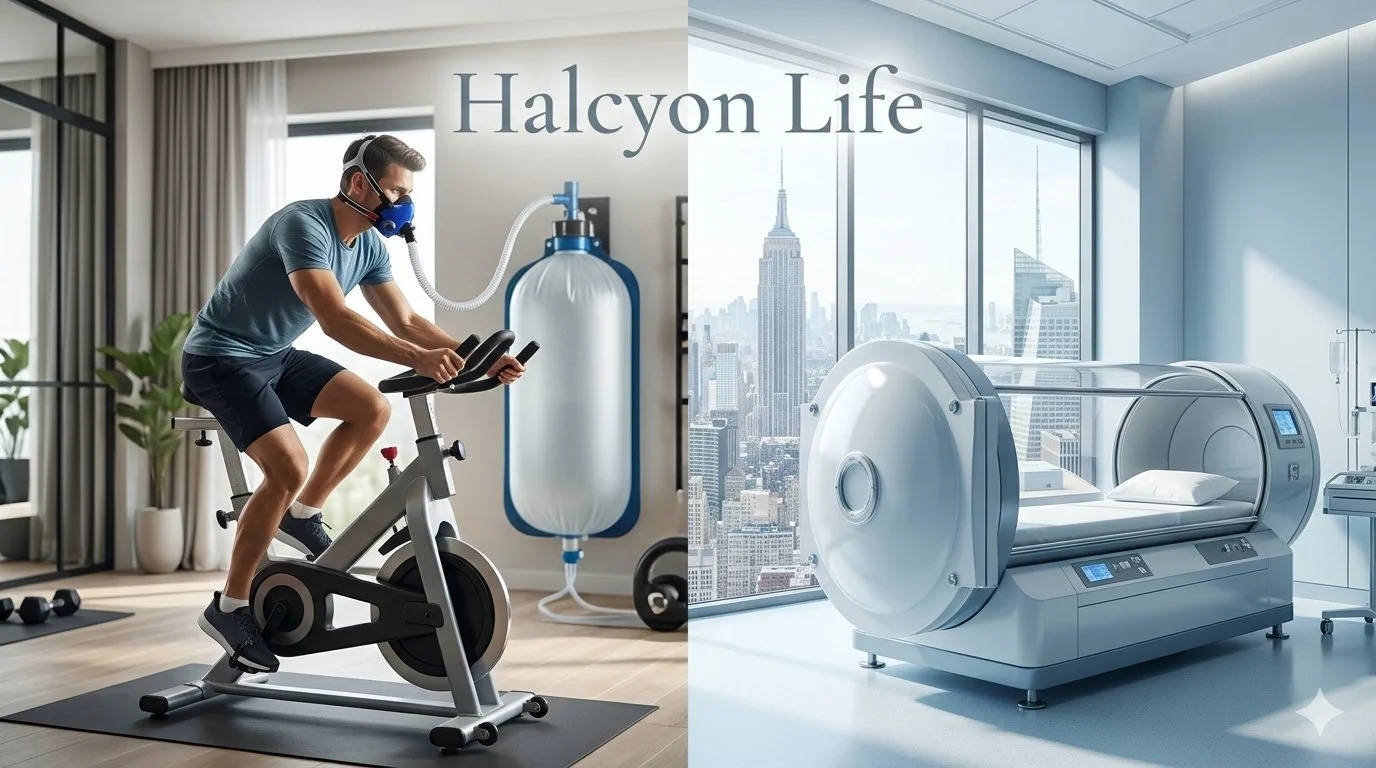
You have probably seen it by now. Someone on a bike or treadmill, a mask over their face, a tube running to a big inflated bag of oxygen behind them. The caption promises more energy, faster recovery, sharper focus, sometimes "detox," and occasionally something much bigger. EWOT, short for exercise with oxygen therapy, has moved from niche biohacking forums into boutique studios and home gyms, and New York has picked it up fast.
It is easy to see why. It looks scientific, it feels productive, and it sounds like a shortcut to what people come to a hyperbaric chamber for. So we get the question constantly: is EWOT basically HBOT you can do on a bike?
The short answer is no. EWOT and HBOT both involve oxygen, and that is roughly where the similarity ends. One changes how hard you can push while the mask is on. The other is designed to change your body after the sessions are over. Here is what the research actually shows.
What EWOT Actually Is
EWOT means breathing oxygen enriched air through a mask while you exercise, usually from an oxygen concentrator that fills a large reservoir bag. Sessions are often short, 10 to 20 minutes of cardio. Some newer systems switch back and forth between low oxygen and high oxygen air during the session.
Everything happens at normal room pressure. That single detail matters more than anything else in this comparison, and we will come back to it.
What the Research Shows About Breathing Oxygen While You Train
The best summary of the science is a 2018 meta-analysis in Sports Medicine by Mallette, Stewart, and Cheung. It pulled together 51 studies on breathing extra oxygen at sea level, and split them into three questions.
Does it help performance while you are breathing it? Yes, clearly. Across the acute studies, performance improved by about 16.5 percent on average, with the biggest effect in tests of how long someone could last before exhaustion. This is the real, legitimate part of EWOT. Extra oxygen lets you work harder or longer in that session.
Does training with it make you fitter afterward, breathing normal air? That is unproven. Only four training studies existed. The average effect looked promising, but the range of results was so wide it included no benefit at all, and the authors called the evidence "very preliminary."
Does it speed recovery between efforts? No meaningful effect. The recovery studies showed a small, statistically insignificant benefit, and the one study testing a longer gap between sessions found nothing.
Read that again, because it flips how EWOT is usually sold. The proven benefit is acute. It exists while the mask is on. The things EWOT is most often marketed for, lasting fitness gains and faster recovery, are exactly the parts the research has not established.
Where EWOT Marketing Outruns the Evidence
This is where we will be direct. A lot of what circulates about EWOT is not supported by any research.
You will see claims that EWOT "flushes toxins," "oxygenates every cell for hours," reverses disease, or was invented by Nobel Prize winner Otto Warburg. A 2023 Lead Stories fact check investigated a viral video claiming EWOT could wipe out "the top 200 diseases." Warburg did not invent it, and Stephen Cheung, the sports scientist who co-authored the meta-analysis above, told the fact checkers there is no evidence that oxygen therapy makes any disease go away.
The "oxygen lasts for hours" idea has a basic biology problem. In a healthy person at rest, red blood cells are already close to fully loaded with oxygen. Breathing richer air at normal pressure adds only a modest amount, and blood oxygen returns to baseline within minutes of taking the mask off. There is no tank inside your body that EWOT fills up.
None of that makes EWOT useless. It makes it a training aid with one well supported effect, sold as something much bigger. Short form content rewards certainty, and a mask, a bag, and a bold caption travel faster than a meta-analysis. We covered the same pattern in oxygen bars in NYC vs hyperbaric oxygen therapy.
Why Pressure Changes the Whole Equation
Hyperbaric Oxygen Therapy is a systemic modality that influences the human body on cellular and physiological level.
The difference starts with physics. At normal pressure, oxygen mostly rides on red blood cells, and they are already near full. Pressure unlocks a second route. Under Henry's Law, a gas dissolves into liquid in proportion to the pressure around it. In a hard chamber at 2.0 ATA, concentrated oxygen dissolves directly into the liquid part of your blood at more than double the level you can reach breathing pure oxygen in a normal room, and many times the level of everyday air. Normal pressure cannot get you there, no matter how good the mask or how big the bag.
The second difference is more interesting. Researchers Hadanny and Efrati described what they call the hyperoxic hypoxic paradox in a 2020 paper in Biomolecules. The idea is that cells respond to the swing in oxygen levels, not just the level itself. When high oxygen periods under pressure are followed by returns to normal air, the body reads those drops as a signal and switches on repair programs normally triggered by low oxygen: new blood vessel growth, stem cell activity, and changes in mitochondria, the energy factories inside cells.
That is why our sessions always include air breaks. The pressure raises the oxygen, and the breaks create the swing that tells the body to adapt. Work by Thom and colleagues in 2006 found that a course of 20 sessions raised circulating stem and progenitor cells about eightfold.
Some EWOT systems now switch between low and high oxygen air for a similar reason. The difference is scale. At normal pressure, the swing in dissolved oxygen is a fraction of what happens under pressure, and the studies showing these repair signals were run in pressurized chambers.
What HBOT Research Shows for Performance
This is where the comparison gets clearest. EWOT's best evidence is about performance during the session. HBOT's best evidence is about what changes after a course is complete.
In 2022, Hadanny and colleagues published a double blind, randomized, sham controlled trial in Sports Medicine Open. Middle aged master athletes did 40 sessions of either real hyperbaric oxygen at 2.0 ATA or a sham at near normal pressure, and were tested afterward breathing ordinary air. The HBOT group improved maximal oxygen uptake, often called VO2 max, more than the sham group. Muscle biopsies showed greater mitochondrial capacity and more mitochondrial mass. Those are lasting changes in the engine itself, measured off the oxygen.
A 2024 randomized trial in BMC Geriatrics found a similar direction in sedentary adults over 64, with improved aerobic capacity and better blood flow in the heart.
Honest caveats. These trials are small, about 30 athletes completed the first one, and several authors work with a commercial hyperbaric company. They need replication. But compare the quality of what exists. EWOT's training evidence is four small studies whose results include zero. HBOT has a blinded, sham controlled trial showing lasting changes in the exact things athletes care about. For a broader look at endurance, see HBOT for marathon and endurance athlete recovery in NYC, and if you want to judge these studies yourself, start with how to read a hyperbaric oxygen study.
One more point. Those results came from hard chambers at clinical pressure. Soft inflatable chambers usually top out around 1.3 ATA, which is a different exposure. Here is what the difference between hard and soft chambers means for your body.
How to Tell What You Are Actually Buying
Whether it is EWOT, a chamber, or the next oxygen product in your feed, three questions cut through most of the noise:
Was the benefit measured during the session or after it? A tool that only works while you are using it is a performance aid, not an adaptation tool.
Was there a comparison group that did not get the real thing? Without a sham or control, you cannot separate the effect from the excitement of trying something new.
Was it tested on the setup you are being sold? Results from pressurized hard chambers do not transfer to a mask at room pressure, or to a soft chamber at lower pressure.
Run EWOT through those questions and it passes the first only for in-session performance. Run HBOT through them and the best trial passes all three, with the honest caveat that it was small. That is not a marketing claim. It is just what the studies measured.
Where Each One Fits
EWOT is not a scam if you keep it in its lane. If you want to squeeze more work out of a hard interval session, extra oxygen during that session can help you do it. That is the real, supported use.
But if your goal is to become fitter, recover faster, and have more capacity next month than you have today, the evidence points somewhere else. Training, sleep, and food still do most of the work. HBOT sits on top of that as a recovery and adaptation tool, not a replacement for any of it. We explain how it fits with other tools in how HBOT fits into a real recovery stack with sauna and cold plunge.
In New York, where most people train before work, after work, or squeezed between both, the question is not which tool sounds most advanced. It is which one gives you something that is still there tomorrow.
The Money Side
Home EWOT setups with a concentrator and reservoir often run into the thousands of dollars, and studio sessions add up over time. That can be reasonable if you know what you are buying: a harder workout while the mask is on.
The problem is paying for lasting fitness and recovery and getting an effect that ends when the session does. With HBOT, you are paying for a course aimed at changes that remain after you leave, backed by trials measured in normal air afterward. We keep our pricing visible so you can do that math yourself: what hyperbaric oxygen therapy costs in New York City and what drives the price.
The goal was never to breathe more oxygen. It was to build a body that does more with the oxygen it already has, one that recovers, adapts, and shows up stronger on an ordinary Tuesday. That is the kind of performance worth paying for.
Frequently Asked Questions
-
EWOT stands for exercise with oxygen therapy. It means breathing oxygen enriched air through a mask during exercise, at normal room pressure.
-
Breathing extra oxygen can improve performance during the session itself. Research has not shown that it makes you fitter afterward or speeds recovery.
-
No. HBOT happens in a pressurized chamber, which dissolves far more oxygen into the blood and creates signals for repair that normal pressure cannot.
-
A blinded, randomized trial in master athletes found greater improvement in VO2 max and muscle mitochondrial capacity after 40 HBOT sessions compared with sham.
-
There is no research showing EWOT removes toxins. Blood oxygen returns to normal within minutes after the mask comes off.
-
Yes, many people use EWOT as a training aid and HBOT for recovery and adaptation. They do different jobs.
-
Halcyon Life has a hard chamber at 347 5th Avenue in Midtown Manhattan. Call or text 212 355 0810 to talk through your training goals.