Here is a thing that happens to almost everyone who researches Hyperbaric Oxygen Therapy seriously.
You find a study. It is randomized, it is sham controlled, it is published in a real journal, and it reports that people improved. Good. Then, two searches later, you find another study. Also randomized. Also sham controlled. Also a real journal. And it reports no significant difference from placebo.
At that point most people do one of two things. They pick the study that matches what they already suspected, or they give up and decide the whole field is noise. Both are understandable. Both are wrong, and the reason why is genuinely interesting.
This is the first post in a series where we work through hyperbaric research in public, including the parts that do not flatter us. If you have already tried the protocols, listened to the specialists, bought the supplements and followed the routines, you do not need another confident voice. You need tools for reading the confident voices yourself.
Two Trials, Same Condition, Opposite Headlines
The example is real and recent, and it involves long COVID.
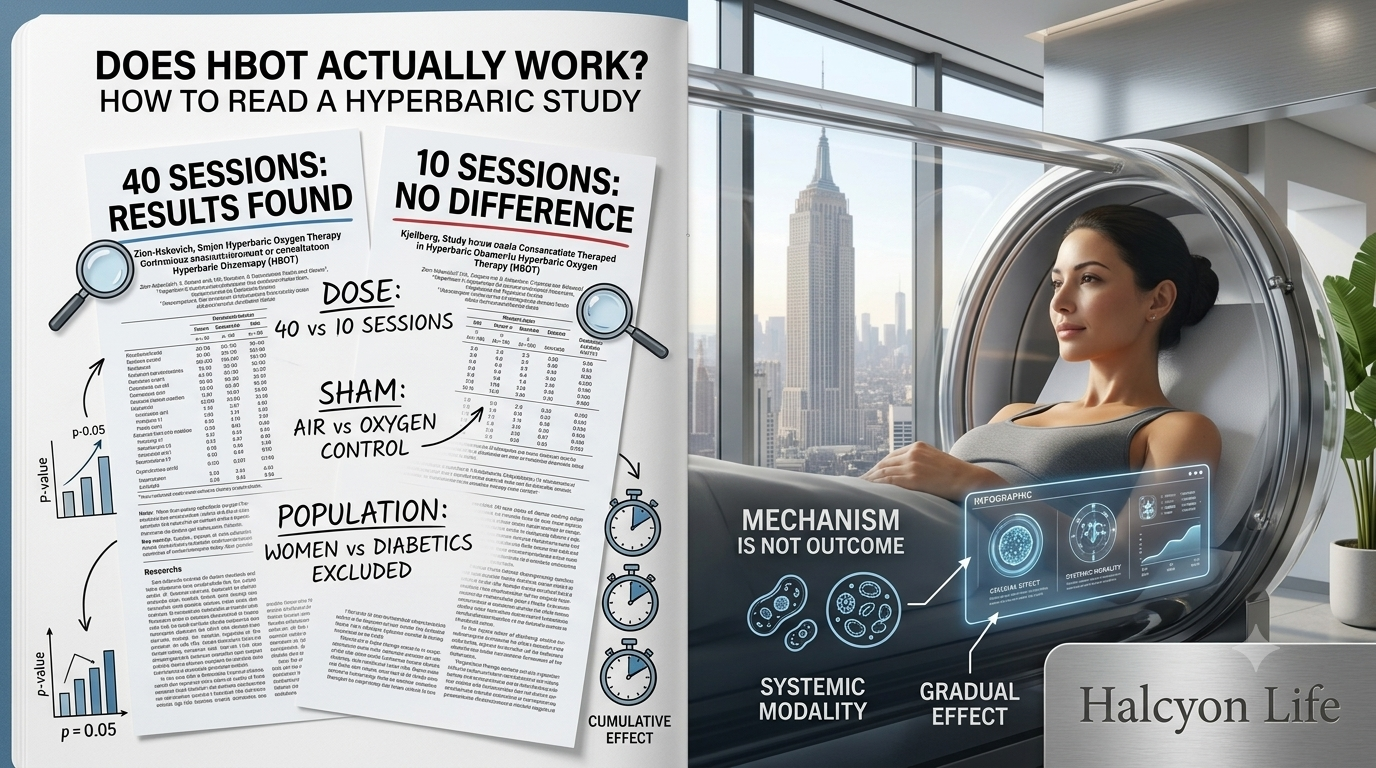
In 2022, a team at Shamir Medical Center in Israel published a randomized, sham controlled, double blind trial in Scientific Reports. Seventy three patients were randomized, thirty seven to hyperbaric sessions and thirty six to sham. The hyperbaric group did forty daily sessions. The paper reported significant group by time improvements in global cognitive function, attention, and executive function, with effect sizes around 0.46 to 0.50 and p values sitting right at the edge of conventional significance. Citation: Zilberman-Itskovich et al., Scientific Reports 12, 11252 (2022), DOI 10.1038/s41598-022-15565-0.
In 2025, a team at Karolinska University Hospital in Sweden published HOT-LoCO in BMJ Open. Also randomized, also placebo controlled, also double blind. Eighty subjects, forty per arm. Primary endpoints were physical functioning and role physical scores at thirteen weeks. The finding was no significant difference between hyperbaric sessions and placebo. Both groups improved. Citation: Kjellberg et al., BMJ Open 15(4), e094386 (2025), DOI 10.1136/bmjopen-2024-094386.
Two well conducted trials. Opposite conclusions. Neither one is fraudulent, and neither one is the final word.
The most obvious difference is dose. The Israeli trial ran forty sessions. HOT-LoCO ran ten. The Swedish authors were explicit about this being a phase II question, and the trial is honestly titled: ten sessions of hyperbaric oxygen versus sham. If the effects being investigated are cumulative and physiological rather than immediate and pharmacological, then ten and forty are not two doses of the same thing. They are closer to two different questions.
This is the single most useful habit you can build when reading this literature. Before you look at the conclusion, look at how many sessions people actually did.
Mechanism Is Not Outcome
The second habit is harder, because it cuts against how most health content is written.
There is a very large body of work on what happens inside cells under pressure with concentrated oxygen. Inflammatory signaling shifts. Mitochondrial behavior changes. Angiogenic signaling is triggered. Stem cell mobilization has been documented. All of this is real laboratory and imaging work, and it is where most marketing in this industry lives, because mechanism is easy to describe confidently and looks like proof.
It is not proof. A mechanism tells you a pathway exists. It does not tell you that moving that pathway produces something a person can feel in their life. The history of medicine is substantially a history of elegant mechanisms that failed to produce outcomes.
So when you read a page describing what oxygen does to your mitochondria, the correct response is not skepticism about the biology, which is usually fine. It is a question: what happened to the humans? We go into the underlying cellular picture in our piece on HBOT and mitochondrial function, and the same caution applies there. The mechanism is well described. The outcome data is thinner and more variable, and saying so is not a weakness in the argument.
What a Sham Actually Is, and Why It Is Hard Here
Blinding a hyperbaric trial is a real technical problem, and it explains a lot of the inconsistency in this field.
You cannot give someone a sugar pill version of a pressurized chamber. Participants feel their ears. So researchers use a slight pressurization with ordinary air to mimic the sensation. In the 2022 Israeli trial, the sham group breathed 21 percent oxygen at 1.03 atmospheres. In HOT-LoCO, the placebo arm received medical air at roughly 1.2 to 1.34 bar.
Notice the problem. Mild pressurization with ambient air is not obviously inert. Some researchers argue it may itself produce mild physiological effects, which would make a sham arm a low dose arm and push results toward no difference. Others argue the opposite, that anything less than a convincing sham inflates results through expectation.
There is no clean solution. This is a genuine, unresolved methodological problem in hyperbaric research, and any source that does not mention it is either unaware of it or hoping you are. When you read a trial, find the sham description in the methods. It is usually two sentences, and it frequently changes how you should read the conclusion.
Who Was Studied, and Do They Look Like You
Inclusion criteria are where most of the useful information hides.
HOT-LoCO enrolled previously healthy subjects aged 18 to 60 and excluded people with diabetes and hypertension. Sixty five of the eighty participants were women. That is a specific population. If you are 63, or managing a metabolic condition, that trial was not designed to answer your question, regardless of what its conclusion says.
This matters enormously for the people who read this site. Someone managing the aftermath of a viral illness that never fully resolved and someone working through a mold and environmental exposure history are often excluded from trials by design, because heterogeneous populations produce messy data. The trial protects its own clarity by narrowing who is in it. That is good science and it also means the published literature systematically underrepresents complicated people, who are the ones most likely to be reading about this in the first place.
One Arm Is Not Two Arms
The other thing worth learning to spot is the single arm study, because these travel further on social media than anything else in the field.
A single arm trial gives everyone the intervention and measures them before and after. No control group, no sham, no randomization. The widely circulated work on hyperbaric sessions and markers of cellular aging, including telomere length and senescent cell counts, was of this design. That does not make it worthless. It makes it a signal that something may be happening, which is precisely what an early stage study is for.
What it cannot do is separate the intervention from time, from regression to the mean, from the effect of showing up somewhere daily for two months, or from expectation. When you see a striking percentage quoted without a comparison group, you are reading a hypothesis dressed as a result.
The same discipline applies to harms. HOT-LoCO reported forty three adverse events across its hyperbaric arm and thirty eight across placebo, mostly cough and chest discomfort, with the authors concluding a favorable harm profile. That kind of even handed reporting is what you want to see, and it is why we keep an honest page on what people actually report experiencing rather than pretending the experience is uniformly pleasant.
Follow the Funding, Both Directions
Check the conflict of interest statement. It is at the bottom, it takes ten seconds, and people skip it.
In the 2022 Israeli trial, several authors are affiliated with a commercial hyperbaric company and one is a shareholder. That is disclosed in the paper. It does not invalidate the work, which was peer reviewed and methodologically serious, but it belongs in your reading of it.
Apply the same standard in reverse. A trial finding no benefit is not automatically more trustworthy because it is negative. Ask who ran it, what dose they chose, what population they enrolled, and what the trial was actually powered to detect. Negative results carry assumptions too.
So Where Does This Leave HBOT
Hyperbaric Oxygen Therapy is a systemic modality that influences the human body on cellular and physiological level. That statement is well supported. What follows from it, for any specific person with any specific problem, is much less settled, and we would rather say that plainly than pretend otherwise.
The honest summary as it stands: the mechanistic evidence is substantial, the outcome evidence is real but uneven, the strongest signals tend to appear in longer session courses rather than short ones, and the conditions where evidence is thin are the conditions where marketing is loudest. Outcomes vary. It may support recovery capacity, inflammatory balance, and nervous system regulation. It resolves nothing on its own, and any page telling you otherwise is a page you should close.
That honest picture is also why the same caution applies to adjacent modalities. When we looked at the evidence behind PEMF and related frequency based approaches, the pattern repeated: strong mechanism, promising early work, and a gap between the two that the marketing quietly fills in.
The Financial Version of This Argument
In New York the cost of being wrong about a health decision is not mostly the money. It is the years. People arrive at our chamber having spent a decade cycling through specialists, protocols, and modalities, each one preceded by a confident claim and followed by a quiet disappointment. The cumulative bill for that decade dwarfs any individual intervention in it.
Which is the actual case for learning to read this literature. Not so you can become a researcher, but so that the next time something is presented to you as settled, you can spend ninety seconds checking the dose, the sham, the population, and the disclosure. That habit is worth more than any single modality, including ours. We publish what HBOT in NYC actually costs and why in the same spirit.
What We Are Doing With This Series
Going forward we will take individual hyperbaric papers and work through them here, including the ones that report nothing. Where the evidence supports something, we will say so. Where it does not, we will say that too, and we would rather lose a booking than win one on a misreading.
Your confusion about this field is not a personal failure. It is the correct response to a literature that genuinely disagrees with itself, wrapped in marketing that pretends it does not. The goal is not certainty. The goal is enough clarity to make a decision you can live with, and then to get back to the parts of your life that this was always supposed to be in service of.
FAQs
-
For some conditions and some people, the evidence supports meaningful effects. For others it is thin or mixed. The most honest answer depends entirely on which condition, which dose, and which population you are asking about.
-
Most often because of dose, sham design, and who was enrolled. Trials using ten sessions and trials using forty sessions are not measuring the same intervention, even when they use the same words.
-
The trials reporting the clearest improvements generally involve extended daily courses over several weeks rather than a handful of visits. Short course trials more often report no difference from placebo.
-
A control condition where participants enter the chamber and experience mild pressurization with ordinary air instead of concentrated oxygen, so they cannot easily tell which group they are in.
-
Read it carefully rather than dismissing it. Disclosed industry involvement is a reason to scrutinize methods and effect sizes, not a reason to discard peer reviewed work outright.
-
PubMed is free and searchable. Look at the methods section before the abstract conclusion, and specifically at session count, sham design, and inclusion criteria.
-
Bring your history and what you have already tried into a conversation, and expect an honest answer about where the evidence is strong and where it is not. If nobody mentions limitations, that is information.