You typed "hyperbaric chamber near me" into your phone and ended up with fourteen open tabs. One place quotes sixty dollars a session. Another quotes four hundred. A third has a fabric pod in the corner of a med spa next to the facial room. A fourth has something that looks like a small submarine. All of them use the same three words. None of them explain why the price gap is nearly seven times.
So you do what most people do. You pick based on the reviews and the commute, because nobody has given you the one piece of information that would let you actually compare.
Here is that piece. The word hyperbaric describes a category, not a dose. Two chambers can both be honestly described as hyperbaric and still be doing meaningfully different things to your physiology. The variable that separates them is pressure, and pressure is the thing almost no one in the New York wellness market wants to discuss plainly, because doing so means admitting that not every chamber is equivalent. If you are working out which one fits what you are actually after, our guide to choosing the best hyperbaric oxygen chamber in NYC for your health goals pairs directly with what follows.
Why the Market Sounds Identical When It Is Not
There is nothing sinister about this. It is mostly a structural problem with how wellness gets sold.
Short-form content and search results reward certainty and simplicity. "Oxygen therapy" fits in a caption. "Chamber operating pressure and the resulting change in dissolved gas physics" does not. So the category flattens. Every operator uses the same photography, the same language about recovery and energy, the same broad promises. Confidence is easier to share than context.
The result is a market in which price becomes the only visible signal. That is a bad situation for you, because here price and capability are only loosely correlated, and the thing you are paying for is invisible from the outside.
We would rather explain the mechanism and let you decide. Understand what pressure does and you can walk into any facility in the city, ask two questions, and know what you are looking at.
The Physical Difference, In Plain Terms
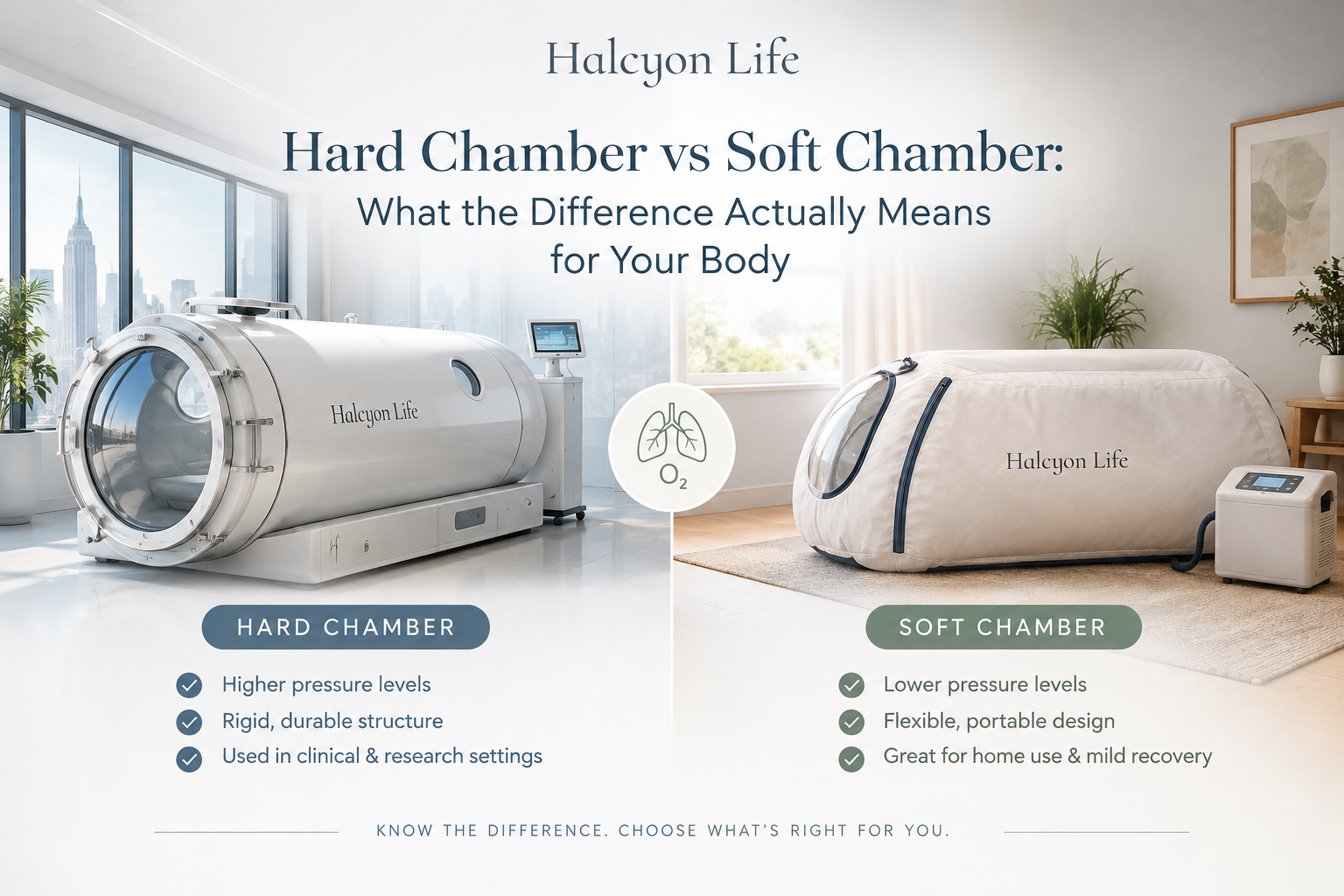
A soft chamber is a flexible enclosure, usually a reinforced fabric shell with a zipper or sealed seam, inflated by a compressor. Because the walls are not rigid, it has a low ceiling on how much pressure it can safely hold. These units typically operate a small fraction of an atmosphere above the pressure you are sitting in right now.
A hard chamber is a rigid vessel, steel or thick acrylic, engineered and certified to hold substantially higher pressure. This is the category that clinical and research settings use, and it is the category that operates in the range where most of the published human research on Hyperbaric Oxygen Therapy was actually conducted, commonly around 2.0 ATA.
That last point matters most and gets mentioned least. When you read a study, a meta-analysis, or a podcast summary describing what hyperbaric oxygen may do for inflammation, cognition, tissue recovery, or fatigue, you are almost always reading about conditions produced in a hard chamber. Applying those findings to a session at a materially lower pressure is an assumption, not a finding. It might turn out to be partly true. It has not been demonstrated at anything like the same level of evidence.
Why Pressure Is the Variable and Not the Marketing
Under normal conditions, the oxygen your body uses is carried almost entirely by hemoglobin in your red blood cells. That system is efficient and nearly maxed out. If you are healthy and breathing room air, your hemoglobin is already close to fully saturated. Breathing richer air at normal pressure adds very little, which is the honest reason an oxygen bar is pleasant rather than physiologically significant.
Pressure changes the equation because it changes how much gas dissolves directly into the plasma, the fluid portion of your blood. That dissolved fraction is small under ordinary conditions and it scales with pressure. Raise the pressure meaningfully and you create a state where oxygen moves into fluid and into tissue by diffusion rather than depending on red blood cells to deliver it.
This is the actual leverage point, and it explains why the modality is interesting at all. Plasma goes places red blood cells struggle to reach. Swollen tissue. Compressed or inflamed regions. Areas where microcirculation is compromised. A red blood cell is a large object trying to squeeze through a narrow, inflamed vessel. Dissolved gas in plasma has no such constraint.
Downstream of that, the interesting biology is not the oxygen itself. It is what cells do with a temporarily altered internal environment. Mitochondria operate differently. Inflammatory signaling shifts. Repair pathways get engaged. The body reads the cycle of a pressurized session and a return to normal as a signal, and it adapts to signals. We go deeper into that machinery in our piece on HBOT and mitochondrial dysfunction, because the mitochondrial angle is where most of the durable changes seem to originate.
Hyperbaric Oxygen Therapy is a systemic modality that influences the human body on cellular and physiological level. It is not a delivery service for a gas you already have plenty of. It is a controlled change to the conditions your cells operate in, and the size of that change depends on pressure.
Where Soft Chambers Legitimately Fit
We are not going to tell you soft chambers are useless, because that is not what the evidence says and it is not what we believe.
They are genuinely more accessible, portable for people who cannot travel to a facility several times a week, and dramatically cheaper to own, which is why home units are almost always soft. Some people report feeling better using them, and we do not think those people are imagining things. Mild pressure changes are not nothing, and consistency has real value in physiology.
What we would push back on is the substitution claim. A soft chamber is not a lower-priced version of a hard chamber session any more than a brisk walk is a lower-priced marathon. Different inputs, different magnitudes. Both can be worth doing. Only one is what the research literature describes.
If your goal is general relaxation, a mild recovery habit, and something you can use at home, a soft unit is a defensible purchase. If your goal is to give your physiology the kind of input studied for the harder problems, chronic fatigue, post-viral symptoms, stubborn inflammation, recovery after surgery, cognitive fog that has not lifted, then the pressure ceiling is the whole point and you should not compromise on it. Our post on how to find the best hyperbaric oxygen therapy in NYC goes through the rest of the evaluation criteria in detail.
The Money Question, Honestly
Here is the financial contrast that almost never gets laid out.
Think about what an unresolved chronic issue actually costs a person in New York over a few years. The specialist consultations that end in normal labs. The supplement drawer that keeps growing. The IV drips, the modality of the month, the memberships that get used four times. The cost of working at seventy percent for years and calling it your personality. The vacations that are mostly sleep. The compounding professional and personal cost of a nervous system that never fully recovers.
Set against that, the price gap between a mild-pressure session and a session at a pressure the research actually studied is small. A handful of sessions at a real pressure is often less than one round of a specialist workup that ends in a shrug.
That is not an argument that HBOT is cheap, and it is not an argument that you should spend money you do not have. It is an argument about what you are comparing it to. The right comparison is not chamber against chamber on price per session. It is what a course of a real physiological input costs against what another two years of the same baseline costs you. We break the actual New York numbers down in our guide to accessing HBOT in NYC on a budget, including the honest range for what different operators in the city charge.
The version of this that bothers us is when someone spends real money on a mild session for two months, feels little, and concludes that hyperbaric oxygen therapy does not work for them. They did not test the thing they think they tested.
What This Looks Like in New York Specifically
New York has a particular version of this problem. The wellness market here is dense, expensive, and extremely good at presentation. A room can look clinical without being capable. A price can signal quality without indicating it. And New Yorkers have less time than almost anyone to research a category properly, so the decision gets made in the ten minutes between meetings.
There is also the practical geometry of the city. Space is the most expensive input any operator has. A rigid vessel is heavy, large, and requires structural and mechanical accommodation. A fabric unit fits in a spare room. Some of what you see in this market is not a philosophical position about pressure. It is a real estate constraint dressed as a service offering.
That is context rather than accusation, and context is what lets you ask better questions. The same dynamic shapes how other recovery modalities get positioned here, which we walk through in our comparison of HBOT, sauna, and cold plunge in a real recovery stack.
The Two Questions to Ask Anyone
You do not need to become an engineer. You need two answers.
First, what pressure does your chamber operate at, and is it rigid or flexible. Any operator who is comfortable with their setup will answer this immediately and without defensiveness. Hesitation, redirection, or a pivot to talking about oxygen concentration instead of pressure tells you something.
Second, how long is a session and how is the protocol determined for an individual. Protocols should be aligned to a person's biology rather than forcing everyone's biology into the same session. A place that gives everyone the identical schedule regardless of what they walked in with is running a format, not a practice.
That is the whole test. Two questions, thirty seconds, and you know more than most people who have researched this for a month.
Where This Leaves You
The honest summary is that hyperbaric is a category and pressure is the dose, and the market has every incentive to keep those two blurred together. Once you can see the difference, the landscape becomes legible. You stop comparing prices against each other and start comparing what each option can actually do inside your body.
That clarity is worth more than any single session. It is what lets you spend your money and your limited New York time on something with a real chance of changing how you feel, rather than on the version that photographs well. You deserve a straight answer when you ask, and anyone unwilling to give you one has told you what you needed to know. For the rest of the confusion around the category, our post on common myths about hyperbaric oxygen therapy clears it out.
FAQs
-
Rigidity and pressure ceiling. A hard chamber is a rigid vessel built to hold substantially higher pressure. A soft chamber is a flexible enclosure limited to a small fraction of an atmosphere above ambient. Pressure is what determines how much oxygen dissolves into plasma, so the two produce different physiological conditions.
-
It can be, depending on your goal. For general relaxation, a mild recovery habit, or home use where accessibility matters most, a soft unit is a reasonable option. It is not equivalent to a session at research-level pressure, and it should not be chosen as a substitute for one.
-
The great majority of published human research on Hyperbaric Oxygen Therapy was conducted in rigid chambers at meaningfully higher pressures, commonly around 2.0 ATA. When you read about outcomes in the literature, that is the setting being described.
-
Ask what pressure the chamber operates at and whether it is rigid or flexible. Both are simple factual questions. Any facility comfortable with its equipment will answer directly.
-
Rigid chambers cost far more to purchase, install, and maintain, and they require more space, which is the most expensive input in Manhattan. Session length and staffing also vary. Some of the price spread reflects genuine capability differences and some reflects positioning.
-
No. More pressure means a larger physiological input, not a better outcome for every person or goal. Sessions should be paced to the individual. The point is that pressure is the variable that determines what kind of input you are receiving, so it should be a conscious choice rather than an invisible one.
-
Halcyon Life runs a hard chamber in Midtown Manhattan. We are happy to walk you through our setup, our pressures, and how we think about individualized pacing before you commit to anything.