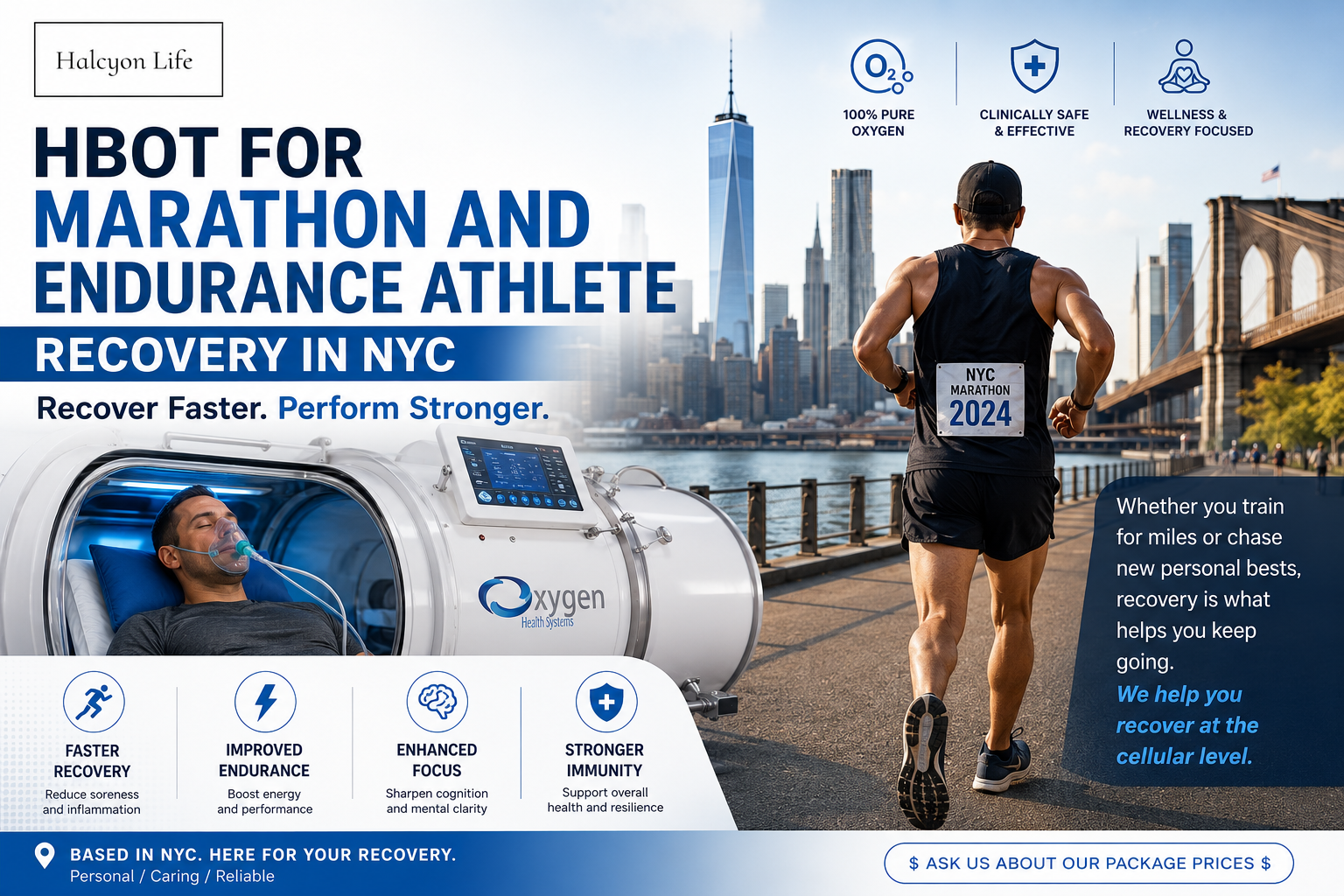
HBOT for Marathon and Endurance Athlete Recovery in NYC
The Weight of Week Ten
Somewhere around week ten of a marathon build, most runners in New York City hit the same wall. It is rarely the long run itself that breaks momentum. It is everything that happens after it.
Your legs do not quite reset before the next hard session. Your sleep feels thinner than it should, even after a twenty mile Saturday that ought to have flattened you. A low hum of fatigue follows you into Monday easy miles and never fully clears before Tuesday afternoon on the track.
If you are building toward fall race season, you already know the rhythm. Loops through Prospect Park before sunrise. Track work squeezed between morning meetings. Long runs scheduled around subway maintenance and whatever daylight is left in November. Reservoir miles cut short because the rest of your life did not pause for your training block.
Triathletes feel this even more sharply. Early swim sessions compete with evening trainer rides and midday runs, and every discipline draws from the same narrow window of time and energy.
Founders, executives, and busy professionals training for a major race often describe the same contradiction. They have the discipline to hit every scheduled workout, and they still feel like they are falling behind. That happens because recovery was treated as the absence of training rather than as a physiological process with its own requirements.
This is the part of endurance sport that training plans handle badly. Mileage gets a spreadsheet. Recovery gets a foam roller and a cold shower.
Athletes who hold up across a full build understand something more specific. Recovery is not empty time. It is a set of biological processes that cost energy, run on a schedule your training calendar does not consult, and can be supported or neglected.
If you want to look honestly at where your training load and your physiology currently sit, you can book a consultation with Halcyon Life and talk it through with our team.
Why Recovery Gets Misunderstood
The standard advice treats recovery as the gap between hard workouts and assumes the body repairs itself if you leave it alone long enough. That is not wrong. It is incomplete, and the incompleteness is where training blocks fall apart.
Endurance training makes simultaneous demands on several systems that operate on different timescales. Muscle fibers sustain mechanical damage and need to be repaired. Inflammatory signaling has to be raised and then actively shut down. Mitochondria have to be built, and building them means synthesizing new proteins. Your autonomic nervous system has to swing from the sympathetic drive that lets you run a hard interval to the parasympathetic state where most of the repair actually happens.
Each of those processes has a rate limit. None of them is instant. And crucially, none of them speeds up just because you added a rest day to the calendar.
When one of them falls behind, the signal is rarely an acute injury. It is a plateaued pace. It is a resting heart rate that will not settle. It is restless sleep the night before a workout you were looking forward to. It is legs that feel heavy in a way that stretching does not touch.
Runners tend to read those signals as a discipline problem and respond by adding inputs. More supplements. More mobility work. Another gadget. But the body is usually not asking for more inputs. It is telling you that a specific biological process has fallen behind the rate at which you are generating demand.
New York adds a layer that most training literature ignores. Chronic stress, noise, screens, irregular sleep, and long working hours all raise sympathetic tone and elevate baseline inflammatory signaling before you have run a single step. Your capacity to recover is shared across every stressor in your life, not just the ones logged in your running app. This is why so many people here describe persistent exhaustion despite decent nutrition and adequate hours in bed, a pattern we unpack in more depth in our piece on why you wake up tired in NYC even after sleeping enough.
So the useful question is not how much rest you need. It is which specific process is lagging, and why.
What Recovery Capacity Actually Is
"Recovery capacity" gets used loosely enough to mean nothing. Here is what is actually underneath it.
Inflammation is easy to start and expensive to stop
Every hard session causes microscopic mechanical damage to muscle fibers, and that damage triggers an inflammatory response. Neutrophils and then monocytes arrive at the tissue. Monocytes differentiate into macrophages that clear damaged proteins and cellular debris. This is not a malfunction. Without it, you would not adapt.
The part that gets missed is that inflammation does not simply fade out. Resolution is an active, energy-consuming program in its own right. Macrophages have to switch phenotype, moving from the aggressive debris-clearing state into a reparative state that supports satellite cell activity and new tissue construction. That switch is driven by a family of signaling molecules known as specialized pro-resolving mediators, built from omega-3 fatty acids, and the whole process depends on adequate cellular energy and an adequate local oxygen environment.
When that switch happens cleanly, you finish the week stronger. When it stalls, macrophages linger in the pro-inflammatory state, low-grade inflammatory signaling persists into the next session, and you begin the following workout with an inflammatory baseline that was supposed to have returned to zero. Stack that across six weeks of a build and you get the heavy, dull, slightly inflamed feeling that runners describe and rarely have language for. If you want the fuller treatment of this mechanism, we go deeper in our article on whether HBOT helps with inflammation.
The iron problem most runners never hear about
There is a specific and underappreciated consequence of unresolved inflammation in endurance athletes, and it is worth naming because it explains a lot of otherwise confusing fatigue.
Persistent inflammatory signaling raises interleukin-6, and interleukin-6 drives the liver to produce a hormone called hepcidin. Hepcidin's job is to restrict iron availability. It reduces iron absorption in the gut and locks iron inside storage cells rather than releasing it into circulation. From an evolutionary standpoint this makes sense, since limiting free iron during infection starves bacteria.
During a heavy training block, though, it works against you. You can eat well, supplement diligently, and still drift toward functional iron deficiency because the iron you are consuming is not reaching the bone marrow where red cells are made. Runners with chronically elevated inflammatory load are more prone to this than almost any other athletic population, and the felt experience is exactly what you would expect: legs that feel leaden, paces that require more effort than they should, and a sense that you are working harder for less.
This is one of the clearest illustrations of why inflammatory resolution is not a soft, abstract concept. It has direct downstream consequences for oxygen carrying capacity and how your training actually feels.
Mitochondria are built on a slower clock than your mileage chart
Mitochondria are where aerobic energy is produced, and endurance adaptation is substantially a story of building more of them and making the ones you have work better.
That process has a name and a controller. The master regulator of mitochondrial biogenesis is a protein called PGC-1 alpha, and it gets activated by several signals that hard training produces: the rise in the AMP to ATP ratio when a cell is running low on energy, which activates AMPK; repeated calcium flux from muscle contraction; and a modest, controlled amount of reactive oxygen species. Your body reads those signals, transcribes new mitochondrial proteins, and assembles new machinery.
Here is the timing problem. That process runs on days to weeks. Protein synthesis, assembly, and integration into functional respiratory chains are not fast. You, meanwhile, can add fifteen percent to your weekly mileage in a single planning session.
That mismatch, between how quickly you can generate demand and how slowly the machinery to meet it can be constructed, is the actual bottleneck people are gesturing at when they say "capacity." It is not a metaphor. It is a rate limit on protein turnover. And it explains the specific, maddening experience of easy runs feeling heavy while your fitness on paper is improving.
Diffusion distance and the capillary question
Building more mitochondria only helps if oxygen and fuel can reach them, and metabolic byproducts can be carried away.
Oxygen leaving a capillary has to travel through tissue by simple diffusion, and diffusion is unforgiving about distance. Muscle fibers at the far edge of a capillary's supply territory sit in a measurably lower oxygen environment than fibers adjacent to the vessel. Endurance adaptation therefore involves not only mitochondrial density but capillarization, meaning an increase in the capillary-to-fiber ratio that shortens the distance oxygen has to travel.
That growth is driven largely by vascular endothelial growth factor, or VEGF, which is itself released in response to local oxygen and metabolic signaling during training. Capillary networks are slow to build, and they are one of the quieter reasons that experienced runners tolerate volume that would break a newer athlete on identical talent.
Your nervous system is not a mood, it is an input to repair
Autonomic state is usually discussed in terms of how you feel. It matters for a more concrete reason.
Sympathetic activation raises circulating catecholamines and, when sustained, shifts cortisol patterns. Parasympathetic activity, carried largely by the vagus nerve, is the state in which digestion, tissue repair, and consolidated deep sleep occur. Heart rate variability is a rough readout of how flexibly you move between the two, which is why it correlates with training readiness better than resting heart rate alone.
There is also a direct and often overlooked link between autonomic state and the inflammation discussion above. Vagal signaling releases acetylcholine, which binds alpha-7 nicotinic receptors on macrophages and dampens their release of pro-inflammatory cytokines including tumor necrosis factor alpha. This is known as the cholinergic anti-inflammatory pathway, and it means your nervous system state is not merely correlated with your inflammatory state. It is one of the levers controlling it.
A nervous system locked in sympathetic drive by work stress, screens, and a city that never quite goes quiet is therefore not just a sleep problem. It is a slower inflammatory resolution problem, which becomes a slower tissue repair problem, which eventually becomes a performance problem.
If a virus knocked you out mid-block and you never quite came back, that intersection of immune signaling and autonomic recovery is exactly the territory covered in our guide to post-viral and chronic fatigue.
Why Two Runners on the Same Plan Get Different Results
Two athletes follow an identical mileage progression. One arrives at race day healthy and running personal bests. The other spends the last month managing soreness, heavy legs, and a plateau nobody can explain.
The difference is rarely willpower, and it is usually not talent either. It is whether each of those five processes had the bandwidth to keep pace with the demand being generated, given everything else the body was already handling.
That is why effective NYC marathon training recovery is not a matter of adding rest days to a spreadsheet. It is a matter of supporting the underlying processes that determine what a rest day is actually able to accomplish.
Where HBOT Fits Into Endurance Training
This is the point where recovery shifts from waiting into something you can support.
Hyperbaric Oxygen Therapy is a systemic modality that influences the human body on cellular and physiological level. It is not a targeted intervention aimed at a single tissue. It changes conditions across the whole system, which is why it maps onto the processes described above rather than onto any one symptom.
The mechanism worth understanding is about pressure, not about oxygen concentration alone. At normal atmospheric pressure, your hemoglobin is already close to fully saturated, which is why breathing concentrated oxygen at ambient pressure does relatively little for a healthy person. Under pressure, however, oxygen dissolves directly into blood plasma and other body fluids in proportion to the pressure applied, independent of hemoglobin entirely. Because that oxygen is in solution rather than bound to a carrier, it diffuses further into tissue and reaches regions that sit at the far edge of capillary supply.
That is relevant to endurance recovery for several converging reasons. Macrophage phenotype switching and the resolution of inflammation are oxygen-sensitive and energy-dependent processes. Satellite cell activity and the protein synthesis required for mitochondrial construction are metabolically expensive. Diffusion-limited regions of muscle are precisely the areas where repair tends to lag.
There is a further mechanism that endurance athletes in particular tend to find interesting. Cells respond not only to absolute oxygen levels but to changes in them. A period of elevated oxygen followed by a return to normal is read by the cell as a relative drop, and this can stabilize hypoxia-inducible factor and trigger the same downstream adaptive programs, including VEGF expression and angiogenic signaling, that altitude exposure is prized for. Researchers refer to this as the hyperoxic-hypoxic paradox. The evidence base is still developing and outcomes vary between individuals, but the underlying signaling is well characterized and it is the reason the biological rationale here is more interesting than a simple oxygen delivery story.
What HBOT is not is a replacement for the fundamentals. It does not substitute for sleep, adequate fueling, iron status you have actually measured, or an intelligently structured training plan. It does not make an overreaching build sustainable. Anyone promising that is selling something. What it may do is support the physiological conditions in which the processes you depend on can run closer to their natural pace.
Many athletes building a complete approach also layer other modalities, and we compare how they overlap in our breakdown of the HBOT, sauna, and cold plunge recovery stack and our look at red light therapy alongside HBOT in NYC.
If you are curious how sessions fit around a peak mileage week, contact Halcyon Life to speak with a specialist about your schedule.
Recovery Framework: Local Tools vs. Systemic Support
| Biological Process | Local and Acute Tools (Ice, Massage, Compression) |
Systemic Hyperbaric Support | Combined Training Outcome |
|---|---|---|---|
| Inflammatory resolution | Constricts peripheral vessels and numbs localized soreness without altering the resolution program. | Supports the oxygen-dependent and energy-dependent conditions under which macrophage phenotype switching occurs. | Soreness clears without blunting the inflammatory signaling that drives adaptation. |
| Cellular energy production | Provides passive rest and a temporary surface circulation effect. | Raises dissolved oxygen availability in diffusion-limited tissue where mitochondrial construction is occurring. | Less persistent systemic fatigue and better tolerance of weekly load. |
| Autonomic regulation | Short-term relief, or in the case of cold, a deliberate sympathetic stimulus. | A quiet, enclosed, pressurized environment that supports a parasympathetic shift. | Deeper sleep, more responsive heart rate variability, clearer thinking. |
| Capillary networks | Limited to surface tissue stimulation and local fluid movement. | May influence angiogenic signaling including VEGF expression. | Shorter diffusion distances and improved nutrient delivery over time. |
Frequently Asked Questions
-
It works on the conditions underneath recovery rather than on symptoms. Inflammatory resolution, satellite cell activity, and mitochondrial protein synthesis are all energy-intensive and oxygen-sensitive processes. Supporting the environment in which they run may help them keep closer pace with training demand. Outcomes vary between individuals.
-
It is non-invasive and does not impose a training load, so it can generally be integrated into an active build. Timing still matters, and sessions are usually best placed on light or rest days rather than stacked against your hardest work.
-
Local tools act on specific tissues and largely on sensation and fluid movement. Hyperbaric sessions act systemically, influencing conditions across the whole body including tissue that sits at the edge of capillary supply. The two address different problems and are not interchangeable.
-
Many athletes begin during peak mileage, when accumulated load is highest. Starting earlier in the build is often more useful, since the goal is to keep pace with demand rather than to recover from a hole you have already dug.
-
Returning to volume too quickly after illness is one of the more reliable ways to derail a block, in part because immune signaling and autonomic recovery lag behind how you subjectively feel. Systemic support may help create better internal conditions while that returns to baseline, but it is not a substitute for a conservative return to training.
-
No. Many runners, triathletes, and cyclists use sessions purely as part of a recovery and performance approach during heavy training seasons.
-
No, and it should not be sold that way. Sleep, adequate energy intake, hydration, and iron status you have actually had tested remain the foundation. Systemic support is an addition to that foundation, not a way around it.
-
Parasympathetic activity is the state in which most tissue repair and deep sleep consolidation occur, and vagal signaling also directly dampens inflammatory cytokine release. A nervous system stuck in high sympathetic drive slows repair on both fronts, which shows up as poor sleep, stalled adaptation, and a resting heart rate that will not come down.
-
Yes. Inflammatory resolution, mitochondrial turnover, capillary density, and autonomic regulation are common to all endurance sport. The training modality changes. The underlying biology does not.