Most people find the price before they find the explanation.
You search for a hyperbaric chamber in NYC because something has not resolved. Maybe it is fatigue that survived every reasonable intervention. Maybe it is a surgery that healed on paper and not in your body. Maybe it is a long stretch of feeling like a lower-resolution version of yourself. You read enough to think this might be worth trying, you look for a price, and you find a number that stops the conversation. Then you close the tab and go back to living with it.
That moment happens constantly, and almost nobody addresses it honestly. Facilities either hide pricing behind a consultation form or they quote a number with no explanation attached, which leaves you to assume the number is arbitrary. It is not arbitrary. It is the output of a fairly specific set of physical, operational, and real estate constraints, and once you understand them you can tell the difference between a facility charging what the work costs and a facility charging what the market will bear.
This is our attempt to lay all of it out.
The actual range in New York City
A single session of hyperbaric oxygen therapy in Manhattan generally runs somewhere between $300 and $500 at standard rates. Packages bring the per-session number down, and the spread between the low end and the high end of this city is wider than in almost any other market in the country.
Our own base rate at Halcyon Life is $120 per session. We are stating that plainly because we think the refusal to publish pricing in this industry is itself part of the problem, and because a number you can compare is more useful to you than a consultation form.
That spread is the part worth understanding, because it is not primarily a spread in quality of service. It is a spread in what is physically inside the room. Two facilities can both advertise hyperbaric oxygen therapy and be running fundamentally different operations, with different equipment, different pressure capability, different gas delivery, and different session structure. The word on the door is the same. What happens to your physiology is not.
Why the equipment is the whole story
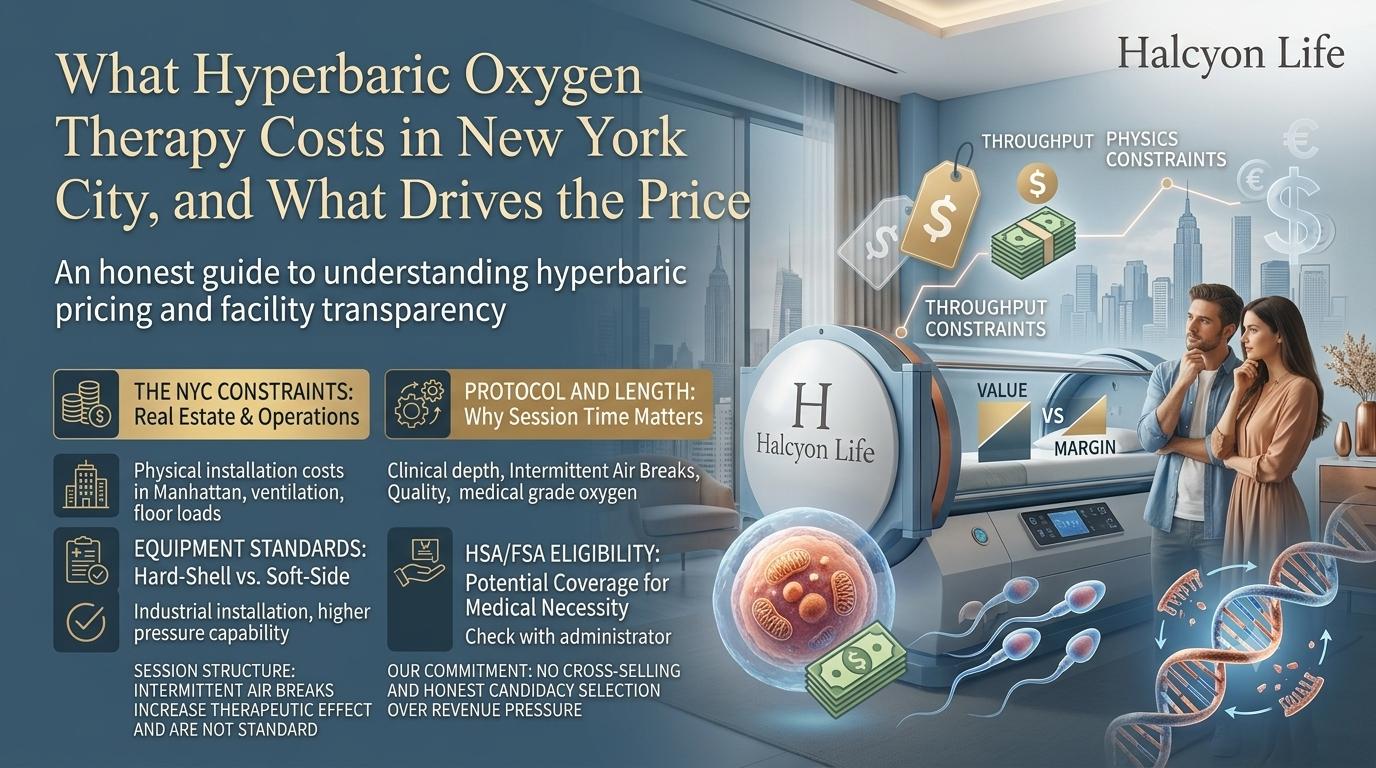
A hard-shell chamber capable of holding meaningful pressure with a continuous supply of concentrated oxygen is an industrial installation. It has weight, it has a footprint, it has ventilation and fire safety requirements, and it needs a reliable oxygen supply chain feeding it every single day it operates. In Manhattan, where commercial square footage is among the most expensive on earth and freight elevators and floor loads dictate what can physically go into a building, that installation is not a small line item on a business plan. It is the business plan.
Soft-sided chambers, by contrast, are portable, they run at much lower pressure, and they can be set up in a spare room. They have a legitimate place, and we are not interested in pretending otherwise. But they are a different physiological proposition, and the reason they cost less to offer is that they cost dramatically less to install and operate. When you see an unusually low session price, the equipment is usually the explanation.
This is the first thing that separates HBOT from nearly every other service in the wellness category. Most modalities scale by adding staff or adding hours. A massage practice adds a table. An IV lounge adds a chair. A hyperbaric practice running hard chambers adds capacity only by acquiring another chamber, finding somewhere in New York City that can structurally hold it, and feeding it oxygen indefinitely. There is a hard ceiling on how many sessions exist in a day, and that ceiling is set by physics rather than by ambition.
Our owner Jacob describes this as the reason the economics of this field are so poorly understood from the outside. People assume a high session price means a high margin. In practice, a serious hyperbaric operation in Manhattan is a capital-heavy, throughput-limited business with a fixed number of sessions to sell and no way to manufacture more of them.
What a session actually contains, and why length matters
Session length is the second variable people do not know to ask about, and it may be the most consequential one.
Clinical hyperbaric protocols in the published literature typically run around ninety minutes at pressure, and they include intermittent air breaks. In a study of patients undergoing sixty daily sessions at 2 ATA, the protocol was ninety minutes of concentrated oxygen with five minute air breaks every twenty minutes, and pulmonary function was measured before and after the full course. Air breaks appear throughout the research literature for a specific physiological reason: continuous high-pressure oxygen exposure carries a cumulative burden on lung tissue, and periodic returns to ordinary air reduce that burden while preserving the therapeutic exposure.
This matters commercially in a way that is easy to miss. Air breaks make a session longer without making it more profitable. A facility optimizing for revenue per chamber-hour has a direct financial incentive to shorten sessions and skip air breaks, because a shorter session means more sessions per day out of the same fixed asset. Nobody advertises that they have done this. You simply get a shorter session and no explanation of what was removed.
Air breaks are not standard practice everywhere in this city, and we consider that one of the more important things a prospective client can ask about. When you compare two prices, you are often not comparing the same product.
The incentive problem nobody names
Here is the part that explains more of the wellness market than any individual price does.
Consider a multi-modality clinic that offers cryotherapy, red light, IV drips, compression, and a hyperbaric chamber. The chamber is one line on a service menu. The business model is built on selling packages that move a client across several modalities, and the revenue logic works best when the client uses everything. Nobody in that structure has a reason to tell you that hyperbaric therapy is not the right fit for your situation, because the alternative recommendation is simply a different item on the same menu.
Now consider a franchise or lease-financed chamber operation. The equipment carries a monthly obligation that exists whether the chamber is used or not. That obligation creates real pressure to fill hours, and filling hours means enrolling people. Again, nobody in that structure is behaving badly. The structure itself makes candidate selection a cost rather than a service.
We are not interested in accusing anyone of bad faith, and we would rather critique the incentive than the practitioner. But the incentive is worth naming plainly, because it is what a prospective client is actually navigating when they read five websites that all sound equally confident.
Our own structure is narrower and it produces a different pressure. We do one thing. We cannot cross-sell you into something else if hyperbaric therapy is a poor match for your situation, which means an enrolled client who was talked into it is not a win for us. They finish a package, they do not feel a difference, they do not come back, and they tell people. In a modality where results genuinely vary and where the honest answer is often "this may help and we will know more after a few weeks," the only durable business is one built on telling people the truth about candidacy up front. That is not virtue. It is the structure we chose.
Why the people who understand this best explain it worst
There is a related distortion worth understanding.
The clinicians and researchers with the most rigorous grasp of hyperbaric medicine are, almost as a rule, the people least equipped to explain it to the public. Their training rewards precision, caveat, and restraint. It does not reward writing a compelling paragraph. The result is that the public explanation of this modality gets outsourced by default to whoever is best at selling, and selling rewards certainty.
That is how a field with a real and genuinely uneven evidence base ends up publicly represented by two extremes. On one side, the claim that hyperbaric therapy does almost nothing outside a narrow list of approved indications. On the other, the claim that it reverses aging. Neither is what the literature says.
What the literature supports is more useful and much harder to fit in a caption. Hyperbaric Oxygen Therapy is a systemic modality that influences the human body on cellular and physiological level. The strength of the evidence varies considerably by condition, and outcomes depend heavily on the person and the protocol. That is a harder thing to sell and a better thing to know.
Working backward from the problem instead of forward from the product
Most wellness marketing runs in one direction. Here is the modality, here is a long list of things it might help, find yourself somewhere on the list.
We think the useful direction is the reverse. Start with what is actually happening, work back to which system is under strain, and only then ask whether this is a reasonable place to intervene.
Take persistent fatigue that survived a normal bloodwork panel. The lived experience is that you sleep and do not recover. Underneath that, the common physiological contributors are some combination of low-grade inflammatory signaling, impaired mitochondrial output, autonomic nervous system dysregulation, and reduced microcirculatory delivery to tissue that needs it. Those are not separate problems. They feed each other, which is why single-target interventions so often produce partial results that fade.
Consider what that looks like one level down. Chronic inflammatory signaling changes how mitochondria behave, shifting cells toward a defensive metabolic posture that produces less usable energy. Less available energy means slower tissue maintenance and repair. Meanwhile the vascular network delivering substrate to those cells is itself affected by the same inflammatory environment, so diffusion distances effectively lengthen and the tissue furthest from a capillary gets the least. Layer autonomic dysregulation on top, and the body loses its ability to shift into the parasympathetic states where most repair actually happens. None of those four things is the cause. They are a loop, and the relationship between hyperbaric therapy and mitochondrial function is one of the more interesting places that loop can be interrupted.
If that is the shape of the problem, then a systemic input that touches inflammatory balance, mitochondrial behavior, and vascular function at the same time is at least a rational thing to consider. If it is not the shape of the problem, it is not.
The same logic applies across the conditions we work with most. Long COVID and post-viral states tend to involve persistent immune activation and endothelial disruption rather than a simple energy deficit. Neurological presentations involve neuroinflammation and regional perfusion. Migraine involves cortical excitability thresholds and vascular reactivity. Multiple sclerosis involves demyelination in an inflammatory environment. In each case the honest question is not "does HBOT work" but "is the mechanism under strain here one that a systemic physiological input can plausibly reach, and what does the evidence for this specific condition actually look like."
Sometimes the answer is encouraging. Sometimes it is thin. We would rather tell you which one you are looking at.
The markets this sits on top
Something worth understanding about the price is where hyperbaric therapy sits economically.
The global wellness economy reached $6.8 trillion in 2024 and is projected to approach $9.8 trillion by 2029, which makes it roughly four times the size of the global pharmaceutical industry and about sixty percent the size of all global health expenditure combined. Within that, chronic wound care alone is a market in the range of $15 billion to $18 billion annually, driven substantially by diabetic foot ulcers, which is also the indication where hyperbaric oxygen has its longest and best-established clinical track record. The personalized medicine segment sits around $147 billion and is growing at over nine percent a year as people increasingly pay directly for diagnostics and optimization.
The hyperbaric market itself is small by comparison and the published estimates for it disagree wildly, ranging from under $4 billion to over $40 billion depending on whose methodology you use and whether they are counting devices, services, or both. That disagreement is itself informative. It means the category is not yet well defined even by the people whose job it is to define it.
What that adds up to is a modality touching the edges of wound care, sports recovery, neurological rehabilitation, post-surgical healing, fertility support, and longevity, each of which is a large market with its own economics and its own marketing conventions, without fully belonging to any of them. That structural position is part of why the public conversation is so confused, and part of why pricing varies so much. There is no settled category, so there is no settled price.
The financial contrast worth actually doing
Set the session price against the thing it is competing with, which is not another wellness purchase. It is the ongoing cost of the unresolved problem.
Someone in their third year of post-viral fatigue in New York is typically absorbing a very real financial load already. Reduced work capacity. Specialist visits at Manhattan rates. Supplements bought on hope. Sometimes a career trajectory that quietly bends downward. Someone recovering from a significant surgery has already spent, in most cases, five figures, and the recovery period determines whether that spend delivered what it was supposed to.
Against that, a course of hyperbaric sessions is a defined, bounded expense with a decision point at the end of it. You will know within a few weeks whether your body is responding. That is a materially better proposition than an open-ended search, and it is a much better proposition than another year of the status quo.
We are not going to tell you it is cheap. In New York it is a real expense and we would rather you weigh it clearly than be talked into it. But the comparison that matters is not session price against a massage. It is session price against the cost of continuing to carry the thing you came in about.
How to judge a facility
Three questions will tell you most of what you need to know. Ask what type of chamber it is and what pressure it reaches. Ask how long a session runs and whether it includes air breaks. Ask what happens if you are not a good candidate, and listen closely to whether that answer has ever actually happened.
A facility that answers all three directly is telling you something about how it operates. A facility that redirects to a package price is also telling you something.
The third question is the one that matters most and the one almost nobody asks. Every facility will tell you who this is for. Very few will tell you who it is not for, and the ones who cannot answer that question have usually never had to. In our experience the people who benefit most from hyperbaric therapy tend to arrive with a reasonably specific physiological situation and a realistic expectation, and the people who benefit least tend to arrive having been told it will resolve something it was never going to resolve. That second outcome is avoidable, and avoiding it is a conversation, not a sales process.
It is also worth asking what happens between sessions. Hyperbaric therapy is not a standalone intervention and pretending otherwise does clients a disservice. Sleep, nutrition, movement, stress load, and whatever else you are already doing all determine what the sessions have to work with. A facility uninterested in any of that is selling chamber time rather than helping you recover.
If you want to see how we think about the modality itself before you think about the cost, our overview of what HBOT is covers the mechanism, and our FAQ page handles most of the practical questions people ask before a first session. When you are ready to talk through whether this makes sense for your specific situation, you can book a session or a conversation here, and a conversation is genuinely fine as a starting point.
The point of all of it
Price is the easiest thing to compare and the least informative. What actually determines whether this is worth it to you is whether the problem you came in with is the kind of problem a systemic physiological input can reach, whether the facility you choose is running a protocol worth the money, and whether anyone in the process is willing to tell you honestly when the answer is no.
We would rather you spend nothing here and understand your situation clearly than spend a great deal and remain confused about what you bought. The goal was never the sessions. It was getting back the capacity to do the things you have been rationing, and to stop organizing your life around a problem that has been setting the terms for too long.
Frequently Asked Questions
-
Single sessions in Manhattan generally run between $300 and $500 at standard rates, with package pricing bringing the per-session cost down. The range is wide because chamber type, pressure capability, and session length vary significantly between facilities.
-
Commercial real estate, the structural requirements of installing hard chambers in Manhattan buildings, and ongoing oxygen supply costs. Capacity is limited by physical equipment rather than staffing, so there is a hard ceiling on how many sessions exist in a day.
-
Hard-shell chambers hold higher pressure and are permanently installed industrial equipment. Soft-sided chambers are portable and operate at much lower pressure. They are different physiological propositions, and the price difference largely reflects the difference in installation and operating cost.
-
Air breaks are short periods during a session where you breathe ordinary air rather than concentrated oxygen. They appear throughout clinical hyperbaric protocols because they reduce the cumulative pulmonary burden of continuous high-pressure oxygen exposure while preserving the therapeutic effect. They make sessions longer without making them more profitable, which is why not every facility includes them. They also increase efficacy and healing factors considerably, heightening the quality value of each session.
-
Hyperbaric oxygen therapy appears on standard HSA and FSA eligibility lists, and many plans will cover it. Whether yours does usually depends on your plan administrator and whether your sessions connect to a specific health reason rather than general wellness. Some plans ask for a letter of medical necessity. One call to your administrator answers it.
-
It depends entirely on what you are working with, and any facility quoting a universal number is guessing. Most people have a reasonable sense of whether their body is responding within the first few weeks, which is the honest decision point rather than a fixed package length.
-
That depends on whether your situation is one where a systemic physiological input is plausibly relevant, which is a real question with a real answer. The comparison worth making is not against other wellness spending but against the ongoing cost of leaving the problem unaddressed. We would rather talk that through with you than sell you a package.