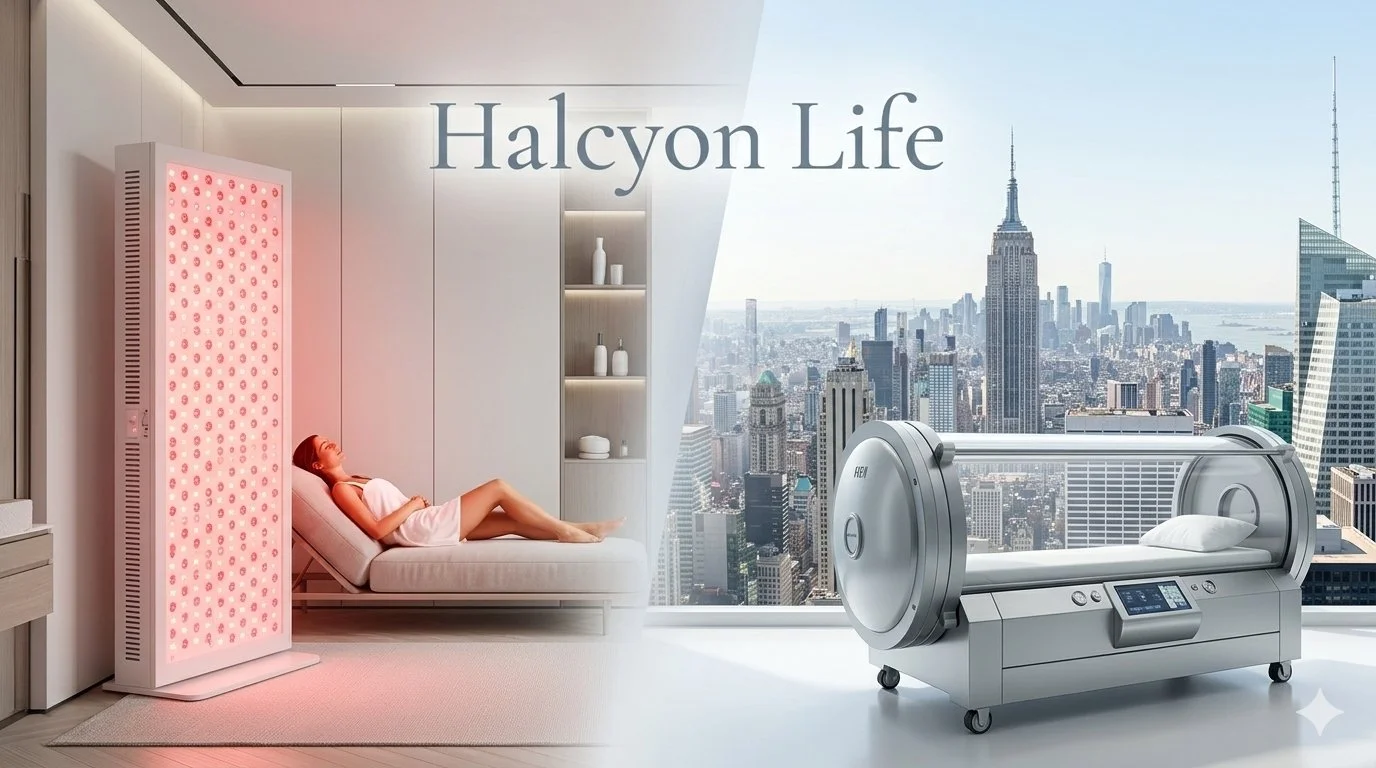
There is a red light panel in almost every gym in Manhattan now. There is one in the back of your physical therapist's office, one at the recovery studio in Williamsburg that charges forty dollars for twelve minutes, and quite possibly one leaning against your bedroom wall because a video convinced you at eleven at night.
Red light therapy went from obscure to unavoidable in about four years. And because the short version of how it works mentions mitochondria, and the short version of how hyperbaric oxygen therapy works also mentions mitochondria, a lot of people in New York now hold both in the same mental folder. Same category. Pick one. Probably interchangeable.
They are not interchangeable, and the reason is simple enough that nobody bothers to say it out loud. One of them has to get through your skin. The other does not.
That single difference explains almost everything else, including why one is reasonable to own and the other is not, and why the honest answer to "which should I do" is usually a question about what you are actually trying to reach.
Two Therapies That Got Filed Under the Same Idea
The reason the confusion happened is that both got marketed with the same sentence: this supports your mitochondria.
That sentence is not wrong about either of them. It is just so compressed that it stops being useful. It is like saying two restaurants both serve food. True, and it tells you nothing about whether you should walk forty blocks to one of them.
What matters is the route each one takes into the body, because the route determines the ceiling on what it can influence. If you want to judge this kind of claim yourself rather than taking anyone's word for it, the route is the first thing worth asking about.
What Light Actually Does Inside a Cell
Red light therapy, which researchers call photobiomodulation, uses red light roughly in the 600 to 700 nanometer range and near infrared light roughly in the 760 to 940 range. The leading explanation is that this light is absorbed by cytochrome c oxidase, an enzyme that sits at the end of the mitochondrial electron transport chain, the final step before your cells produce usable energy. Michael Hamblin, who has done more work on the mechanism than almost anyone, has described this as the primary chromophore, with light sensitive ion channels as a secondary target (Hamblin, Photochemistry and Photobiology, 2018, doi:10.1111/php.12864).
The proposed effect is that absorbed photons nudge that enzyme into working more efficiently, with downstream changes in cellular signaling. That is a real mechanism with real laboratory support behind it, and anyone dismissing red light as nonsense has not read the work.
The strongest human evidence sits where you would expect it to sit, which is skin. In a controlled trial of 136 volunteers, with 113 randomized across four light groups and 23 untreated controls, twice weekly sessions over thirty sessions produced measurable improvements in skin roughness, complexion, and ultrasound measured collagen density (Wunsch and Matuschka, Photomedicine and Laser Surgery, 2014, doi:10.1089/pho.2013.3616). The honest caveat is that the comparison group received nothing at all rather than a sham light, so expectation effects are not ruled out. Still, it remains the most cited controlled study in the field for good reason.
Skin is also exactly where the light is. Which brings us to the part that gets skipped.
The Part Nobody Mentions: Light Has to Get There
Light attenuates as it moves through tissue. It scatters and it gets absorbed. Red and near infrared sit in the window where tissue is most transparent, which is precisely why those wavelengths were chosen, and penetration peaks around 810 nanometers. But most transparent is a relative term. We are talking about millimeters to roughly a centimeter of meaningful dose depending on the wavelength, the tissue, and how much of you is in the way.
This is not a criticism. It is a specification. It tells you what red light is built for: skin, superficial tissue, the surface of a joint, scalp, anything close to where the photons land. For skin and collagen questions, which get discussed constantly in New York, that specification lines up well with the goal.
What it cannot do is reach a deep tendon, an organ, bone marrow, or the inside of your brain at any dose resembling what the skin receives. Transcranial research exists and is genuinely interesting, but it is early, and the physics of getting light through scalp and skull is the central obstacle, not a detail. When you see a claim that a panel in your living room is working on your brain fog, the thing to ask is how much light is arriving there, not whether light does anything to cells.
What a Pressurized Environment Does Differently
Hyperbaric Oxygen Therapy is a systemic modality that influences the human body on cellular and physiological level.
The route is the difference. Under pressure, breathing concentrated oxygen, a much larger quantity dissolves directly into blood plasma rather than riding on hemoglobin. Plasma goes everywhere blood goes. Behind swollen tissue. Into areas where circulation is poor. Through the body as a whole rather than to the surface facing the device.
There is no targeting involved and no depth limit to argue about. This is why the effects discussed with HBOT tend to be systemic ones: inflammatory signaling, tissue repair, nervous system regulation, recovery capacity. The exposure is not aimed at a body part. It changes conditions across the system.
The other half of the mechanism is the rhythm. Sessions include scheduled air breaks, which are periods of breathing ordinary air inside the pressurized chamber. Those breaks are not filler. The alternation between high and normal oxygen is part of what the body reads as a signal. One of the clearest examples comes from Stephen Thom's group at the University of Pennsylvania, where a single session at 2.0 ATA doubled circulating CD34 positive stem cells in human subjects, and twenty sessions raised them roughly eightfold, through a nitric oxide dependent pathway (Thom et al., American Journal of Physiology Heart and Circulatory Physiology, 2006, doi:10.1152/ajpheart.00888.2005).
That is a different kind of claim from a surface effect. It is the body responding to a repeated environmental pattern, not a tissue absorbing energy. Pressure matters here, which is also why the difference between a hard chamber and a soft one is not a technicality.
Where Each One Actually Earns Its Place
For skin, scalp, superficial soreness, and anything you can point to on the outside of your body, red light is a sensible and relatively inexpensive option with a plausible mechanism and decent evidence. It is low commitment and low risk, and owning a device is reasonable in a way that owning a hyperbaric chamber generally is not.
For whole body questions, red light runs into its ceiling. Deep tissue recovery, systemic inflammation, cognitive symptoms, post viral states, surgical healing, and training adaptation are not surface problems, and surface tools reach them indirectly at best.
The evidence for HBOT in that territory is stronger than most people assume. In a double blind sham controlled trial, master athletes aged forty to fifty who completed forty sessions showed improvements in maximal oxygen uptake and anaerobic threshold compared with sham, along with muscle biopsy evidence of greater mitochondrial respiration and mass (Hadanny et al., Sports Medicine Open, 2022, doi:10.1186/s40798-021-00403-w). Those results were measured afterward, breathing ordinary air, which is the point. Something had changed in the engine. The honest caveats apply: the sample was small, around thirty athletes completed it, and several authors have commercial hyperbaric ties. It needs replication. But it is a blinded trial measuring deep tissue outcomes, which is not something the red light literature has produced at that depth.
If you want the fuller picture on training specifically, we covered it in HBOT for marathon and endurance athlete recovery in NYC. For symptoms that sit in the nervous system rather than in a muscle, HBOT for brain fog in NYC covers that ground.
The Money Side
This is where New York makes the comparison unusually clear.
A decent home red light panel runs somewhere between two hundred and two thousand dollars as a one time purchase. Studio sessions in Manhattan and Brooklyn generally land between thirty and eighty dollars. The per exposure economics are mild, which is a genuine advantage, and it also means a panel that does very little is easy to keep using without noticing.
Private hyperbaric sessions in New York City generally run between four hundred and six hundred dollars, and a meaningful course is measured in sessions rather than visits. That is real money, and nobody should pretend otherwise.
The useful comparison is not price against price. It is price against what you are actually buying. Spending a thousand dollars on a panel to address fatigue that originates in systemic inflammation is not a bargain, it is a thousand dollars aimed at the wrong depth. Spending several thousand on a hyperbaric course to soften fine lines, when thirty red light sessions have controlled evidence for exactly that, is also a poor use of money.
The expensive mistake in this city is rarely picking the wrong price point. It is paying for a tool that cannot physically reach the thing you are trying to change, then concluding that nothing works.
Using Both Without Overcomplicating Your Week
They are not competitors. They occupy different depths, and there is no mechanistic reason to avoid using both.
The practical advice is boring on purpose. Keep red light where red light belongs, which is skin and surface, and run it consistently rather than intensely. Handle systemic work as a separate question with its own reasoning, and approach it in a pace matched to your biology rather than to a package someone is selling. We walked through the same logic with heat and cold in how HBOT fits into a real recovery stack, and the principle holds here.
What New York makes difficult is not access. It is restraint. There is a version of this where you accumulate six modalities, track none of them properly, and cannot tell which one did anything. Fewer inputs, understood clearly, applied long enough to read a result. That is still the strategy.
The goal was never to own more equipment. It was to stop feeling like your body is working against you, and to get enough clarity about what each thing does that you can stop guessing.
Frequently Asked Questions
-
No. Red light therapy delivers light to the surface of the body, where it is absorbed within roughly millimeters to a centimeter of tissue. Hyperbaric oxygen therapy changes the pressure and oxygen content of the air you breathe, which affects the whole body through the bloodstream. Different routes, different reach.
-
Research on transcranial light is ongoing and some of it is promising, but getting a meaningful dose of light through scalp and skull is a real physical obstacle. If cognitive symptoms are the main concern, it is worth looking at approaches that act systemically rather than from the surface.
-
Red light has the more direct evidence here, including a controlled trial measuring increased collagen density after thirty sessions. Skin is where the light actually arrives, so this is the one place the comparison is not close.
-
No. They work at different depths and can be used together. The more useful question is what you are trying to change, then matching the tool to the depth of the problem.
-
For skin and surface use, it can be reasonable, especially since consistency matters more than intensity. Be aware that many consumer devices deliver a far lower dose per session than the devices used in published studies.
-
Most of the research showing systemic change uses courses measured in the dozens of sessions rather than a handful. Single sessions are not where the evidence sits. Pacing should be individualized, not standardized.
-
Halcyon Life provides hyperbaric oxygen therapy in New York City in a hard chamber with scheduled air breaks built into every session. We will tell you honestly when something else is a better match for what you are dealing with, including when a cheaper option is the right one.