Reading the Research, Part 4: What the Trials Really Show About Hyperbaric Oxygen for Sudden Hearing Loss
It usually starts quietly. You wake up and one ear sounds like it is underwater. Maybe there is ringing, maybe a feeling of fullness, maybe the whole room just sounds lopsided. Most people in New York do what busy people do. They assume it is wax, a cold, or the subway, and they give it a few days. Then they start searching. "Sudden hearing loss in one ear." "Hyperbaric chamber for hearing loss." And they land in a mess of hospital pages, clinic ads, and forum threads that all say something different.
This is Part 4 of our Reading the Research series, where we take one question about Hyperbaric Oxygen Therapy and walk through the actual studies, the strong parts and the weak parts. Earlier in the series we covered how to read a hyperbaric oxygen study for yourself, what 40 years of trials show for multiple sclerosis, and why concussion trials on HBOT disagree with each other. This time the stakes feel more urgent, because with sudden hearing loss, the clock matters more than almost anything else.
If you are in the first days of sudden hearing loss right now, read our practical guide, Sudden Hearing Loss in One Ear: Why the First Two Weeks Decide Everything, and get to an ear, nose and throat specialist today. This post is the evidence behind that guide.
First, What Sudden Hearing Loss Actually Is
The medical name is sudden sensorineural hearing loss. "Sensorineural" means the problem sits in the inner ear or the hearing nerve, not in a blocked ear canal. Specialists usually define it as a meaningful drop in hearing across several neighboring pitches that develops within about three days. Most cases are called idiopathic, which is the polite medical word for "we do not know exactly why."
It is not rare. The American Academy of Otolaryngology estimates between 5 and 27 new cases per 100,000 people every year, roughly 66,000 people a year in the United States. In a city of more than eight million, that is a steady stream of people waking up to the same frightening silence.
Part of what makes this condition confusing is that some people recover partly on their own. That is real, and it is also the reason every serious study needs a comparison group. Without one, you cannot tell whether an approach helped or whether the ear was going to come back anyway. Keep that in mind as we go through the evidence, because it is exactly the question good trials are built to answer.
Why the Inner Ear Is So Fragile
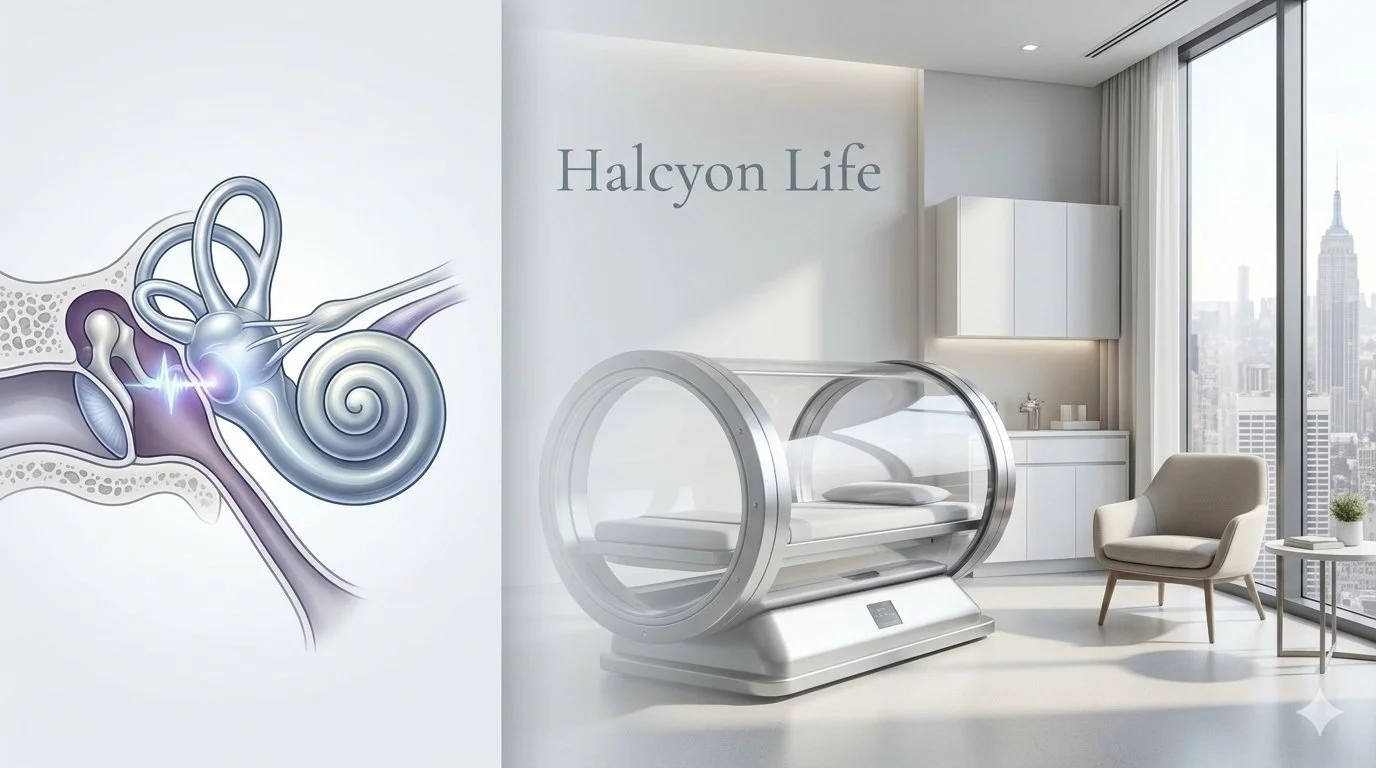
The cochlea, the snail shaped organ that turns sound into nerve signals, is one of the most energy hungry tissues in the body. Its sensory hair cells and the cells supporting them run constant chemical pumping just to stay ready. And they are fed by a very small artery with almost no backup route. When that supply is disrupted, whether by swelling, inflammation, a tiny clot, or a viral hit, the tissue runs short fast.
Here is the part that shapes everything else. Human hair cells do not grow back. But after a sudden injury, not every cell is gone. Some are lost, and some are stunned, struggling, and still salvageable if their environment improves in time. That stunned but recoverable zone is the whole story of sudden hearing loss care, and it is why timing keeps showing up in the research.
This is where hyperbaric oxygen enters the picture. Hyperbaric Oxygen Therapy is a systemic modality that influences the human body on cellular and physiological level. Inside a pressurized environment, concentrated oxygen dissolves into the liquid part of the blood far beyond normal levels, so it can reach tissue that struggling circulation cannot. The more interesting effects are downstream of that: calmer inflammatory signaling, less swelling around fragile structures, and support for the energy machinery of cells that are deciding whether to recover. None of that brings back cells that are already lost. It may help create better internal conditions for the ones still hanging on.
What the Studies Show
Three bodies of evidence matter most here.
The first is the Cochrane review by Bennett and colleagues, the most conservative type of evidence summary in medicine. It pooled seven randomized trials with 392 people. For recent sudden hearing loss, people who received hyperbaric oxygen gained about 15.6 decibels more hearing on average than those who did not, and they were more likely to reach at least a 25 percent improvement. The reviewers estimated that for every five people who received it, one more had a meaningful improvement. They were also clear that the trials were small and poorly reported, and that they found no benefit for long standing hearing loss or for tinnitus alone.
The second is a 2018 meta-analysis in JAMA Otolaryngology by Rhee and colleagues. It pulled together 19 studies and more than 2,400 patients. Adding hyperbaric oxygen to standard medical care raised the odds of complete hearing recovery by about 61 percent and the odds of any recovery by about 43 percent. The benefit looked larger in people with severe or profound loss, when HBOT was used as a second line approach after steroids alone had not worked, and when people completed more total time in the chamber.
The third is a 2022 meta-analysis, also in JAMA Otolaryngology, by Joshua and colleagues. It was stricter and included only three randomized trials with 150 patients. People who added hyperbaric oxygen to steroids gained about 10 decibels more than steroids alone, and 74.7 percent recovered meaningful hearing compared with 60.8 percent in the comparison groups. Every one of those trials started hyperbaric oxygen within 7 to 10 days of the hearing loss, and the authors concluded the benefit applies when it begins within that window.
Professional bodies have moved in the same direction. The 2019 clinical practice guideline from the American Academy of Otolaryngology Head and Neck Surgery says specialists may offer hyperbaric oxygen combined with steroids within two weeks of onset, or as a second line option within one month. Sudden hearing loss was also the most recent condition added to the Undersea and Hyperbaric Medical Society's list of approved uses, and it now appears on the FDA's list of conditions for which hyperbaric chambers are cleared.
What the Research Does Not Tell You
This is the part most clinic websites skip, and it matters.
The trials are small. Many were not blinded. Pressures, session counts, and schedules vary from study to study. And in nearly every trial, hyperbaric oxygen was added to steroids, not used instead of them. So the honest reading is that HBOT is an add-on to standard care, not a replacement for it. That is not a weakness. It is an accurate description of where it fits.
The studies also measure decibels, and decibels are not the same thing as your life. A 10 decibel difference can be the gap between following a dinner conversation in a loud Manhattan restaurant and nodding along while guessing. Research rarely measures that, but people feel it every day.
One more detail worth knowing. The trials behind these numbers were run in hard chambers at clinical pressures. If you are comparing options, it is worth understanding the difference between hard and soft chambers before you commit.
What We See in Our Chamber
Research tells you what happens across hundreds of people. A practice tells you what happens in the room. Here is what our owner Jacob and our team have learned from working with sudden hearing loss in our Midtown chamber. This is lived experience, not proof, and every ear is different.
The first ten days are the window we care about most. People who begin a consistent, rigorous schedule early tend to have a better chance than people who arrive in week three or four after trying everything else first. That matches the research almost exactly, which is why we handle every new sudden hearing loss inquiry with real urgency and fit people in as fast as we can.
Recovery does not end when the hearing comes back. Our standing advice is to avoid flights, scuba diving, and anything physically strenuous for the following months, even if your hearing feels normal again. The inner ear that just recovered is still healing, and sharp pressure swings or heavy straining put stress right where you least want it. This is our conservative practice guidance rather than a trial result, and we would rather be careful with an ear that just came back.
Insurance is still the most frustrating part. Even though sudden hearing loss is one of the most recently recognized uses for hyperbaric oxygen, approval through insurance remains surprisingly difficult for many patients. There is no national Medicare coverage decision for it, and state level decisions are only recent. Washington State's health technology committee voted to cover it with conditions in 2025. Because covered care matters, we regularly recommend that people try in-network hospital programs first. Many of them end up coming back to us anyway, and the days spent waiting in between are days the inner ear does not get back.
The Real Cost Math
It helps to put the money side in plain numbers. Prescription hearing aids bought privately average about $3,400 a pair according to HearingTracker's consumer survey, and people typically replace them every five or six years. Even then, a hearing aid amplifies sound. It does not restore what was lost, and for severe loss in one ear, a standard aid often helps less than people expect.
Compare that with a focused course of sessions inside the window that research says matters most. We keep our pricing visible because we think you deserve to see it before you call, and you can read what hyperbaric oxygen therapy costs in New York City and what drives the price. Many of our clients also use HSA or FSA funds. Weighing a short term expense against decades of living with one quieter ear is not a hard calculation for most people. The hard part is making it fast enough.
If This Is Happening to You Right Now
Keep it simple. See an ear, nose and throat specialist the same day you notice the change, because steroids also work best early. Ask directly whether hyperbaric oxygen makes sense for you and how quickly you can start. If you are told to wait for insurance approval, ask how long that will take and whether that timeline fits inside the window. And once your hearing returns, protect it for a while.
Sudden hearing loss is frightening because it happens without warning and it asks you to make decisions fast, in a city that rarely gives you time to think. You do not have to understand every study to make a good call. You only need to know that the window is real, that the evidence supports acting inside it, and that hearing your people clearly at the dinner table is worth moving quickly for. That is what getting your life back sounds like.
Frequently Asked Questions
-
Research suggests hyperbaric oxygen added to steroids may improve hearing recovery in recent sudden sensorineural hearing loss. Major ear specialist guidelines list it as an option within the first two weeks, or within a month as a second line approach.
-
As early as possible. The strongest trials started within 7 to 10 days of onset, and in our experience the first ten days are the most important window.
-
No. In the research, hyperbaric oxygen was added to steroids, not used instead of them. Think of the two as working together.
-
Guidelines still list hyperbaric oxygen as an option within one month of onset, especially when steroids alone have not helped. Beyond several months, the evidence is much weaker.
-
We recommend avoiding flights, diving, and strenuous activity for the following months, even if your hearing returns, because the inner ear is still healing.
-
Coverage varies widely and approval is often slow. Many of our clients use HSA or FSA funds, and we are happy to talk through options before you start.
-
Halcyon Life offers hyperbaric oxygen therapy in a hard chamber at 347 5th Avenue in Midtown Manhattan. Call or text 212 355 0810 and tell us when your hearing changed so we can prioritize your start.