Hyperbaric Oxygen and Multiple Sclerosis: What 40 Years of Trials Actually Show
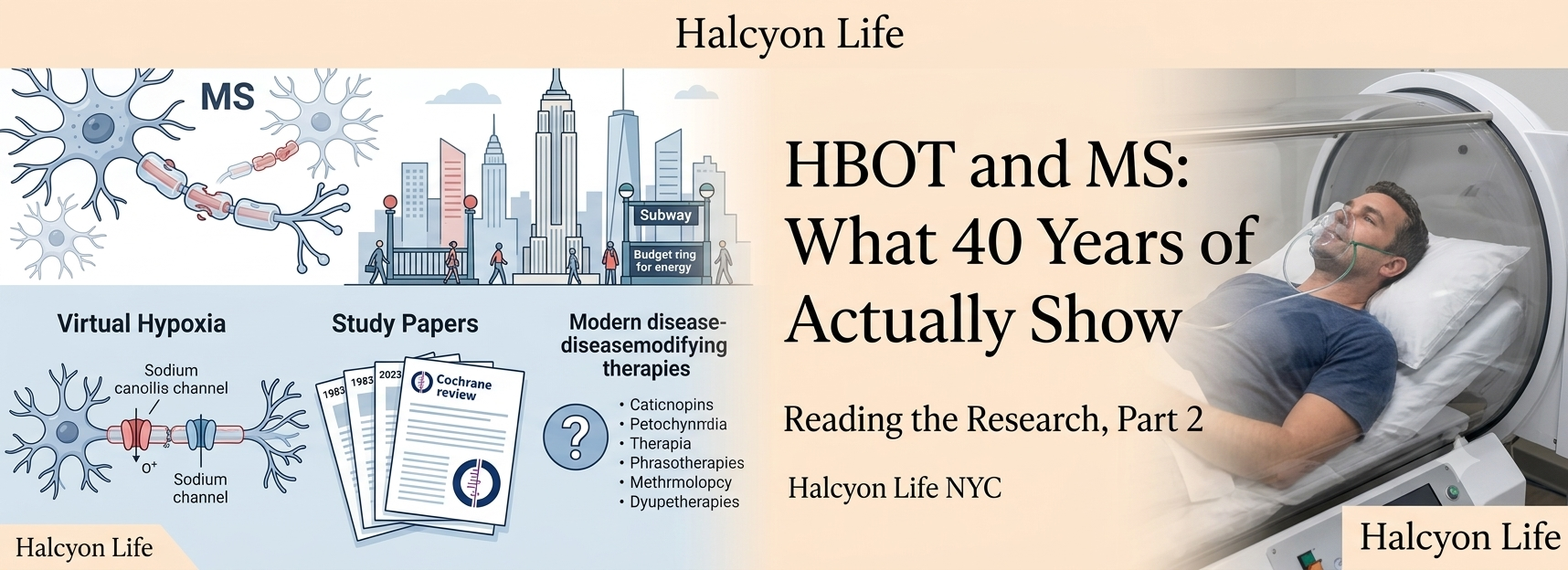
If you live with multiple sclerosis in New York, you already know the particular exhaustion of this city. Not the ordinary tired of a long week. The kind where the walk from the subway to the office gets budgeted like money, where heat on a crowded platform can make a leg go unreliable, and where every plan comes with a quiet calculation about whether today will be a good day.
At some point, usually late at night, a lot of people with MS type the same phrase into a search bar: hyperbaric treatment for MS. What comes back is two separate internets. One says hyperbaric oxygen has helped people with MS for decades and points to charity-run chambers in Britain that have operated since the 1980s. The other says a Cochrane review settled the question years ago, and the answer was no. Both sound certain. Neither explains why the other exists.
This is the second post in our series on reading hyperbaric research for yourself. In the first, we walked through how to read a hyperbaric oxygen study using two long COVID trials that reached opposite conclusions. MS is the older, messier version of the same story, and it started a short walk from where many of our clients work.
The Trial That Started It Ran in Manhattan
In 1983, the New England Journal of Medicine published a randomized, double-blind, placebo-controlled trial from New York University Medical Center. Boguslav Fischer and colleagues enrolled 40 people with advanced chronic MS and divided them into matched groups. One group breathed pure oxygen at 2 atmospheres absolute for 90 minutes a day, 20 sessions in total. The comparison group sat in the same chamber at the same pressure, breathing a mix of 10 percent oxygen and 90 percent nitrogen.
That comparison gas deserves a second look, because it was clever. At 2 atmospheres, a 10 percent oxygen mix delivers roughly what you breathe at sea level. The control group experienced the pressure, the noise, the ritual, and the hours in the chamber, without the extra oxygen. That is about as honest a sham as hyperbaric research gets.
The results: objective improvement in 12 of 17 people who breathed oxygen, compared with 1 of 20 on placebo. In seven of those twelve the improvement faded, and in five it lasted. At one year, disability had worsened in 12 percent of the oxygen group and 55 percent of the placebo group. The trial was funded by the National Multiple Sclerosis Society, not by anyone selling chambers.
Then the authors did something that rarely makes it into marketing. They called their findings preliminary, described the effect as transient, and wrote that the therapy could not be generally recommended without longer follow-up and confirmation. Anyone quoting the 12 of 17 figure without that sentence is quoting half the paper.
Then Came the Replications
The Fischer trial set off a wave of studies in the UK, the United States, and Europe through the rest of the 1980s. In 2004, Michael Bennett and Robert Heard pooled the controlled trials for the Cochrane Library. They found nine trials with 504 participants. Two were generally positive. Seven found generally no effect.
There was one striking number inside that review. At 12 months, average disability scores were about 0.85 points better in the oxygen groups than in the sham groups, a statistically strong result. But only the two positive trials reported that outcome at that time point, and together they covered 16 percent of all participants. The reviewers concluded there was no consistent evidence of benefit and that routine use was not justified. The Undersea and Hyperbaric Medical Society, the main professional body in the field, does not list MS among its accepted indications.
That is the honest headline, and we are not going to soften it. The controlled evidence does not show that a course of hyperbaric sessions changes the course of MS.
But a headline is not the whole paper. Apply the questions from the first post in this series, and the MS literature turns out to be answering a narrower question than most people assume.
Four Things the MS Trials Did Not Test
They tested one dose, over and over. Nearly every trial in the Cochrane review used the same design: 20 sessions over four weeks, most at 2.0 atmospheres for 90 minutes. Meanwhile, a 2020 paper in Multiple Sclerosis and Related Disorders reported that most people using the UK therapy centres breathe oxygen at around 1.5 atmospheres for an hour, on ongoing individualized schedules. The literature answered whether one intensive four-week block changes disability a year later. It never tested the pattern people with MS actually use.
They measured with a blunt instrument. The main outcome was the Expanded Disability Status Scale, a score heavily weighted toward walking. It is a reasonable way to track progression. It is a poor way to detect whether fatigue lifted, whether thinking felt clearer, or whether someone got back two usable afternoons a week. The same 2020 paper noted that conventional disability scores seldom reflect the effects people with MS report.
They mixed very different people together. In the Fischer trial, people with less severe disease appeared to respond more. The trials that followed did not stratify participants by severity, age, sex, or exposure regime, which makes them hard to compare. Someone who has used a wheelchair for a decade and someone diagnosed two years ago are not asking the same biological question.
They all happened before modern MS care existed. These trials ran in the 1980s. The first disease-modifying drugs for MS reached the US market in the early 1990s, and neurologists now choose among more than 20. An early appraisal of the trials pointed out that none had tested hyperbaric oxygen against current best practice. Nobody has run a controlled trial asking whether hyperbaric sessions add anything for a person already on a modern disease-modifying therapy. That question is simply open.
The Other Side Gets the Same Scrutiny
The enthusiast side has evidence too, and it deserves the same questions.
In 2005, David Perrins and Philip James published a study following 703 people who had used the MS National Therapy Centres in the UK and Ireland, a network of charity-run chambers. Among 117 people who attended regularly and without interruption for 5 to 15 years, disability scores had not risen by more than one point. Across the network, more than 25,000 people with MS have used these centres over roughly three decades.
That may reflect something real. It is also exactly the kind of result our first post in this series taught you to question. There was no control group. The 117 were the people who kept coming back, which filters for people who felt it helped, or whose disease happened to be progressing slowly anyway. The first author was affiliated with the centres delivering the sessions. None of that makes the finding false. It means the study cannot separate whether oxygen slowed anyone's MS from whether people with slower MS were the ones who stayed.
The fair summary: the negative trials answered a narrow question clearly, and the positive observational data asked a broad question loosely. Neither settles what most people with MS in 2026 actually want to know.
Why the Biology Keeps Researchers Interested
Researchers have not walked away, and the reason is mechanism rather than hope.
A demyelinated nerve fiber has to work much harder to carry a signal. When myelin is lost, sodium channels spread along the exposed axon, and the pumps that restore balance after each impulse burn far more energy. In 2009, Bruce Trapp and Peter Stys described the result in The Lancet Neurology as virtual hypoxia: an axon whose energy demand has outrun its mitochondria's ability to supply it, even when blood flow is normal. Chronic inflammation drags mitochondrial output down further. Over years, that energy gap is thought to contribute to the axon loss behind lasting disability.
That picture also maps onto how MS fatigue feels from the inside. Not sleepiness. A nervous system running a deficit.
Hyperbaric Oxygen Therapy is a systemic modality that influences the human body on cellular and physiological level. A session raises dissolved oxygen in plasma, and the cycle of pressurized oxygen and scheduled air breaks acts as a signal the body adapts to, reaching inflammatory signaling and mitochondrial behavior along the way. The 2020 lab work above found that oxygen exposure modeled on real MS centre use reduced an adhesion molecule that helps inflammatory cells cross into the brain. That was in cells, not people. We go deeper on the energy side in our piece on HBOT and mitochondrial dysfunction, and on the immune side in does HBOT help with inflammation. For someone with MS, the question is whether that signal may support the energy budget and inflammatory balance of a strained nervous system. That is plausible. It is not proven. Outcomes vary.
Where This Leaves Someone With MS in New York
If you are considering hyperbaric oxygen therapy in NYC for MS, here is how we would think about it.
It belongs alongside your neurologist's plan, never in place of it. Disease-modifying therapy carries the strongest evidence in MS for reducing relapses and new lesions, and nothing in the hyperbaric literature challenges that.
The reasonable goal is quality of life rather than disease modification: fatigue, energy stability, clarity, the number of days that feel usable. Those are the outcomes the old trials were least equipped to see, and the ones you can observe yourself.
Pressure and chamber type matter, because they change the input your body receives. Our explainer on hard chamber vs soft chamber HBOT covers why. Protocols should be aligned to the person's biology, including heat tolerance and fatigue patterns, rather than forcing everyone into one schedule. For the wider autoimmune picture, see our piece on HBOT and autoimmune disease in New York, and our multiple sclerosis page covers how we approach MS specifically.
And be skeptical of anyone who tells you a hyperbaric chamber stops MS. Forty years of research does not support that claim.
The Cost Question, Stated Plainly
MS is one of the most expensive chronic conditions in the country. Nearly a million American adults live with it by the best recent estimate, and a 2021 review found the median annual price of MS disease-modifying drugs was $91,835 in 2020, with several above $100,000.
Hyperbaric sessions are not competing with that spending and should never be framed as a cheaper substitute for it. The real financial question is smaller and more personal: is a defined trial period worth it, judged against measures you set in advance? Track fatigue on a simple scale, how far you walk before you need to stop, and how many afternoons you can actually use. If those move, you have your answer. If they do not, you have spared yourself an open-ended expense. Our guide to what hyperbaric oxygen therapy costs in New York City lays out the market so you can compare honestly.
The point of reading the research this closely is not to talk you out of anything. It is so you can decide from clarity rather than from whichever internet you landed on first. Living with MS in this city already asks a lot of you. What you are after is more days that feel like your own.
FAQs
-
The controlled trials do not show that it changes the course of the disease. Some people report better energy and fewer bad days, and the trials were not designed to measure those outcomes well. It is best viewed as possible support for quality of life, alongside standard care.
-
It pooled nine trials with 504 participants. Two were generally positive and seven showed no consistent effect, so the reviewers concluded routine use was not justified.
-
Many people are curious about exactly that combination, and no controlled trial has studied it yet. Talk it through with your neurologist, and share your full medication list during intake so sessions can be planned around it.
-
They were founded by people with MS after the early positive trials, and tens of thousands of members have used them. Their long-term data is encouraging but uncontrolled, so it cannot prove the chambers are the reason for the results.
-
Most controlled trials used about 2.0 atmospheres for 90 minutes. UK centres commonly use lower pressure for shorter sessions. The two approaches have never been compared head to head.
-
No. Soft chambers operate at much lower pressure than the chambers used in MS research, so they produce a different physiological input.
-
Halcyon Life offers hard chamber sessions in Manhattan, with an intake conversation first so pacing fits your energy, heat tolerance, and current care.