Your concussion was two years ago. Maybe it was a fall on an icy subway stair, a collision in a rec league game, or a car door swinging open into a Brooklyn bike lane. The scan at the ER was normal. Everyone agreed you were lucky.
And yet. Words arrive half a second late. Bright offices give you a headache by 3 p.m. You reread the same email four times. You get through the workday and have nothing left for the evening. When you try to explain it, people tell you that you seem fine.
So one night you search "hyperbaric oxygen for concussion" and find two headlines that cannot both be true. One says a military trial found hyperbaric oxygen no better than placebo. The other says a randomized trial found it improved brain function years after injury.
Both headlines describe real, published, peer-reviewed research. This is Part 3 of our Reading the Research series, and it is about how that happens and what it means for you. If you are new to the series, start with Part 1, how to read a hyperbaric oxygen study for yourself.
The Short Answer
The trials that found "no difference" compared HBOT against a placebo that was not actually inactive. People in both groups got better, by similar amounts. The trials that found a clear benefit used more truly inactive comparisons, but they were smaller and carry their own weaknesses.
The honest read: many people with lingering post-concussion symptoms improve meaningfully in a hyperbaric chamber. What science is still sorting out is how much of that comes from oxygen, how much from pressure, and how much from the experience itself.
That is very different from "it doesn't work."
Why a Concussion Is So Hard to Study
A concussion is not a bruise on the brain that heals on a schedule. It is a disruption in how the brain runs.
At the cellular level, the impact stretches nerve fibers and throws brain chemistry out of balance. Neurons suddenly need far more energy to restore order, at the exact moment their mitochondria, the power plants inside each cell, are struggling. Small blood vessels can stop regulating flow properly. Immune cells in the brain switch on and, in some people, never fully switch back off.
At the system level, that looks like a brain running a constant energy deficit with a low hum of inflammation underneath. Some regions are not destroyed. They are dormant: alive, underpowered, and waiting for better conditions.
At the level of lived experience, it looks like fog, fatigue, light sensitivity, poor sleep, irritability, and a shorter fuse. That is exactly why it is hard to study. Most of those symptoms are measured with questionnaires, and questionnaires are sensitive to hope, attention, and expectation. Any trial in this area lives or dies on the quality of its placebo.
Where HBOT Fits in That Picture
Hyperbaric Oxygen Therapy is a systemic modality that influences the human body on cellular and physiological level.
Inside a pressurized environment, concentrated oxygen dissolves into the blood plasma at levels ordinary breathing cannot reach. The interesting part is what the body does in response. The repeated cycle of pressure, concentrated oxygen, and short air breaks acts as a signal, and the body adapts to signals. Research on that adaptation points to neuroplasticity, the growth of new small blood vessels, calmer inflammatory signaling, and changes in how mitochondria behave.
For a brain stuck in a dormant, underpowered state, those are the conditions that matter. We cover the lived side of this in HBOT for concussion and traumatic brain injury in NYC. Here, we stay with the evidence.
The Military Trials: Everyone Got Better
Between 2012 and 2018, the U.S. military funded several careful, double-blind trials in service members with persistent symptoms after mild brain injury.
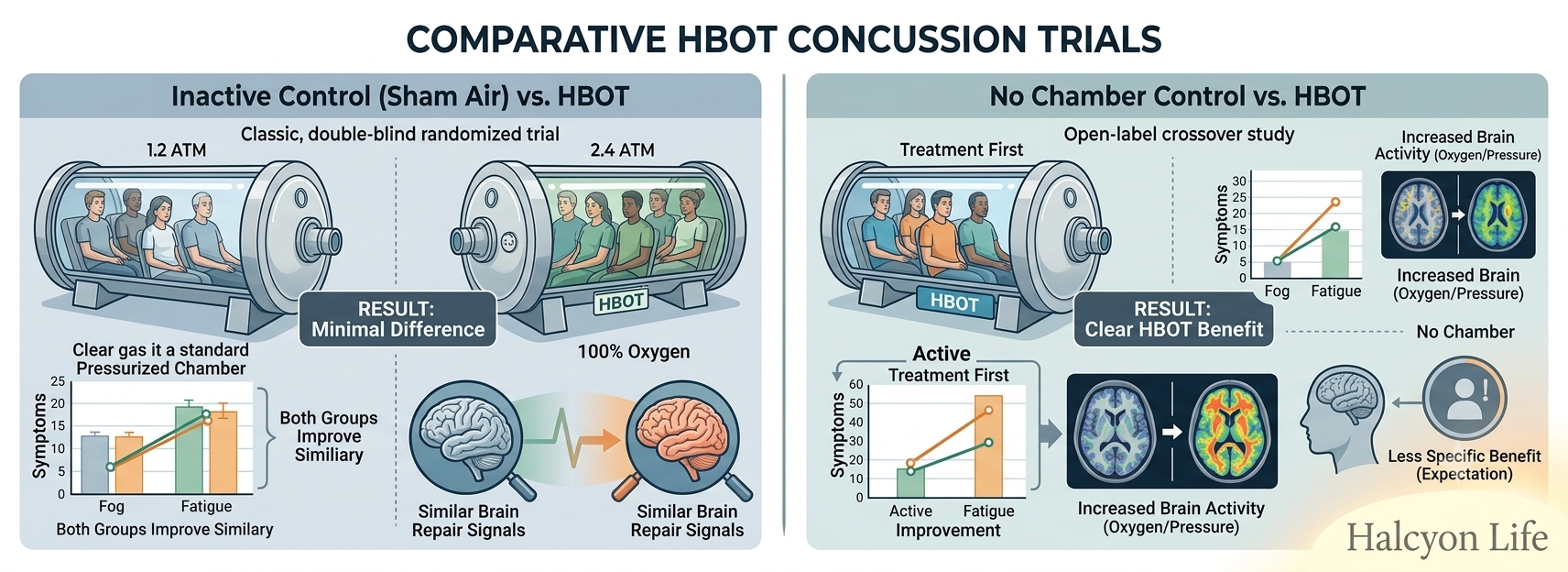
The first, from the Air Force, compared 30 sessions at 2.4 atmospheres of pure oxygen against a placebo of room air at 1.3 atmospheres in 50 service members. Both groups improved on symptom and cognitive testing, and the difference between them was not significant.
The HOPPS trial, published in JAMA Internal Medicine in 2015, randomized 72 service members into three groups: 40 sessions of oxygen at 1.5 atmospheres, 40 placebo sessions of air at 1.2 atmospheres, or usual care with no chamber at all. The two chamber groups improved by similar amounts, and both did better than the group that never entered a chamber. The authors concluded the benefit was likely a placebo effect.
The BIMA trial, published in 2018, used the same oxygen and placebo doses in 71 service members and measured far more: symptoms, cognition, sleep, balance, and brain imaging among them. This time the oxygen group came out ahead at 13 weeks on post-concussion symptoms, PTSD symptoms, processing speed, sleep quality, and balance. The gains were largest in people who also had PTSD, an overlap we explore in how HBOT may support the work therapy is trying to do.
That third result gets far less airtime than the first two.
The Problem With the Placebo
Here is the detail that changes everything. In these trials, the placebo group sat in a chamber pressurized to 1.2 or 1.3 atmospheres while breathing air.
That is not nothing. Breathing air at 1.2 atmospheres delivers roughly the oxygen you would get breathing 25 percent oxygen at sea level, compared with the normal 21 percent. Pressure itself is also a change the body registers.
Dr. Paul Harch, a long-time HBOT researcher, argued in the same journal that published the Air Force trial that it had compared two doses of hyperbaric therapy, not a therapy and a placebo. His later systematic review concluded that sessions at 1.5 atmospheres of oxygen produced significant improvements across multiple randomized trials. Worth knowing: Harch practices hyperbaric medicine, so he is not a neutral party.
That leaves two honest explanations for why both groups improved:
The ritual explanation. Lying in a chamber, being cared for daily, and expecting to improve produces real symptom relief, and the oxygen added little.
The low-dose explanation. Mild pressure with slightly more oxygen is itself biologically active, so the trials compared a smaller dose with a larger one.
The military trials cannot tell these apart, and both may be partly true. What they do not show is that HBOT has no effect. They show that a chamber with mild pressure and a chamber with more pressure and oxygen produced similar gains on questionnaires.
The Israeli Trials: Clear Gains, Different Weaknesses
The other headline comes from the Sagol Center in Israel.
In 2013, Boussi-Gross and colleagues randomized 56 people who were one to five years past a mild brain injury. One group started 40 sessions at 1.5 atmospheres of oxygen right away. The other waited with no chamber, then crossed over to the same course. After their sessions, participants improved on cognitive testing, symptoms, and quality of life, and SPECT brain scans showed increased activity consistent with those gains.
The strength: the gains appeared years after injury, when spontaneous recovery is unlikely. The weakness: the comparison group got no chamber at all, so the ritual explanation cannot be ruled out. The authors acknowledged that limitation themselves.
In 2022, the same group ran a placebo-controlled trial in children aged 8 to 15 with lingering symptoms. The placebo group breathed ordinary air without meaningful added pressure, a far more inactive comparison than the military trials used. After 60 sessions, the oxygen group showed significant improvements in memory, executive function, emotional symptoms, and behavior.
The weaknesses are real. Only 25 children were enrolled, and recruitment stopped early because many parents would not accept the chance of placebo. The lead researchers are also affiliated with a commercial HBOT clinic network. Small, early-stopped, industry-connected trials deserve caution, even when the design is good.
How the Field Is Correcting Itself
Good science corrects its own blind spots, and that is happening here. Newer registered trials use placebos designed to remove the dosing problem. One briefly pressurizes the placebo chamber so it sounds and feels real, then quietly returns it to normal pressure for the rest of the session. Another pressurizes both groups fully but gives the placebo group a gas mixture with less oxygen, so its oxygen exposure matches ordinary air.
Those designs can finally separate pressure, oxygen, and ritual. Until they report, the fair summary is that the signal is real and the size of the oxygen effect is still being measured. For a closer look at why pressure matters at all, see our comparison of hard chamber vs soft chamber HBOT.
What This Means If You Are Considering HBOT in NYC
You do not need to become a researcher. You need a few sharp questions.
What pressure and what gas? Most positive concussion trials used 1.5 atmospheres while breathing concentrated oxygen. If a provider quotes a study, ask whether their sessions resemble it.
How many sessions did the research use? The trials above used 30 to 60. Judging results after a handful of sessions is judging a book by its first chapter.
How will we know if it is working? Agree on what you will track before you start, such as sleep, headaches, and the hour of the day your brain gives out.
There is also something no trial captures well: the individual. Olympic champion wrestler Helen Maroulis has spoken publicly about using HBOT with us after multiple brain injuries from her sport. Her experience is not proof of anything. It is a reminder that averages describe groups, and you are one person. If your history involves contact sports, our piece on post-concussion syndrome in athletes speaks to that situation directly.
The Real Cost Question
Lingering post-concussion symptoms are expensive in ways that never show up on a single receipt. Specialist visits that end with "give it time." Months of reduced output at a job that pays for your output. Evenings lost to exhaustion. In New York, where rent does not pause while your brain recovers, two years of operating at 70 percent is a serious financial event.
Against that, a focused course of HBOT is a defined cost with a defined endpoint and a clear way to judge whether it is helping. The expensive mistake is not choosing HBOT. It is buying a dose that does not resemble the evidence, or stopping long before the point where the research measured results. Our breakdown of what hyperbaric oxygen therapy costs in New York City explains what drives the price and what you should expect for it.
Where This Leaves You
The research on hyperbaric oxygen for concussion is not a story of failure. It is a story of a hard-to-measure injury, an imperfect placebo, and a field slowly learning to ask better questions.
What it says for you is simple. Your symptoms are real even when your scan is normal. There is a credible and growing body of evidence that the brain can still change years after an injury. And you are allowed to approach your recovery with clear eyes, good questions, and patience for a process that does not happen in a week.
The goal was never the chamber. It is getting back the clear, steady mind that runs your life, and feeling like yourself again.
FAQs
-
Many people with lingering post-concussion symptoms improve with HBOT, and several randomized trials found meaningful gains in memory, attention, and symptoms. Some military trials saw similar gains in their placebo groups, so the exact size of the oxygen effect is still being studied. Outcomes vary.
-
Their placebo groups sat in mildly pressurized chambers breathing air, which may itself be biologically active. Both groups improved, so the comparison could not show a clear difference.
-
Not necessarily. The 2013 Israeli trial enrolled people one to five years after injury, and the 2022 pediatric trial enrolled children up to ten years after injury. Both found improvements.
-
Most used between 30 and 60 sessions, with results measured after the full course rather than after the first few sessions.
-
Most positive trials used 1.5 atmospheres while breathing concentrated oxygen in a hard chamber.
-
In the 2018 BIMA trial, people with both a brain injury and PTSD showed the largest improvements. HBOT may support the brain's capacity to change, which can complement the work done in therapy.
-
Halcyon Life offers hyperbaric oxygen therapy in a hard chamber in Midtown Manhattan, with individualized pacing built around your history and goals. A free consultation is the best place to start.