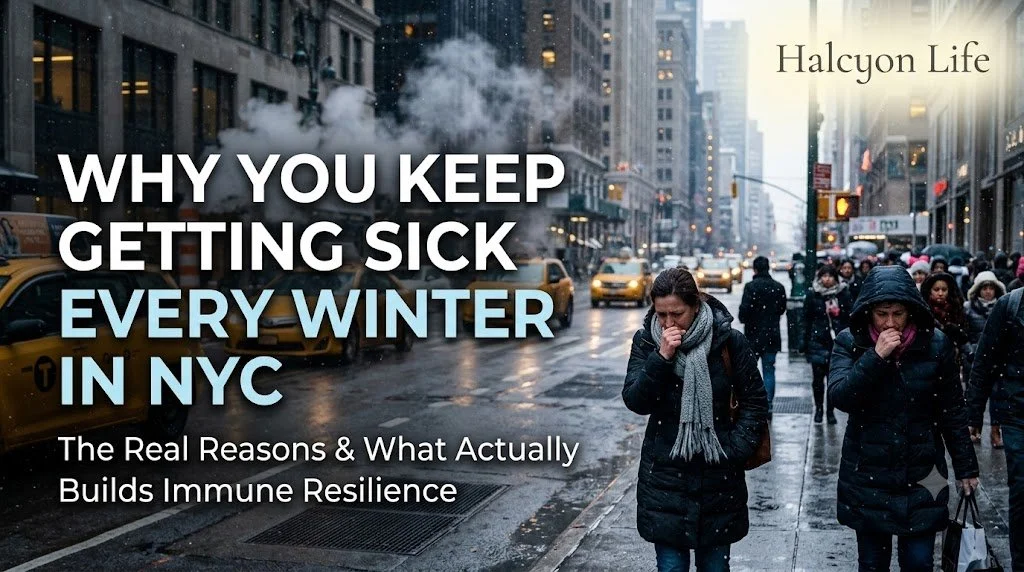
It starts the same way every year. The first cold snap arrives in October. The radiator in your apartment comes on with a bang and stays on whether you want it or not. The subway fills with heavy coats and dry coughs. By Halloween you have your first cold. By Thanksgiving, your second. Somewhere in January you notice you have had the same cough for three weeks.
Meanwhile the coworker who sits next to you seems untouchable, and you start to wonder whether your immune system is simply weak.
It almost certainly is not. For most people, getting sick more often in winter is not a sign of a weak immune system. It is a sign of a capable immune system working under bad conditions. New York in winter is close to a laboratory designed to create bad conditions.
The Short Answer
Winter wears down your defenses from several directions at once: dry heated air, cold air in your nose, shorter sleep, chronic stress, and less daylight. Each one is modest on its own. Together, they add up.
The most effective moves are cheap, unglamorous, and come first. HBOT fits after that, as support for a body carrying a heavy load and for recovery after illness. It is not a shield against germs, and anyone who tells you otherwise is selling something.
Boosting Your Immune System Is the Wrong Goal
Every October, pharmacy shelves fill with products promising to boost your immune system. It sounds right. It is not quite how the system works.
An immune system that is simply more active is not a better one. Allergies are an overactive immune response. Autoimmune disease is an immune system attacking the wrong target. Chronic low-grade inflammation, the kind often connected to fatigue and brain fog, is an immune system that never fully stands down.
What you actually want is regulation: a fast, strong response when a virus arrives and a clean shutdown once it has been handled. People who bounce back quickly are not running a bigger engine. They are running a better-tuned one.
That reframe matters because it changes where you look. Instead of adding more things, you start asking what is getting in the way.
Your First Line of Defense Lives in Your Nose
Most winter viruses enter through your nose and upper airways, and that lining is not a passive wall. It is coated in mucus that traps particles and lined with tiny hair-like cilia that sweep them out, like a conveyor belt running quietly all day. When a virus does get through, the cells lining the airway sound an antiviral alarm long before the rest of the immune system arrives.
Winter attacks this layer in two ways.
The first is dry air. Steam heat in a New York apartment can push indoor humidity far below comfortable levels for months. In a Yale study, mice kept in very dry air handled influenza worse: their cilia cleared less, their airway lining repaired more slowly, and their antiviral alarm signals were blunted. That was in mice, so it describes a mechanism rather than a final answer for humans. It does match what many people feel waking up in a radiator-heated bedroom with a scratchy throat.
The second is cold. Researchers at Mass Eye and Ear found that the lining of the nose releases swarms of tiny particles that act as decoys, binding viruses before they can latch onto your own cells. When volunteers breathed cold air for 15 minutes, the temperature inside their noses dropped by as much as 9 degrees Fahrenheit. In lab testing, a drop of that size cut the decoy response by roughly 42 percent. It was a small study, much of it in lab tissue, but it offers a believable reason why a long, freezing walk to the train matters more than it seems.
Sleep, Stress, and Light: The Rest of the System
Barriers are only the first layer. Behind them, three things shape how well the rest of your immune system performs, and New York in winter squeezes all three.
Sleep. In a well-known Carnegie Mellon study, 164 healthy adults wore wrist sensors that tracked their sleep for a week before researchers exposed them to a cold virus. Those who slept less than six hours a night were 4.2 times more likely to develop a cold than those who slept more than seven. Sleep mattered more than any other factor the researchers measured, including stress and smoking. The holiday season in New York, with late events and early meetings, is exactly when sleep gets cut first. If you are sleeping enough hours and still waking up drained, our piece on why you wake up tired in NYC looks at what else may be going on.
Stress. Sheldon Cohen's research group has shown for decades that psychological stress raises the chance of catching a cold after exposure, and the more stress, the higher the risk. Later work explained part of the reason. Under chronic stress, immune cells become less responsive to cortisol, the hormone that normally tells inflammation when to stop. The result is an immune system that reacts poorly to the virus and then has trouble standing down. That is the regulation problem in a single sentence, and it describes a lot of people in this city between October and March.
Light. By late December, New York gets a little over nine hours of daylight. Vitamin D, which your skin makes from sunlight, plays a role in airway immune defense, and winter sun at this latitude is too weak for your skin to make much of it. A large 2017 analysis in the BMJ pooled 25 trials and found vitamin D supplementation modestly reduced acute respiratory infections, with the biggest benefit in people who were deficient to begin with. That is a reason to test your level rather than guess. Light also anchors your body clock, which is wired directly into immune timing, a connection we unpack in our post on travel, body clocks, and recovery.
What Actually Helps First
Before you buy anything, look at your conditions. The most effective winter moves are inexpensive and easy to overlook.
Measure your humidity. Put an inexpensive humidity meter in your bedroom. If heat season drops it far below 40 percent, a humidifier you keep clean is worth it. Aim for roughly 40 to 50 percent, since going much higher invites mold.
Protect your sleep in December. Guard the hours before midnight during the busiest weeks of the year.
Get morning light. Ten minutes outside soon after waking, even on a gray day, helps anchor your body clock.
Test your vitamin D. Ask for a blood test before winter deepens, then decide with your physician.
Cover your nose in the cold. A scarf over your nose on a long walk keeps that first defense layer warmer.
None of this is exciting. All of it works on the conditions your immune system depends on.
Where HBOT Fits, and Where It Does Not
Hyperbaric Oxygen Therapy is a systemic modality that influences the human body on cellular and physiological level.
The honest part first. HBOT is not a germ shield. No trial shows that sessions prevent colds or flu, and we will not suggest they do. Its relevance sits on the regulation side of the immune story.
Inside a pressurized environment, the cycle of concentrated oxygen and short air breaks acts as a signal the body adapts to. A 2021 systematic review of 137 human studies from Amsterdam found that HBOT tends to lower pro-inflammatory markers and raise growth factors involved in repair. A 2022 study from the same team gave healthy young men three sessions and found no systemic inflammatory response and no rise in systemic oxidative stress, a reassuring sign for anyone worried that HBOT strains the body. The researchers did see a temporary dip in some white blood cell activity, which is one more reason to think of HBOT as recovery support rather than frontline defense.
In practice, that points to three clear roles.
Building capacity through a demanding season. When sleep is short and stress is high, HBOT may support inflammatory balance, sleep quality, and energy stability, the same foundations that decide how well you weather an exposure. Outcomes vary from person to person.
Recovering after illness. This is where many New Yorkers find us: the fever is gone, but the fatigue, fog, and slow recovery are not. The biology of lingering post-viral recovery overlaps with what we describe in our work on HBOT for long COVID in New York.
Not during active illness. If you are congested or running a fever, we reschedule. Pressure changes go most smoothly with clear sinuses and ears, and your body is already busy. HBOT fits during onset of cold, when you start to feel sickly, but fever has not started yet; when it feels like it might. As long as you’re not congested, Halcyon Life encourages you to come in for a session to circumvent the feverish feeling.
Immune Drips, Supplements, and Where the Money Goes
From October to March, the immune economy in New York runs hot. IV lounges sell immune drips, juice bars sell wellness shots, and supplement stacks grow by the month. A single drip often costs a few hundred dollars, and most of the water-soluble vitamins it delivers clear from your blood within hours to days. We compare what that buys you against HBOT in HBOT vs IV therapy and NAD+ drips.
Now consider what getting sick actually costs. For a freelancer or anyone paid by the day, a week in bed is a week of income gone. For everyone else, it is the three weeks after: the lingering cough, the half-speed meetings, the gym routine that quietly disappears until February. Three rounds of that in one winter can cost more in lost output than almost anything you could buy to prevent it.
So spend in the right order. First the nearly free levers: humidity, sleep, light, a vitamin D test. Then, if your winters have become a cycle of getting sick and recovering slowly, a defined course of support with a clear way to judge whether it is helping. Heat and cold have a place in that routine too, which we cover in how HBOT fits into a real recovery stack. And if you are comparing providers, our guide on how to choose a hyperbaric chamber in New York will help you compare without guessing.
A Winter You Can Actually Live In
The goal was never to become someone who never gets sick. Nobody in a city of eight million people sharing the same air manages that.
The goal is to get sick less often, recover faster when you do, and stop losing whole weeks to a cough that will not quit. That comes from giving a capable immune system better conditions to work in, not from chasing the next boost.
Reach March with your energy intact, your sleep steady, and the sense that your body is back on your side. That is what resilience feels like.
FAQs
-
Usually because winter conditions wear down your defenses at the same time: dry heated air, cold air in your nose, shorter sleep, more stress, and less daylight. It is rarely a sign of a weak immune system.
-
Research suggests it can. In a Yale study, very dry air impaired the airway's ability to clear influenza in mice. Keeping bedroom humidity around 40 to 50 percent is a simple step.
-
Yes. In one study, people who slept less than six hours a night were over four times more likely to catch a cold after exposure than those who slept more than seven.
-
HBOT may support immune regulation and inflammatory balance, which matter for how well you recover. It is not a way to prevent colds or flu, and outcomes vary.
-
No. If you are congested or have a fever, it is best to reschedule. HBOT fits before and after illness, not during it.
-
For many people, the slow tail of recovery is where HBOT is most relevant. It may support energy, sleep quality, and inflammatory balance while the body finishes recovering.
-
Halcyon Life offers hyperbaric oxygen therapy in Midtown Manhattan, with individualized pacing built around how you are recovering. A free consultation is the best place to start.