HBOT vs IV Therapy and NAD+ Drips: What a September Reset Actually Buys You
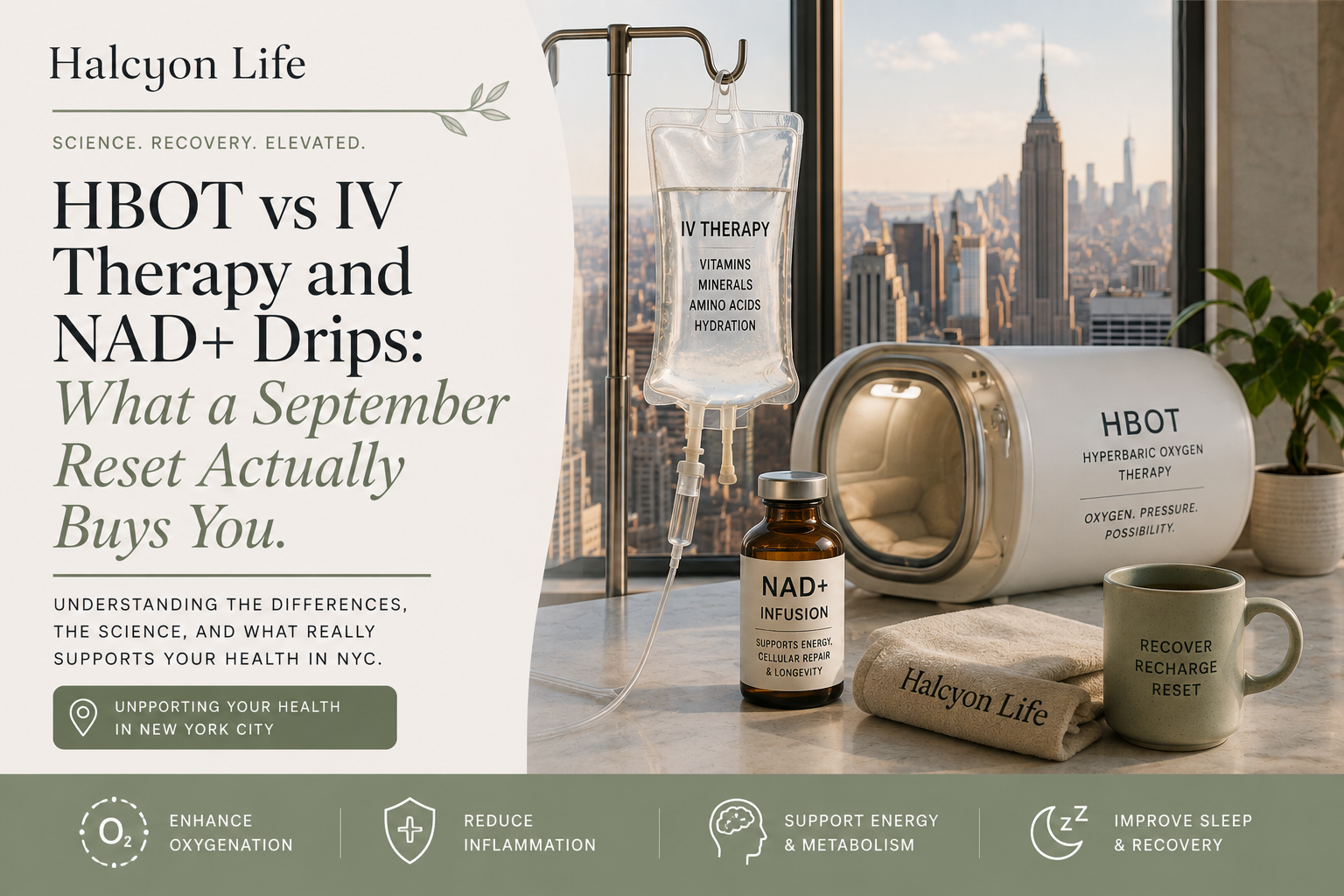
Everyone Comes Back From August With a Plan
There is a specific week in New York, usually the one right after Labor Day, when the entire city decides to become a better version of itself.
The out of office comes down. The gym contract gets signed. Somebody in the group chat books a NAD+ infusion. Someone else has a standing Thursday IV drip appointment now. The supplement order arrives in a box big enough to be embarrassing. There is a real feeling in the air, and it is not fake: after two weeks away, most people genuinely do want to come back sharper than they left.
What usually happens next is less inspiring. By the second week of October, half of it has quietly stopped. Not because the intent was wrong, but because most September resets are built out of inputs rather than conditions, and inputs are the easier thing to sell.
This piece is about the difference. Specifically, it is about what IV vitamin therapy and NAD+ infusions actually do inside the body, what they do not do, and where hyperbaric oxygen therapy sits relative to them. Not because these things compete for the same job. Because they do not, and most of the marketing around all of them obscures that.
If you want to think through where your own reset should start, you can book a consultation with our team and talk it through honestly.
Why the IV Drip Argument Is Real, and Where It Stops
Start with the part that is true, because there is a genuine mechanism here and it deserves credit.
When you swallow a nutrient, two things stand between it and your bloodstream. The first is the gut wall, where absorption for most vitamins and minerals happens through specific transport proteins. Those transporters are saturable, meaning there is a ceiling on how much can cross per unit time no matter how large the dose. Vitamin C is the textbook case: past a certain oral dose, the additional amount simply does not get absorbed. The second obstacle is the liver. Blood leaving the intestine goes to the liver before it reaches general circulation, and the liver metabolizes a share of what arrives. This is called first pass metabolism.
An intravenous infusion bypasses both. That is not marketing. Plasma concentrations achievable by IV are genuinely higher than anything oral dosing can reach, and for people with real absorption problems, that difference matters.
Here is where the argument usually stops short. Higher plasma concentration is not the same thing as higher cellular use.
The body regulates most of these compounds tightly. Push plasma vitamin C well above the normal range and the kidneys begin clearing the excess within hours, because renal reabsorption is also transporter limited. You have created a steep, temporary peak, and then it is gone. The cell, meanwhile, took what its own uptake machinery allowed it to take, which was governed by its transporter density and its current metabolic state, not by how much was floating past outside.
Put simply: an infusion changes what is available. It does not change what the cell is able to do with it.
For someone genuinely depleted, availability is the bottleneck and the drip helps. For a mostly healthy person in New York who ate badly for two weeks in Europe, availability is usually not the bottleneck. Something else is.
NAD+: The Most Interesting Molecule in the Room, and the Most Oversold
NAD+ deserves a longer look, because the underlying science is real and genuinely important, and the way it is being sold in New York has drifted well ahead of it.
NAD+ is a coenzyme involved in nearly every energy transaction in the body. It carries electrons through glycolysis and the citric acid cycle, feeding the electron transport chain where the majority of cellular energy is produced. It is also the required substrate for two families of enzymes that matter a great deal: sirtuins, which regulate metabolic and stress responses, and PARPs, which repair damaged DNA.
NAD+ availability does decline with age, and one of the better characterized reasons is not that the body makes less of it. It is that the body consumes more. An enzyme called CD38 sits on immune cells and degrades NAD+, and CD38 expression rises with chronic inflammation. The more inflammatory signaling a body is carrying, the faster it burns through its own NAD+ pool.
Sit with that for a second, because it reframes the whole product category. If inflammation is driving the consumption, then infusing more NAD+ without addressing the inflammatory signal is filling a tank with a hole in it.
There is a second problem, and it is mechanical. NAD+ is a large, charged molecule. It does not readily cross the plasma membrane intact. Most of what enters circulation is broken down outside the cell into smaller precursors before anything gets in. This is why the better studied approaches to raising cellular NAD+ use precursor molecules rather than NAD+ itself. The direct intravenous route is the least well supported of the available options, and it is also the most expensive one on offer in Manhattan.
None of this means NAD+ infusions do nothing. Plenty of people report feeling noticeably different, and that experience is real. It means the mechanism being advertised and the mechanism that is actually established are not the same thing, and you are entitled to know which one you are paying for.
The Question Nobody Selling You a Drip Is Asking
Here is the thread that runs underneath all of this.
Every one of these interventions supplies a substrate. Vitamins, minerals, amino acids, NAD+ precursors: they are all inputs into machinery that already exists. That machinery is your mitochondria, and mitochondria have one absolutely non negotiable requirement that no infusion can supply.
At the end of the electron transport chain, after NAD+ has done its job of ferrying electrons, those electrons have to go somewhere. The molecule that accepts them is oxygen. It is the terminal electron acceptor, the last link in the chain, and without it the entire sequence backs up regardless of how much substrate you have loaded in at the front.
In a well perfused, healthy tissue, this is a non issue. In tissue that is inflamed, swollen, poorly perfused, or sitting at the far edge of a capillary's supply territory, it is not. Oxygen reaches cells by diffusion, and diffusion is unforgiving about distance. There are regions of the body where the limitation is not what you put in the blood. It is whether it can get from the blood into the tissue that needs it.
That is a different problem, and it requires a different kind of intervention.
Where HBOT Actually Sits
Hyperbaric Oxygen Therapy is a systemic modality that influences the human body on cellular and physiological level. It is not a supplement, it is not a substrate, and it is not competing with your drip.
The mechanism is about pressure rather than concentration. At normal atmospheric pressure your hemoglobin is already close to fully saturated, which is exactly why breathing concentrated oxygen at ordinary pressure does very little for a healthy person, and why an oxygen bar is a fundamentally different proposition from a hyperbaric chamber. Under pressure, oxygen dissolves directly into blood plasma in proportion to the pressure applied, independent of hemoglobin. Because that oxygen is in solution rather than bound to a carrier, it diffuses further into tissue and reaches areas that hemoglobin bound oxygen struggles to serve.
So the comparison is not HBOT versus IV therapy in the sense of which one wins. It is a difference in category. An infusion changes what is circulating. A pressurized environment changes the conditions inside the tissue where the circulating material has to be used.
There is a second reason this matters for the CD38 problem discussed above. The processes involved in resolving inflammation are themselves oxygen sensitive and energy expensive. Macrophages have to shift from a debris clearing state into a reparative one, and that transition depends on the local environment. Support the environment and you are working on the leak rather than only on the refill.
Honest limits, because they belong here. HBOT does not replace nutrition, sleep, or training. It is not a treatment for a deficiency, and if your ferritin is low or your B12 is low, the answer is to correct that, not to sit in a chamber about it. Outcomes vary between people, and the evidence base across different applications varies in quality. What it may do is support the internal conditions in which everything else you are doing has a better chance of working.
Several people combine approaches deliberately, which we look at in our breakdowns of red light therapy alongside HBOT and the sauna and cold plunge stack. If you want the plain language version of the mechanism before anything else, start with what HBOT actually is.
The Money Conversation, Honestly
A vitamin drip in Manhattan generally runs a couple hundred dollars. NAD+ infusions run considerably more, often several hundred to over a thousand per session, and the packages sold in September are typically structured as a course.
Nobody selling those will tell you the following, so here it is. Those numbers are not unreasonable if availability is genuinely your limiting factor. They are a poor use of money if it is not, and the only way to know which situation you are in is to find out rather than assume. A basic panel costs a fraction of a single infusion and answers the question directly.
The broader point applies to everything on the September list, including us. The question is never what an intervention costs. It is what problem you are actually buying a solution to, and whether that is the problem you have. You can see what HBOT costs in New York and weigh it the same way you should weigh everything else in the stack.
Frequently Asked Questions
-
They are not really comparable, which is the honest answer. IV therapy raises what is circulating in your blood. HBOT changes the physical conditions inside tissue. If you are genuinely depleted in something, an infusion addresses that directly. If the issue is how well your tissue can use what it already has, that is a different problem.
-
Many people do, and there is no mechanistic reason they conflict. They act at different points in the same overall system. The useful thing is to know why you are doing each one rather than stacking them because both were available.
-
The biology behind NAD+ itself is well established and genuinely important. The specific question of whether intravenous NAD+ meaningfully raises cellular NAD+ is less settled, because the molecule does not cross cell membranes easily and is largely broken down before uptake. People do report subjective effects. The mechanism being marketed is ahead of the mechanism that has been demonstrated.
-
Consumption rises more than production falls. An enzyme called CD38 degrades NAD+, and its expression increases alongside chronic inflammatory signaling. This is one reason inflammation and energy problems tend to travel together.
-
No. Breathing enriched oxygen at ordinary atmospheric pressure adds very little, because hemoglobin is already nearly saturated. Pressure is what allows oxygen to dissolve into plasma, and that is the variable that makes hyperbaric sessions mechanistically different.
-
Something boring and specific: sleep, a look at actual bloodwork, and one or two things you will still be doing in November. Interventions are more useful once you know what you are correcting.
-
Halcyon Life is at 347 5th Ave in Midtown Manhattan. The starting point is a conversation about what you are actually trying to solve, not a package. You can see common questions here or reach out directly.
What You Are Actually After
Nobody books a drip because they want a higher plasma concentration of anything. They book it because they want to feel like themselves in a way they have not for a while, and September is when that wanting gets loud.
That is a reasonable thing to want, and it is worth pursuing with more precision than the market usually encourages. The version of a reset that lasts past October is rarely the one with the most items on the list. It is the one where you understood what each thing was for.
Come talk it through with us before you commit to anything, including us.