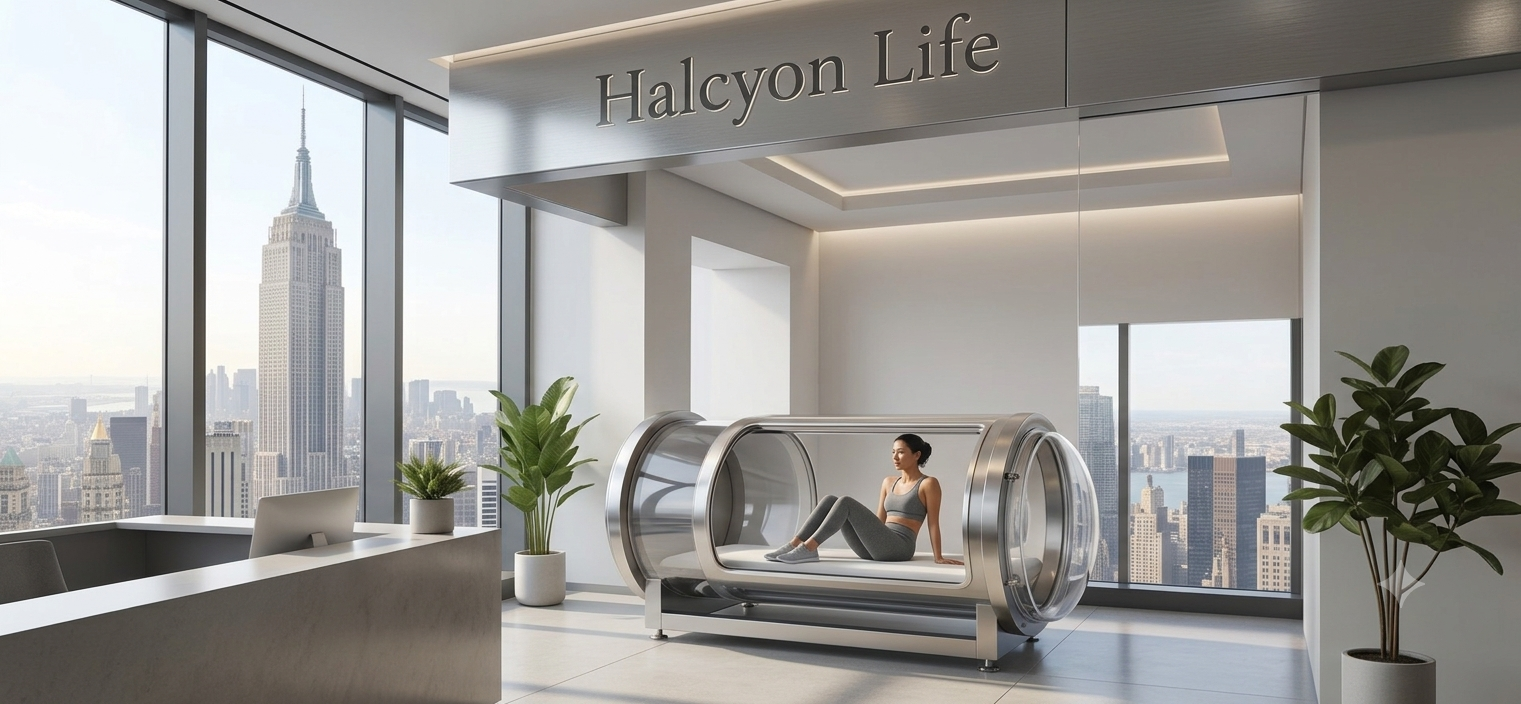
At some point the research stops being about whether to try Hyperbaric Oxygen Therapy and starts being about where.
That is usually the moment things get harder, not easier. You open a map, search hyperbaric chamber NYC, and get a scatter of pins across Manhattan, Brooklyn, and Queens. You open eight tabs. Every site has a photo of a chamber, a list of conditions, a few words about oxygen, and a booking button. Nothing on any of them tells you what is actually different about that particular room.
So people default to whatever they can measure. Price. Distance from the office. Whether the photos look expensive. Those are reasonable tiebreakers and terrible primary criteria, because they have almost nothing to do with whether the sessions will do anything for you.
This is our attempt to give you better criteria. Not a sales page. The questions below will occasionally point away from us, and that is fine.
Why Every HBOT Website in New York Reads the Same
There is a structural reason the marketing all blurs together.
Hyperbaric oxygen is not a proprietary product. Nobody owns it. There is no brand differentiation the way there is with a supplement or a device. So every operator is describing the same underlying thing, drawing from the same small pool of studies, using the same short list of words. Oxygen. Pressure. Healing. Recovery. Cellular.
New York makes this worse than most places. The wellness market here is saturated to the point of parody, rents force operators to fill calendars, and the customer base is unusually well informed and unusually tired of being sold to. In that environment, differentiation gets performed rather than earned. Layer onto that the incentives of a saturated wellness market in a city where attention is expensive. Short form content rewards certainty, so mechanisms get flattened into promises, and the operator willing to say the most confident thing wins the click. That does not make anyone a villain. It means the loudest signal in the market is the least informative one.
The result is that the differences that actually matter are invisible from the outside. They live in the equipment, in the pacing, and in how the person running the place thinks about the human sitting in the chamber.
The Four Things That Genuinely Differ
Pressure environment. Not all chambers reach the same pressure, and this is the single largest technical variable in the field. It determines what physiological effects are even on the table. A great deal of the published hyperbaric research is conducted at pressures that many consumer chambers cannot physically achieve, which means a facility can be entirely honest in calling itself hyperbaric while operating in a completely different range from the studies it cites. This is worth understanding before anything else, and we wrote about the real difference between hard and soft chambers in depth because it is the question most people do not know to ask.
How the oxygen is delivered. Concentration matters as much as pressure, and the two are not interchangeable. A high pressure environment with ambient air is a different physiological experience from a lower pressure environment with concentrated oxygen, and both are different again from combining the two. Ask specifically. The answer should be immediate and unembarrassed.
Session length and pacing. Here we are careful, because there is no universal correct number and anyone who gives you one is selling. What matters is that the place has a reason for its structure and can explain it. Protocols should be aligned to the person's biology. Forcing everyone's biology into one identical protocol because it fits the booking software is the thing to watch for. Thoughtful pacing looks like a plan that changes based on how you respond over the first several weeks, not a package sold on day one and never revisited.
There is a fourth variable that sits underneath the other three, and it is the easiest one to check.
Who is actually with you, and how much they notice. This is the least technical variable and frequently the most predictive. In a busy multi modality studio, hyperbaric sessions are often one item on a long menu, and the person letting you in may be managing four other things. Whether anyone is paying attention to how you respond, whether anyone adjusts anything, whether anyone remembers you between visits, these are not luxuries. Response to hyperbaric sessions is individual, and individual response is only useful if somebody is watching for it.
What a Visit Tells You That a Website Cannot
Go see the place before you commit to anything. Ten minutes in a room tells you more than an hour of reading.
Pay attention to whether the person showing you around explains limitations without being pushed. A facility that tells you who Hyperbaric Oxygen Therapy is not appropriate for, unprompted, is telling you something real about how it operates. So is one that mentions the most common side effects people actually report before you think to ask.
Notice whether they ask about you. A genuine intake conversation covers your history, your medications, your sleep, your existing care, and what you have already tried. If the entire conversation is about their equipment and their packages, you have learned something.
Notice how they handle your skepticism. If you say you have read that the evidence is mixed, the useful answer is a version of yes, here is where it is stronger and here is where it is thin. The unhelpful answer is a testimonial. Anyone who has spent time with the actual literature can tell you within a minute which conditions have randomized sham controlled data behind them and which ones have a mechanism and a hope. Anyone who has not will change the subject to how good people feel afterward.
Watch the room itself, too. Is it clean in the boring, structural way rather than the styled way. Is the equipment maintained or merely photographed well. Does the schedule have enough air in it that a session running long is not a crisis. None of this appears in marketing copy, and all of it tells you how the place is actually run on an ordinary Tuesday.
And notice what happens when you ask what they cannot help with. Everyone has an edge. The places worth your money know where theirs is.
Questions Worth Asking Before You Book
There are five that reliably separate a considered operation from a rented machine.
What pressure does this chamber operate at, and what oxygen concentration am I actually breathing?
How will my plan change based on how I respond in the first few weeks?
What happens if I feel nothing after a month?
Who will be here during my sessions, and what are they watching for?
What do you tell people you cannot help?
The fifth is the one that does the most work. The answer tells you whether you are talking to someone who thinks about biology or someone who thinks about conversion. A place that has thought carefully about its own limits has usually thought carefully about everything upstream of them, and a place that has never considered the question has told you exactly how much consideration goes into the rest.
Where HBOT Actually Fits
Hyperbaric Oxygen Therapy is a systemic modality that influences the human body on cellular and physiological level. That framing matters when you are comparing facilities, because it explains why the room you choose is not interchangeable with any other room.
A systemic modality touches conditions across the whole body rather than acting on one target. It may support inflammatory balance, nervous system regulation, tissue recovery, and mitochondrial behavior, which is the territory we covered in how HBOT relates to mitochondrial function. Because the effects are systemic and gradual, they depend heavily on getting the conditions right and on repeating them consistently. That is exactly why the variables above are not pedantic details. They are the entire mechanism.
It also means outcomes vary, honestly and unavoidably. Someone rebuilding after a long stretch of post viral fatigue and someone using sessions as part of an athletic recovery routine are asking different things of the same environment. The body is not one switch.
The Honest Financial Picture
Nobody in New York needs to be told that this is a city where wellness spending gets out of hand. The average person considering hyperbaric sessions has already spent real money on things that did very little, which is precisely why the price comparison instinct is so strong.
Here is the more useful way to think about it. The cost that matters is not the price per session. It is the price of the whole arc, multiplied by the probability that the arc was set up correctly in the first place. A cheaper session in a chamber that cannot reach a meaningful pressure, run by someone who never adjusts anything, is not cheaper. It is a smaller amount of money spent on nothing, followed by the conclusion that this modality does not work for you, which is the genuinely expensive outcome.
We publish what HBOT in NYC actually costs and why because we would rather you decide with real numbers in front of you than discover them at the end of a consultation. A decision made with clear information is the only kind worth making, even when it sends you somewhere else.
What We Would Tell a Friend
If a friend asked us how to pick, we would say this. Visit two or three places. Ask the five questions. Trust the one that answered your hardest question with the least performance. Pay attention to whether you felt like a person or a booking.
The point of all of this is not to find the most impressive facility in Manhattan. It is to end up somewhere that pays enough attention that you can actually tell whether this is working for you, and to get back to the part of life that had been getting smaller. Clarity in the morning. Energy that lasts past three in the afternoon. The capacity to do the thing you used to do without paying for it for two days afterward.
That is what you are buying. Choose the room that seems most likely to deliver it.
FAQs
-
Ask directly about operating pressure and oxygen concentration, and expect an immediate, specific answer. A facility that is vague about its own equipment is either not paying attention or hoping you will not notice. Ask what they tell people they cannot help with, too.
-
Yes, meaningfully. Pressure capability, oxygen delivery, session structure, and how closely anyone is tracking your response all change what the sessions can realistically do. These differences are not visible from a website.
-
This is individual and depends on what you are working with. What matters more than a number is whether the place you chose has a plan for reassessing, and whether they will tell you honestly if you are not responding.
-
Not reliably. Price in this market tracks rent and design budget at least as much as it tracks chamber quality or attention. Evaluate the equipment and the intake conversation, then look at price.
-
Your full medical history, a current medication list, and an honest account of what you have already tried. The more context you bring, the more individualized the plan can be.
-
Most places allow this, and we would encourage it. A single visit tells you how your body handles the environment and how the facility treats you, both of which are worth knowing before you spend more.
-
We operate in Midtown Manhattan and work with people across New York City. You are welcome to come see the chamber and ask whatever you want before booking anything.