Does Oxygen Kill Mold? The Healing Order for Your Apartment and Your Body
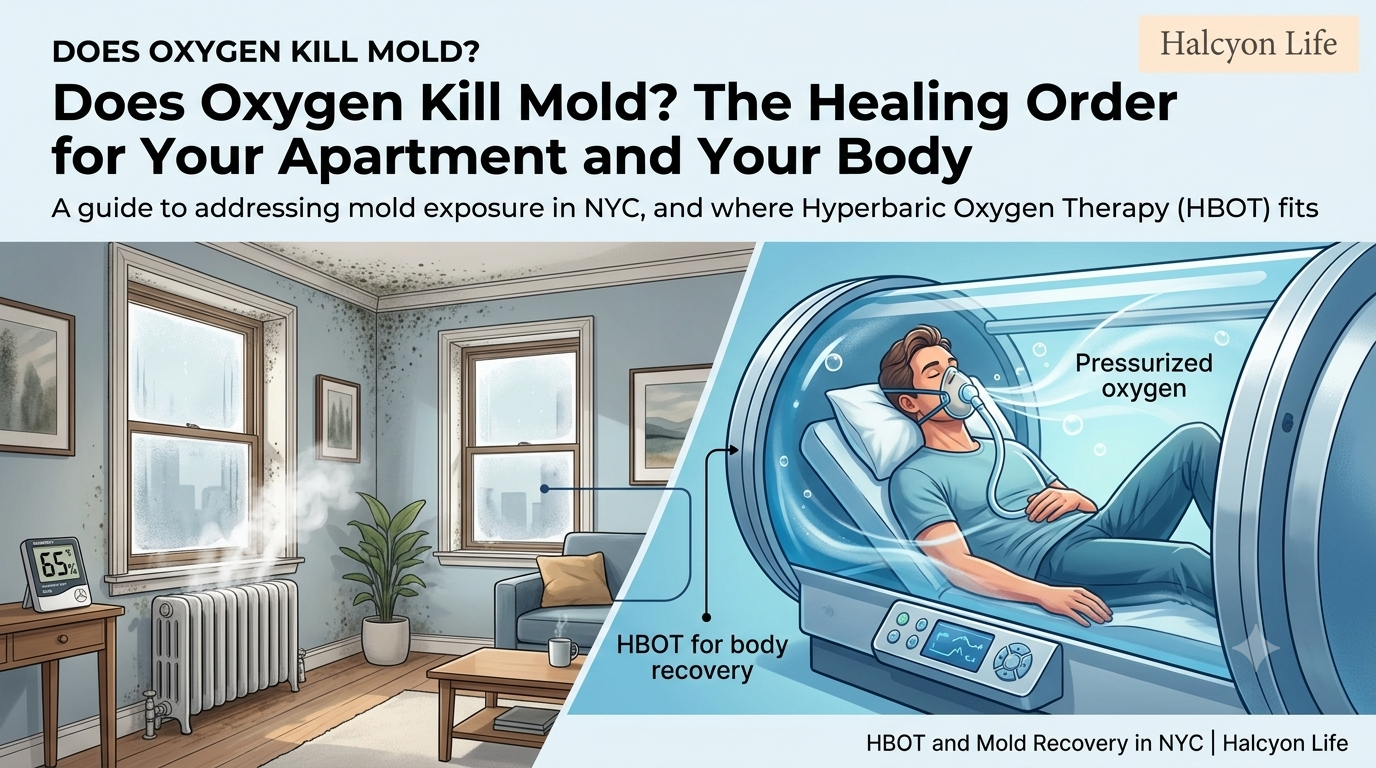
On October 1, heat season starts in New York City. The radiators come on, the windows close, and for the next eight months your apartment holds on to every shower, every pot of pasta, every breath.
By November, a lot of people notice it. Gray specks on the window frame. A musty smell in the closet. A corner of the ceiling that never looked quite right.
And a lot of people notice something else. They are tired in a way sleep does not touch. Their head feels foggy. Their body feels heavy and inflamed, and nobody can tell them why.
That is usually when the search starts: does oxygen kill mold? It is a good question, and the answer has two parts. One for your walls. One for your body.
The Quick Answer
For your walls: the oxygen in ordinary air does not clean mold. Water control does, which is good news, because it is cheap and simple.
For your body: pressurized oxygen is a different story. In lab research, hyperbaric oxygen slowed mold growth. And its real strength comes after exposure, helping your body recover from the damage mold leaves behind.
If mold is part of your life, the healing order looks like this:
Stop the exposure. Fix the water, clean the space, or move.
Clear the mold load from your body, with guidance from your practitioner.
Rebuild with HBOT, so inflammation settles, energy returns, and your body finds its way back to normal.
Everything below explains why that order works.
Your Walls: Why Room Air Does Not Clean Mold, and What Does
Household mold lives happily in ordinary air, which is about 21 percent oxygen, so air alone was never going to clear it. What mold truly cannot live without is water.
The EPA puts it simply: the key to mold control is moisture control. Wet materials dried within 24 to 48 hours usually will not grow mold. Indoor humidity should stay below 60 percent, ideally between 30 and 50 percent, and a humidity meter to check it costs roughly $10 to $50 at a hardware store.
Control the water, and mold has nothing to grow on.
Two products use the word oxygen and are worth knowing about. Ozone generators are sometimes sold as activated oxygen. The EPA says that at levels safe to breathe, ozone does not effectively remove mold, and that inhaled ozone can damage the lungs. Your lungs are already working hard enough, so skip it. Oxygen bleach releases hydrogen peroxide, which can clean a surface, but the spot keeps returning until the water source is dealt with.
Why NYC Apartments Grow Mold in Winter
New York buildings are almost designed for condensation. Prewar walk-ups with single-pane windows. Exterior walls that stay cold while the radiator runs hot. Steam heat you cannot turn down, so you crack a window and chill the wall even more. Bathrooms with no fan at all.
Warm, humid air meets a cold surface, water condenses, and the dust on that surface becomes food.
The city takes this seriously. Local Law 55, in effect since 2019, requires owners of buildings with three or more apartments to inspect every unit for mold each year and to repair the conditions behind it, such as leaks. In buildings with ten or more units, mold covering more than ten square feet must be handled by a state-licensed assessor and a separate licensed remediator. If your landlord is painting over the problem, call 311.
Inside your own apartment, the moves are simple. Run the bathroom fan during and after every shower. Keep furniture a few inches off exterior walls. Wipe condensation off windowsills in the morning. Put the humidity meter in the bedroom first, since that is where you breathe the same air longest. If a spot comes back after cleaning, water is still arriving there, and the building needs the repair, not your spray bottle.
What Mold Does Once It Gets Into Your Body
Mold spores and fragments are tiny, small enough to reach deep into your airways.
Fungal cell walls are made of materials the human body never makes. Your immune cells recognize them instantly, like an alarm system spotting a broken window. They release inflammatory signals that call in more immune activity. Mast cells, the ones behind allergic reactions, add histamine to the mix.
One encounter is no problem. The body handles it and moves on.
The trouble in a damp apartment is repetition. You breathe the same air every night for an entire heat season. The alarm never gets a chance to reset. Low-grade inflammation becomes your new background, and inflammation is expensive. It pulls energy away from everything else, strains the mitochondria that power your cells, and keeps your nervous system stuck on alert.
That is how a problem that starts in the lungs shows up as fatigue, poor sleep, brain fog, and a body that feels heavy. Your body is not failing. It is spending its whole budget on a defense it was never built to run nonstop.
The World Health Organization's review found strong evidence that people in damp or moldy buildings have more respiratory symptoms, more respiratory infections, and worse asthma. Many people also describe the longer, whole-body pattern above. Medicine is still catching up on how to name and measure it, but the experience is real. Our deeper piece on hyperbaric oxygen for mold toxicity covers that side in detail.
Here is the part to remember: much of the damage from mold is the body's own reaction to it. That reaction is exactly what HBOT works on.
What Pressurized Oxygen Does to Mold
Researchers at Dartmouth have spent years studying Aspergillus, a common mold that can cause serious lung infections. They found that mold infections create pockets of low oxygen in tissue, which help the fungus hide and slow down the immune cells trying to reach it.
In a 2018 study, hyperbaric oxygen slowed Aspergillus growth in lab tests and changed how infections played out in mice. Pressurized oxygen pushed back against mold in a way ordinary air cannot.
The effect worked like a pause rather than a knockout: growth picked back up within hours after the pressure ended, and the work was done in lab dishes and mice, not people. That detail is useful. It tells you HBOT works as a repeated input inside a plan, alongside the other steps, rather than as a one-time answer on its own.
Steps One and Two, in Plain Terms
Step one is about your space. Measure the humidity, find the water, and get it repaired. For a small spot on a bathroom tile, that can be a weekend job. For a leak inside a wall, it is your landlord's legal responsibility under Local Law 55. Some people stay with a friend or family member while remediation happens, and some decide to move. Every one of those choices counts as progress, because every night you are not breathing that air is a night your body gets to start resetting.
Step two is about your body. This is the phase many people call detox, and it looks different for everyone. Work with a practitioner who takes mold exposure seriously and can guide the body-side clearing for your specific situation. Protect the basics while you do it: sleep, water, real food, and gentle movement that keeps circulation and lymph flowing. This phase takes patience. Your body spent months building up that inflammatory load, and it deserves time to put it down.
Then comes the part most people are waiting for.
Step Three: Where HBOT Does Its Best Work
Once the exposure is stopped and the body side is being cleared, recovery becomes the main job. This is where HBOT shines.
Hyperbaric Oxygen Therapy is a systemic modality that influences the human body on cellular and physiological level. Inside the chamber, pressure raises the oxygen dissolved in your plasma far beyond what normal breathing allows. The rhythm of concentrated oxygen and scheduled air breaks then acts as a signal, and the body adapts to signals.
That adaptation reaches the exact systems mold exposure wears down: inflammatory balance, mitochondrial energy, and the body's own antioxidant defenses. We cover the inflammation side in does HBOT help with inflammation, and the clarity side in HBOT for brain fog in NYC.
Why step three? Because HBOT helps the body rebuild, and rebuilding goes furthest once the body has stopped taking a hit every night. It is the same logic as repainting a wall after the leak is repaired.
Research on HBOT specifically for mold illness is still early. What is much better studied is how HBOT affects inflammation, mitochondria, and antioxidant defenses, which is why so many people recovering from mold find it worth adding. Outcomes vary from person to person, so decide in advance what you will watch: how you sleep, how your energy holds through the afternoon, whether the fog lifts on workdays. Those markers keep the decision in your hands.
If the heavy, slow feeling has become your normal, our post on why your body feels heavy all the time in New York City looks at it from another angle. And since not everything labeled oxygen does the same thing, we explain the difference in oxygen bars vs hyperbaric oxygen therapy.
Where the Money Actually Goes
Mold is expensive in a quiet, repetitive way. An ozone machine. A second air purifier. Replacement filters. A cabinet of supplements bought on hope. Specialist visits at Manhattan rates to explain symptoms nobody can quite name. Each purchase feels like progress, and none of them touches the water.
Spending in the healing order changes that. First the cheap, effective steps: a humidity meter, a working bathroom fan, a written complaint to your landlord, a 311 call if nothing happens. Then the body-side clearing with your practitioner. Then recovery, where HBOT earns its place, tried for a defined period and judged by how you actually feel. When you reach that point, our guide on how to choose a hyperbaric chamber in New York will help you compare options without guessing.
Spend in the right order, and you stop buying temporary relief and start paying for real recovery.
The goal was never just a clean window frame. It is an apartment you can breathe in, a head that feels clear again, and a body that feels like yours by spring.
FAQs
-
It may help your body recover from the inflammation, fatigue, and fog that mold exposure leaves behind. It works best as step three, after the exposure is stopped and the body-side clearing is underway. Outcomes vary.
-
Ordinary air does not clean mold off walls; moisture control does. Pressurized oxygen in a hyperbaric chamber is different, and it slowed mold growth in lab research.
-
Once you are out of the exposure, ideally with the body-side clearing already in progress, so sessions support rebuilding rather than fighting an ongoing hit.
-
The best-established ones are respiratory: coughing, wheezing, congestion, frequent respiratory infections, and worsening asthma. Many people also report fatigue, brain fog, and poor sleep.
-
Heat season means warm, humid indoor air meeting cold walls and windows. Condensation forms, and mold grows wherever surfaces stay damp.
-
Not at levels safe to breathe, according to the EPA, and inhaled ozone can damage the lungs.
-
Find and stop the moisture source, document it, and notify your landlord in writing. Under Local Law 55, owners of most multi-unit buildings must address mold and the conditions causing it.