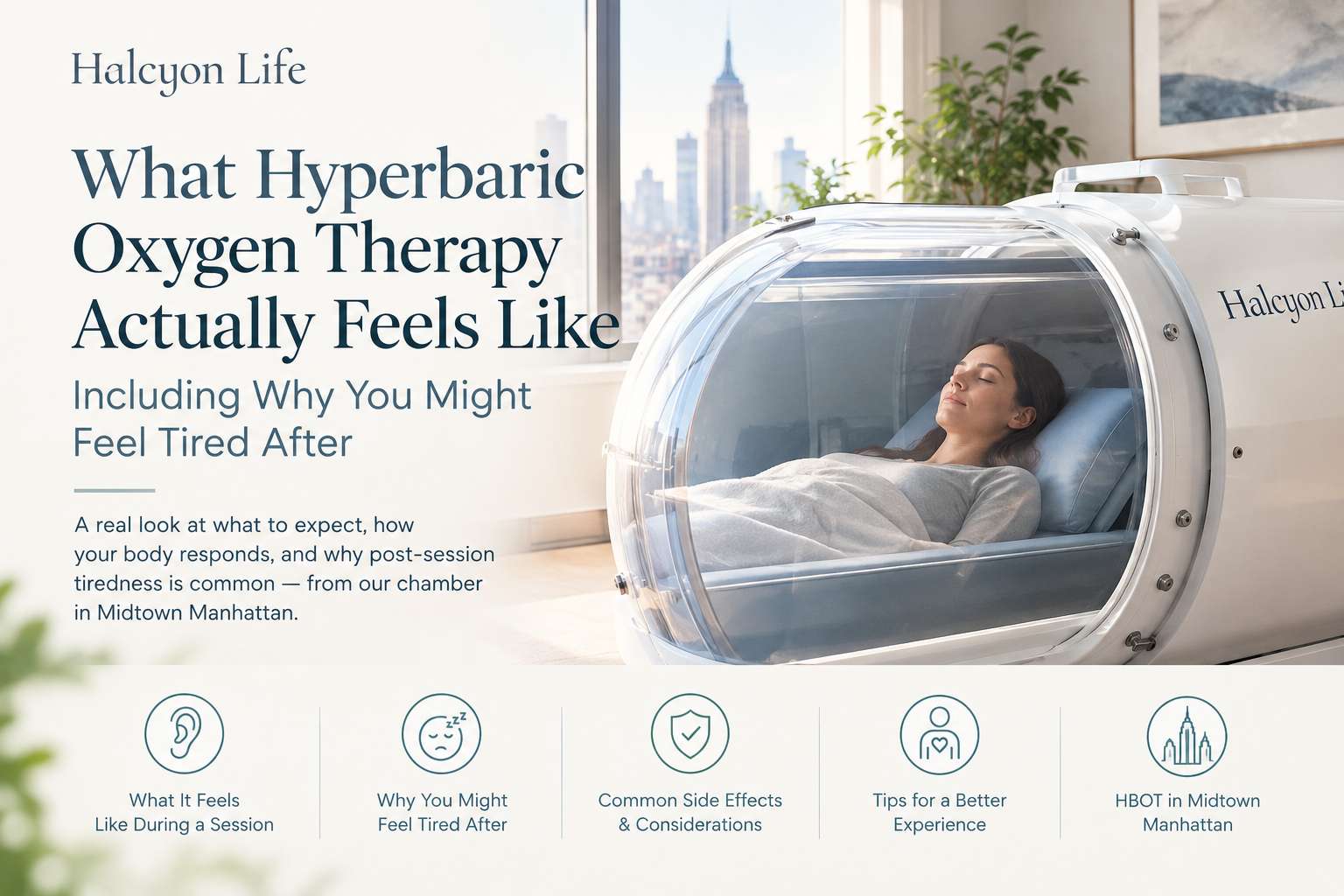
The question people ask right before they book is almost never about mechanism. It is some version of this: what is it going to feel like, and is anything going to happen that I do not expect.
That is the right question, and the one the industry answers worst. Search it and you find two flavors of content. One is a wall of reassurance with no specifics, written to get you to book. The other is a clinical risk list built for a hospital context, full of items real in principle and rare in practice, with no sense of proportion. Neither tells you what the ninety minutes are like, and neither explains what surprises first-timers most, which is that a fair number of people walk out and feel like taking a nap.
So here is the version we would want if we were you.
The Ears Are the Real Story
If anything is mildly uncomfortable, it will be your ears, in the first few minutes.
As the chamber pressurizes, the pressure outside your eardrum rises faster than the pressure behind it. Your middle ear connects to the back of your throat by a narrow passage, the eustachian tube, which has to open to let the pressures equalize. If it does not, you feel what you feel on an aggressive descent into LaGuardia. Fullness, then pressure, then discomfort.
The fix is the same as on the plane and entirely mechanical. Swallow. Yawn. Move your jaw. Pinch your nose and gently push air toward your ears. Most people find their method in the first session and never think about it again.
If you are congested or have allergies locking up your sinuses, equalizing is harder. That is a reason to reschedule, not to push through. A good facility pressurizes slowly, tells you to speak up the moment you feel anything, and pauses when you do. Pacing the descent to the person is the skill of running a session well.
Beyond the ears, the experience is unremarkable in a way most people find slightly anticlimactic. It warms as pressure rises, then cools. Your voice may seem faintly different. Then you are lying in a quiet enclosed space with nothing to do, which for a lot of New Yorkers is the most foreign part of it.
Why You Might Feel Tired Afterward
Here is the one nobody warns you about, and the reason a specific search query keeps showing up: does hyperbaric oxygen therapy always make you tired.
The answer is no, not always. But it is common enough that it belongs in the standard explanation rather than being something you discover on the subway home. Some people feel alert instead. Some feel nothing the first several times. All three are ordinary, and none is a malfunction.
Part of it is nervous system state. You have just spent an extended period lying still in a warm, enclosed, low-stimulus space with no phone and nothing asked of you. For a nervous system running sympathetic-dominant for months or years, that is an unusually strong parasympathetic input. What surfaces afterward is often not new fatigue. It is the fatigue already there, finally allowed into the room. Chronically under-recovered people feel this most sharply.
Part of it is metabolic. A meaningful physiological input costs something to respond to. Repair is not free, and a body engaging it has less spare capacity for the afternoon. Same logic as feeling flattened the day after hard training. The tiredness sits downstream of the work rather than signalling something went wrong, and the cellular energy machinery behind it is where most durable changes seem to originate.
Recovery is also not a linear upward line. It moves in a pattern of input, response, and consolidation, and consolidation does not feel impressive. It feels like wanting an early night.
There is a further idea worth putting on the table, and we want to be precise about its status. Some practitioners read the first session as a rough signal of where a person's cellular energy production is starting from. Someone whose mitochondria are already struggling has the least spare capacity to absorb a new metabolic demand, so pronounced tiredness after a first session may say more about the starting state than about the session. Under that logic, early fatigue is not a warning. It is an argument for a proper consecutive block rather than a single trial, because a run of sessions is what gives the energy machinery a chance to upregulate.
We hold that as a working clinical hypothesis rather than an established finding, and we would rather say so than dress it up. What is published sits adjacent. A small 2013 study of sixteen people with chronic fatigue syndrome ran fifteen sessions across three consecutive weeks and reported meaningful drops in fatigue scores, though it had no control group. A 2022 randomized controlled trial in post-COVID patients found significant improvement in the energy domain alongside changes in brain perfusion. Both point the same direction. Neither tests the first session as a readout.
Practically, this means do not schedule your first session before a presentation. Give yourself an easy evening. Drink water. Eat something real.
But that advice has an expiration date, and this is the part almost nobody explains. The tiredness is a beginner's phenomenon, belonging to a body spending real resources on an unfamiliar input.
Acclimation changes it. Once someone has built a real foundation, which in practice means something like three sessions a week for roughly a month, the response shifts. The body is no longer paying a large adaptation cost each time. It has been primed at a cellular level and meets the same input already knowing what to do with it. What was flattening becomes clarifying.
This is when a session before a presentation, a negotiation, or a competition stops being a bad idea and becomes a useful one. Same chamber, same pressure, different starting biology. People at this stage describe walking in tired and walking out sharp, close to the opposite of week one.
It also changes the economics. Front-load the work and you can pull back, using sessions around demanding stretches rather than grinding a fixed schedule forever. Those who never build the base stay paying the adaptation cost over and over, going once a month for a year and concluding it did nothing.
That is the argument for starting properly rather than dabbling. If tiredness persists well past that first month instead of resolving into a steadier baseline, that is information about pacing, and the answer is to adjust cadence rather than push harder. Protocols should be aligned to a person's biology instead of forcing everyone's biology into the same schedule.
Why Experiences Vary So Widely
Ask five people at our chamber in Midtown what a session feels like and you get five answers.
Hyperbaric Oxygen Therapy is a systemic modality that influences the human body on cellular and physiological level. That is why the felt experience varies. A systemic input lands differently depending on the system receiving it, and on how acclimated that system already is. Someone in year three of post-viral fatigue and someone preparing for a marathon are not in the same starting position.
There is also a timing mismatch. The things most worth having, the steadier afternoon energy, the fog lifting earlier, the sleep that finally goes deep, arrive gradually and get noticed in retrospect. You rarely have a moment of revelation. You have a Tuesday in week five where you got through the day without the two o'clock collapse and it did not occur to you to be surprised.
Which is why we are cautious about anyone promising a specific feeling on a specific timeline. Outcomes vary, the body is not one switch, and honest expectation-setting is more useful than enthusiasm. Our post on post-viral fatigue beyond long COVID covers what that arc looks like for people carrying a long-running load.
The Considerations Worth Actually Knowing
We will be direct rather than either alarmist or evasive, because the honest handling of this is part of why people trust us.
Ear discomfort is the common one and it is manageable. Some people notice temporary changes in near vision over an extended course, which typically resolves afterward. Enclosed spaces are hard for some people, worth naming before you book rather than discovering while the door is sealed.
The more serious items on clinical risk lists are real, well understood, and uncommon under properly run conditions. They are why session design, pressure management, and pacing matter, and why it is worth asking any facility how they handle them.
There are also situations where it is not appropriate at all, including certain lung conditions and some ongoing medications. That is a conversation to have with the physicians managing your care, and one we encourage rather than route around. Our fuller breakdown is in our post on the most common side effects of hyperbaric oxygen therapy.
What Ninety Quiet Minutes Are Worth in This City
There is a financial contrast here that is easy to miss because it is not framed as one.
Consider what people here already spend chasing the feeling of being restored. The class packages. The IV drip that lasts a day. The supplement stack running a few hundred a month that mostly produces expensive urine. The weekend upstate eaten by catching up on sleep. Add the quieter cost of years at a fraction of your capacity.
Against that arithmetic, a proper first month is smaller than most people's annual spend on things that never move their baseline. And because that month buys a lighter cadence afterward, the comparison is a defined block of work against another two years of the same. We put the New York numbers on this in our guide to accessing HBOT in NYC on a budget.
There is also the part on no invoice. Ninety minutes in which nothing is asked of you is close to unobtainable here. Some of the effect is physiology. Some is having been left alone long enough for your own system to catch up. Being unreachable is itself a physiological input, which we cover in our post on how HBOT fits into a real recovery stack alongside sauna and cold plunge.
What We Tell People Before Their First Session
Come in without a fixed expectation of how you should feel. Tell us the moment your ears register anything so we can slow the pressurization. Keep the rest of that first day undemanding. Notice how you sleep that night, because sleep is often the first thing to shift. Commit to a real first month rather than testing it once, and judge it over several weeks rather than on the walk home.
We are this specific because the alternative is worse for everyone. Somebody told to expect a transformation who instead feels tired concludes it failed and quits in week two, right before the arc turns. Somebody who understands what they are participating in reads the same tiredness accurately and stays long enough to reach the version where a session sharpens them instead.
None of this is complicated. It is just rarely said out loud, because reassurance converts better than specificity. We would rather you arrive knowing what your ears will do, why you might want an early night, and what changes once your body knows this input. That makes it feel less like a purchase and more like something you are doing on purpose. If confusion around the category has kept you circling it, our piece on common myths about hyperbaric oxygen therapy clears out the rest of the noise.
FAQs
-
Sometimes. Post-session tiredness is common and usually reflects a strong parasympathetic shift combined with the metabolic cost of an active physiological response. Others feel alert instead, and some feel nothing early on. All of these are ordinary, and the pattern often changes as sessions accumulate.
-
Mostly quiet and uneventful. You feel pressure in your ears during the first few minutes as the chamber pressurizes, similar to an airplane descent, and it clears once you equalize. It warms slightly, then stabilizes. After that it is a still, enclosed, low-stimulus space for the length of the session.
-
Swallowing, yawning, moving your jaw, or gently pinching your nose and pushing air toward your ears all work. Most people settle on a preferred method within the first session. Pressurization should be paced slowly enough that you have time to keep up.
-
It is better to reschedule. Congestion makes equalizing harder and less comfortable. There is no benefit to pushing through it.
-
It varies considerably. Sleep quality is often the first change people report. Steadier energy and clearer thinking usually build over a first month of consistent sessions, commonly around three a week, rather than appearing after a single visit. Outcomes differ between individuals and depend heavily on the starting point.
-
Not in your first weeks, when a session is more likely to leave you tired. Once you have built a foundation, roughly a month of consistent sessions at around three a week, that changes. An acclimated body is no longer paying a large adaptation cost, and many people find a session before a demanding day leaves them sharper. After that base is built, sessions can be used far more sparingly and still hold their benefit.
-
No. Certain lung conditions and some medications make it unsuitable, and enclosed spaces are genuinely difficult for some people. It is worth discussing with the physicians managing your care beforehand, and worth telling us about anything that concerns you so a session can be run appropriately.