Hyperbaric Oxygen Therapy for Sexual Health: Is It Effective for ED or Libido?
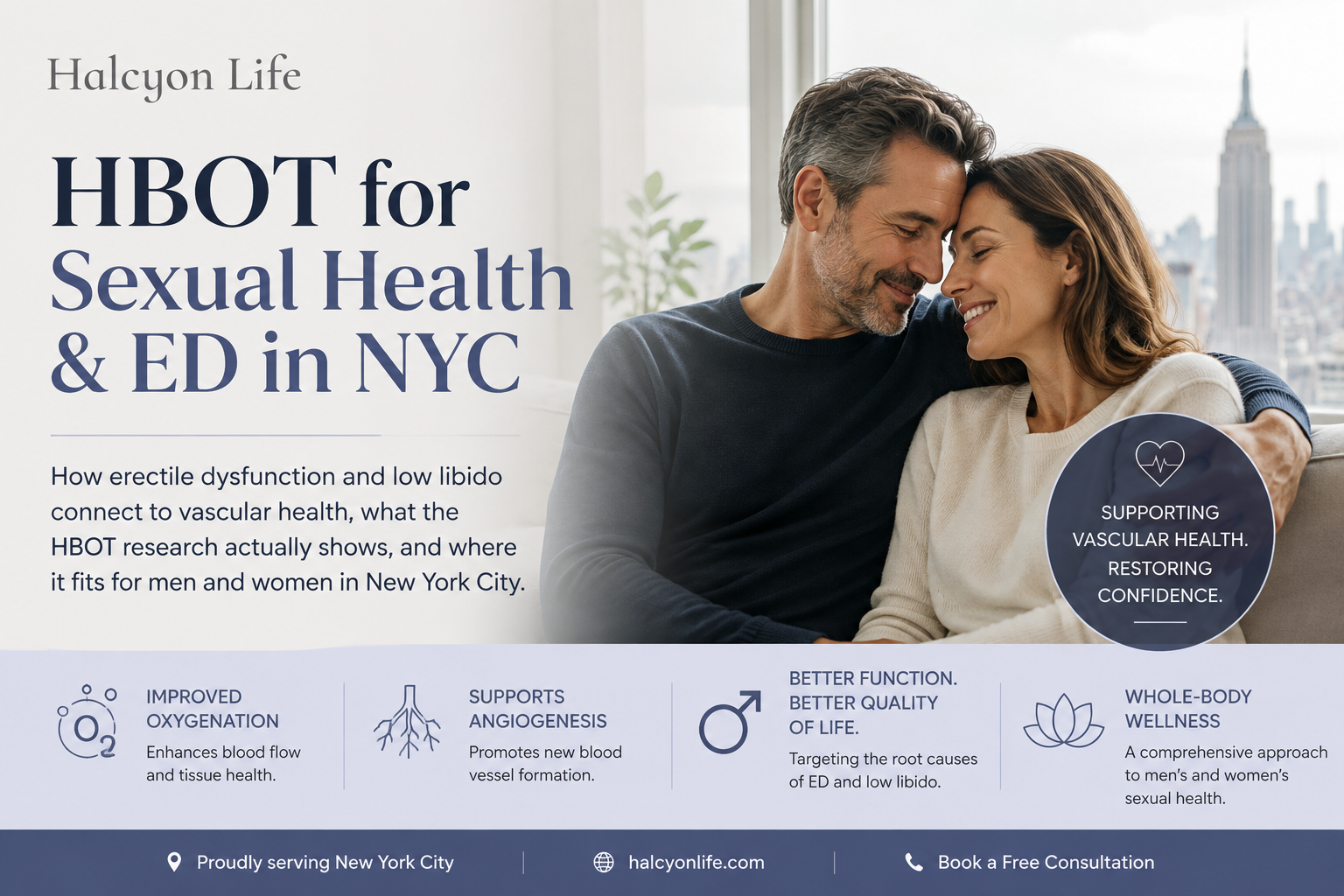
The Conversation Men in New York Aren't Having
There's a conversation many men in this city have with themselves long before they have it with anyone else. A quiet noticing that the body isn't responding the way it used to. That performance, a word that carries more weight here than almost anywhere, has become unreliable in a place where it once felt automatic.
Erectile dysfunction is common. The Massachusetts Male Aging Study, still the reference point decades later, found some degree of it in roughly half of men aged 40 to 70, with prevalence climbing across that range. Low libido is just as widespread, affecting men and women across a broad range of ages, often with no obvious hormonal explanation. Both carry enough stigma that most people spend a long time trying to understand what's happening before they say it out loud to anyone, including a doctor.
This piece is for that stage: trying to understand the biology, weighing the options, and wondering whether hyperbaric oxygen therapy has anything real to offer. The honest answer is possibly, for specific reasons and specific presentations, and with a significant caveat that most content in this space leaves out entirely. The nuance is where the useful part lives.
Why Erectile Dysfunction Gets Misread as "Just Stress" or "Just Age"
Most people assume erectile dysfunction is either psychological (performance anxiety, relationship stress) or a simple consequence of getting older. Both can play a role. But in men over forty, the more common driver is something quieter: vascular decline that's been building for years without symptoms anywhere else.
An erection is, at its foundation, a blood flow event, and the machinery is specific. Parasympathetic and nitrergic nerve signaling triggers release of nitric oxide from endothelial cells lining the vessels of the corpora cavernosa. Nitric oxide activates guanylate cyclase, which produces cyclic GMP, which relaxes the smooth muscle in those vessel walls. The relaxed vessels fill, the expanding tissue compresses the veins that would normally drain it, and pressure is maintained.
Every step in that chain depends on healthy endothelium. When the vessel lining is compromised, nitric oxide production drops and the cascade never gets properly started, regardless of how someone feels emotionally or how much sleep they got that week.
This is why erectile dysfunction is increasingly treated as an early signal of vascular health rather than a standalone issue. The vessels supplying erectile tissue are small, and small vessels show the effects of endothelial decline earlier than the larger vessels doctors typically screen. A man in his forties with unexplained ED is worth paying attention to, cardiovascularly, not because something's necessarily wrong, but because the biology behind it overlaps with long-term heart and brain health.
The Vascular Story, and What the Research Actually Found
This is where the case for hyperbaric oxygen therapy becomes specific rather than general.
Hyperbaric Oxygen Therapy is a systemic modality that influences the human body on cellular and physiological level, and one of its better characterized downstream effects is angiogenesis: the formation of new blood vessels. The mechanism runs through hypoxia-inducible factor and vascular endothelial growth factor, and it's the same process behind HBOT's established role in wound healing, where growing new vessels into poorly supplied tissue is the entire point.
The study people cite here is worth naming precisely, because vague attribution is how overstatement happens. Hadanny and colleagues published in the International Journal of Impotence Research in 2018. <cite index="50-1">Thirty men with a mean age of 59.2 who had experienced ED for an average of 4.2 years completed 40 daily sessions, with all International Index of Erectile Function domains improving significantly, and effects on the penile vascular bed evaluated by perfusion MRI.</cite>
The perfusion imaging is what makes this more than a questionnaire study. It's an objective measure of what happened in the tissue rather than a self-report of how things felt.
The limitation, which we'd rather state than have you discover: it was a prospective single-arm analysis with no control group and thirty participants. There's no placebo arm, and ED is a condition with a well documented placebo response. The finding is real and the imaging is persuasive, but it needs randomized replication that hasn't been published at scale.
The Finding Nobody Quotes, and Why It Matters Here
A 2024 meta-analysis in Sexual Medicine Reviews from a Baylor College of Medicine group pooled the available data, and it found something that should change how anyone talks about this.
The results split by cause. <cite index="62-1">In men with ED following robotic-assisted laparoscopic prostatectomy, the analysis favored the control group significantly. In men receiving HBOT for reasons other than surgery, the analysis favored HBOT significantly.</cite> <cite index="61-1">The authors concluded that while further research is needed to establish efficacy and long-term effects, preliminary studies have shown encouraging results in men with vasculogenic ED specifically.</cite>
Read that carefully, because it's the most useful sentence in this entire article. The evidence does not point one direction. It points opposite directions depending on why the ED exists in the first place, and the group where it looks unfavorable is post-surgical.
That matters practically. If you're recovering from prostate surgery and someone is selling you hyperbaric sessions for erectile recovery, the pooled data does not currently support that, and you're entitled to know before you spend the money. Nerve injury is a different problem from vascular insufficiency, and a therapy aimed at blood vessels doesn't necessarily help a severed or traumatized nerve. This is the same reason we're careful about how we discuss what happens systemically after surgery more broadly.
How This Differs From Medication
It's worth being precise about this rather than competitive, because they're acting at different points in the same system.
PDE5 inhibitors like sildenafil work on the signaling side. They block the enzyme that breaks down cyclic GMP, so the relaxation signal produced by whatever nitric oxide you have persists longer and goes further. They're effective, well studied, and they act within hours. What they require is that there's enough functioning endothelium to produce nitric oxide in the first place, which is part of why response rates are lower in men with significant vascular disease.
The HBOT research is investigating a different question: whether the vascular architecture itself can be supported through angiogenic signaling. That's a slower proposition operating on weeks rather than hours, with a much thinner evidence base, and it isn't an alternative to anything. Some men use both. Whether either applies to you depends on a diagnosis you should get from a physician rather than from an article.
Libido Is a More Layered Picture
For men, testosterone is the primary hormonal driver, and natural decline from the mid-forties onward is a common contributor to reduced desire. For women, estrogen, progesterone, and androgen levels shift across the menstrual cycle, pregnancy, and perimenopause in ways that affect desire directly.
But the vascular and neurological pieces matter too, in both men and women. Genital blood flow affects arousal and sensation regardless of anatomy, and the same endothelial decline behind ED has real analogues in female sexual function, where clitoral and vaginal tissue depend on the same nitric oxide mediated engorgement mechanism. Research specific to female sexual function and HBOT is considerably thinner than the male ED literature, which is a gap worth naming rather than papering over.
The neurological side, the signaling that turns hormonal readiness into conscious desire, runs through dopaminergic circuits that are among the more energy-intensive in the brain, which makes them sensitive to the same cellular energy and perfusion factors the broader HBOT research addresses.
What New York Does to This Specifically
Sexual function is unusually sensitive to the physiological environment a person lives inside, and this city creates a particular one.
Arousal is a parasympathetic process. It requires the nervous system state that chronic stress most reliably suppresses. Sustained sympathetic activation and elevated cortisol actively inhibit the signaling that arousal depends on, and a nervous system calibrated for deadlines and performance doesn't shift easily into anything receptive. The pace here, the work culture, the financial pressure, the noise, the disrupted sleep, isn't background. It's an active physiological force.
Sleep restriction compounds it directly. Testosterone is produced largely during sleep, with the daily peak tied to REM onset, which means fragmented or shortened sleep cuts production at the source. That's a mechanism, not a vague association, and it stacks on top of whatever vascular or age-related decline is already underway. It's closely related to the pattern we describe in why New Yorkers wake up tired even after sleeping enough, and the same nervous system regulation question shows up across how HBOT relates to stress and cognition.
For many people here, reduced sexual function isn't purely vascular or purely hormonal. It's also, meaningfully, a stress and recovery problem, and that's a different category requiring different attention.
The Money Conversation
Here's a framing worth sitting with, because this is an area where people spend badly out of embarrassment.
Men routinely spend hundreds of dollars a month on telehealth ED subscriptions, testosterone protocols started without proper baseline testing, and supplement stacks marketed with language no clinician would sign off on. Almost none of that begins with finding out what's actually causing the problem, because the diagnostic step requires saying it out loud to a doctor and the online version doesn't.
A basic workup, meaning morning testosterone, a lipid panel, fasting glucose, and a conversation about cardiovascular risk, costs a fraction of a year of any of those subscriptions and tells you which category you're in. That's the highest-value spend available here by a wide margin, and it's the one people skip.
Nothing in this article, including anything about us, is worth acting on before that. If it turns out the picture is vascular and you want to understand where hyperbaric sessions might sit, you can review what HBOT costs in New York and weigh it honestly against everything else competing for the same money.
Where This Actually Lands
Sexual health involves too many interacting systems for any single intervention to be a complete answer, and HBOT is no exception.
For men with vasculogenic ED specifically, the mechanism is coherent and the early evidence is encouraging, with the important caveat that it comes from small uncontrolled studies. For men whose ED follows prostate surgery, the pooled evidence currently runs the other way, and we'd rather tell you that than sell you sessions. For men whose ED is primarily psychological, the vascular mechanism isn't the relevant one. For libido in both men and women, the honest framing is that this might be one supportive piece within a broader approach that also includes hormonal evaluation, sleep, and stress, not a standalone fix.
Understanding the specific cause first is what determines whether any of this belongs in your picture at all. At Halcyon Life, that conversation starts with a free consultation rather than a sales pitch. There's no assumption that HBOT is the right fit before that discussion happens, and no pressure either way. You can also read what HBOT actually is before you come in.
References
Hadanny A, Lang E, Copel L, Meir O, Bechor Y, Fishlev G, Bergan J, Friedman M, Zisman A, Efrati S. Hyperbaric oxygen can induce angiogenesis and recover erectile function. Int J Impot Res. 2018;30(6):292-299. doi:10.1038/s41443-018-0023-9
Saffati G, Naeem T, Guhan M, Abello A, Hinojosa-Gonzalez DE, Kaaki B, Stocks BT, Lipshultz LI, Khera M. Hyperbaric oxygen therapy as a treatment for erectile dysfunction: a meta-analysis. Sex Med Rev. 2024;12(1):94-99. doi:10.1093/sxmrev/qead043
Sen V, Sahin MO, Irer B, Koc E, Yildiz G. The impact of hyperbaric oxygen therapy on erectile functions and serum testosterone levels in patients with erectile dysfunction. Aging Male. 2020;23(1):66-70. doi:10.1080/13685538.2019.1578740
Frequently Asked Questions
-
There's published research, most notably a 2018 study in the International Journal of Impotence Research in thirty men with chronic non-surgical ED, which reported significant improvement across erectile function domains alongside perfusion MRI changes in penile tissue. It was a single-arm study without a control group, so it should be read as encouraging rather than established.
-
No, and this is the most important thing on this page. A 2024 meta-analysis found the results split by cause: favorable for non-surgical ED, unfavorable for ED following robotic prostatectomy. Identifying which type you're dealing with comes first, and that's a medical question.
-
The current pooled evidence doesn't support it for that specific indication, and we'd tell you the same in person. Post-surgical ED often involves nerve injury rather than vascular insufficiency, which is a different problem than the one angiogenesis addresses.
-
PDE5 inhibitors act on the signaling cascade, preserving the relaxation signal your existing endothelium produces, and they work within hours. The HBOT research is looking at whether the vascular structure itself can be supported, which is a slower question with much less evidence behind it. They're not substitutes for each other.
-
The vascular and neurological mechanisms behind female arousal overlap substantially with those behind male erectile function, including the same nitric oxide pathway. But research specific to female sexual health is thin, and reasoning by mechanism isn't the same as having data.
-
Not typically. Angiogenesis and endothelial repair build over weeks, not hours. Individual experiences vary considerably, and it's worth going in with realistic expectations rather than the ones the marketing in this space tends to set.
-
That's a conversation for your own doctor, who knows your full history. HBOT is generally well tolerated, but medication questions belong with a prescriber rather than with us.
The Thing Underneath
The goal here was never a single dramatic fix. It's the gradual return of capacity that chronic stress, vascular decline, and sleep debt gradually wear down.
For some people, hyperbaric sessions may be part of how that comes back. For others, the useful answer is a blood panel, a cardiologist, better sleep, or a conversation they've been avoiding. We'd rather point you toward the right one than the profitable one.
Sexual health isn't separate from the rest of the body's health. It's one expression of it, and supporting it means supporting the same biological foundations that make the rest of daily life in this city sustainable. If you want to talk it through, come in and ask us the hard questions.