Someone Tagged You in a Photo
You were not having a bad day. You were, if anything, in reasonably good spirits. Then the photo showed up, taken from an angle nobody chooses for themselves, in the specific overhead lighting of a restaurant, and you looked at it and thought: I look wrecked.
Or it was more direct. A colleague you like asked, in the kind voice people use, whether everything was alright. And you said yes, because everything was alright, and then spent the rest of the afternoon quietly wondering what they saw.
This is a strangely common experience among people who are functioning perfectly well. Not exhausted. Not unwell. Just carrying something on the face that other people register before you do.
Most of us respond to it the way the market has trained us to. We treat it as a surface problem and buy a surface solution. Another eye cream, a brightening serum, a consultation about something injectable. That response is understandable and, in a lot of cases, aimed at the wrong layer entirely.
Other People Are Not Imagining It
Start with the uncomfortable part, because it makes everything after it easier to take seriously.
In 2010, researchers at the Karolinska Institutet photographed 23 healthy adults twice, once after a normal night of sleep and once after being kept awake, under identical lighting and camera distance. Sixty five untrained observers, who knew nothing about the study design, rated the photographs in randomized order. They consistently rated the sleep deprived faces as less healthy, more tired, and less attractive.
Untrained strangers, looking at a still photograph, picked it up reliably. A follow up from the same group in 2017 found the same pattern after merely restricted sleep rather than full deprivation, and also found that people were less inclined to want to socialize with the faces in question.
That last detail is the one that stings, and it is worth stating plainly rather than softening. Looking tired is not a private aesthetic concern. It is a legible physiological signal that other humans read accurately and respond to without deciding to.
Which reframes the whole thing. If a stranger can detect it in a photograph, then whatever is producing it is not a cosmetic surface issue. It is your physiology showing through, and no topical product is positioned to reach it.
What the Face Is Actually Reporting
The face is unusually good at broadcasting systemic state, for reasons that are structural rather than mysterious.
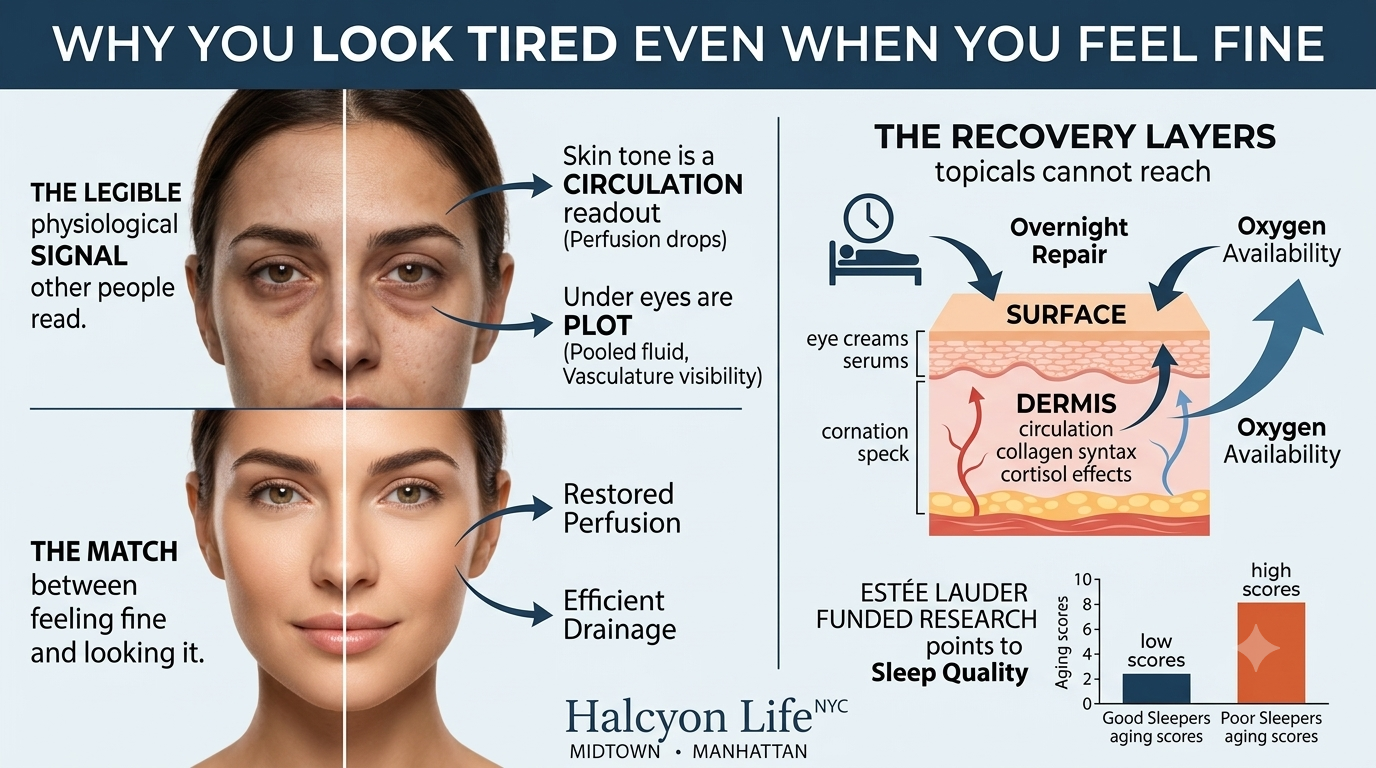
Facial skin sits on one of the densest superficial capillary networks in the body, and it is thin, so the color of the blood underneath shows through. Skin tone is substantially a circulation readout. When perfusion drops or blood oxygenation shifts, the visible result is the specific dull, slightly grey quality that people describe as looking washed out. This is not a metaphor. It is the color of what is flowing under a translucent layer.
The area around the eyes reports even more. The skin there is the thinnest on the body, the underlying vasculature is close to the surface, and lymphatic drainage in that region depends heavily on being horizontal for a sustained stretch. Compress your sleep and fluid that should have cleared overnight is still sitting there in the morning. The darkness under the eyes is partly that pooled fluid and partly the vasculature showing through skin thin enough to be nearly transparent.
Then there is the repair schedule. A significant portion of the skin's maintenance work runs overnight, on the same cycle as the rest of the body's recovery processes. The construction side of that balance is oxygen dependent, which we go into properly in our piece on how collagen is actually built. Shorten the window and breakdown quietly outpaces construction, night after night, in increments too small to notice until a photograph does the noticing for you.
Cortisol sits underneath all of it. A nervous system running elevated from Monday morning through Friday night keeps cortisol higher than it should be, and cortisol directly suppresses collagen synthesis while degrading barrier function. This is the mechanism connecting a demanding job to a face that reads as depleted, and it does not require anything to have gone wrong medically.
The Study the Cosmetics Industry Paid For
Here is a detail we find genuinely useful.
In 2015, Clinical and Experimental Dermatology published a study of 60 women split into good and poor quality sleepers, assessed with a validated skin aging scoring tool. Poor sleepers scored roughly twice as high on markers of intrinsic aging, meaning fine lines, uneven pigmentation, and reduced elasticity. Their skin barrier recovered about 30 percent less well over 72 hours after a controlled disruption. They recovered more slowly from ultraviolet induced redness. They also reported worse satisfaction with their own appearance.
Notably, there was no significant difference between the groups on extrinsic aging, the sun driven kind. The gap was in the intrinsic, internally generated component.
That study was commissioned and funded by Estée Lauder, with two authors employed by the company, all of which is disclosed in the paper.
We are not raising that to dismiss the finding. Disclosed industry funding is not disqualifying, and the result is consistent with the underlying biology. We raise it because of what the finding says: a major cosmetics company funded research that concluded the strongest lever on this particular problem is sleep quality, which is not a product they sell.
When the industry's own research points away from the shelf, that is worth pausing on.
Where This Sits Against the NYC Aesthetic Spend
There is a particular pattern here that anyone working in this city will recognize.
The skincare routine is genuinely good. Well researched, consistently applied, expensive. The wardrobe works. The haircut is current. There is a facial on the calendar. And the whole apparatus is being layered on top of five and a half hours of sleep, a commute that starts before the nervous system has finished waking up, meals eaten at a desk, and a stress baseline that has been elevated for so long it now reads as normal.
None of that is a personal failing. It is what living here reasonably requires of most people. And it produces a specific and slightly absurd outcome, which is a considerable amount of money spent on the outermost layer of a system whose constraint is several layers down.
We want to be careful here, because this is exactly where wellness content usually turns into a lecture. So to be direct: nothing about how you look is a moral matter, and none of this is an argument that you should be optimizing your appearance. Most people who notice this are not chasing perfection. They just want to stop looking like they are barely holding on when they are, in fact, fine.
The useful move is not adding a step. It is recognizing which layer the problem lives on, so you can stop paying the wrong layer to solve it. That distinction is the same one at work when people ask us whether an IV drip does what it claims. Feeling something is not the same as changing something.
It is also worth separating this from a related but distinct issue. Looking tired and feeling tired often travel together, but not always. Plenty of people feel fine and photograph badly, and plenty feel wrecked while looking unremarkable. If the feeling is the louder problem, that one has its own biology and is worth reading separately.
Where HBOT Fits, Stated Honestly
Hyperbaric Oxygen Therapy is a systemic modality that influences the human body on cellular and physiological level. Every mechanism described above runs on conditions rather than ingredients: perfusion, inflammatory tone, autonomic state, and the availability of oxygen at the tissue level where repair actually happens.
There is direct human tissue evidence relevant to this, and it needs its limitations attached. A 2021 trial in the journal Aging took repeated skin biopsies before and after a course of hyperbaric sessions and reported increased collagen density, longer and less fragmented elastic fibers, more blood vessels, and fewer senescent cells. Thirteen participants consented to biopsies. All were men, average age around 68. There was no placebo group. Elastic fiber density and thickness did not change. We cover what that evidence does and does not support in more detail.
So the honest framing is this. HBOT is not a cosmetic treatment and does not treat how you look. It is not a facial, and it is not a substitute for sleeping more. What it may do is support the physiological conditions underneath, which is a slower and less satisfying claim than the one you will find elsewhere, and a more accurate one.
Many of our clients notice skin quality changing without having come in for that reason. They came in for recovery, fatigue, or post surgical healing, and mentioned the skin thing unprompted several weeks later. We take that seriously as an observation and we do not treat it as proof.
The Cost Comparison Nobody Runs
Add up what the aesthetic maintenance actually costs annually in this city. Serums, treatments, facials, whatever is on the recurring plan. For a lot of people that lands somewhere in the low thousands.
Now consider that the intervention with the clearest evidence behind it in this specific area is sleep, which costs nothing and is simply hard to protect.
We would rather you hear that from a business that sells sessions than from a business that sells serums. If the recovery side is genuinely where your constraint sits and the basics are already handled as well as your life allows, then hyperbaric therapy becomes a reasonable question, and what it involves is worth understanding before deciding anything. If your sleep is at five hours and your calendar has no give in it, sessions are not the first lever, and our owner Jacob will tell you that directly rather than book you.
Looking Like Yourself
The goal here is not to look younger, and it is not to look optimized. Both of those are somebody else's targets.
The goal is narrower and more reasonable. To have the version of you that shows up in a photograph match the version of you that is actually in the room. To not spend an afternoon wondering what a colleague saw. To have the face be reporting accurately, because there is nothing much for it to report.
That is not a cosmetic outcome. It is a recovery outcome that happens to be visible. If you want to think through where it sits for you, our team in Midtown Manhattan is glad to talk it through honestly, including the parts where the answer costs you nothing.
Frequently Asked Questions
-
The face reports circulation, fluid clearance, and overnight repair, and those can be running behind before you consciously feel depleted. Skin tone is largely a readout of what is flowing beneath a thin, translucent layer.
-
Yes. In controlled studies, untrained observers rated sleep deprived faces as less healthy, more tired, and less attractive from still photographs taken under identical conditions, without knowing what the study was testing.
-
Lymphatic drainage in that area depends on sustained horizontal time, and the skin there is the thinnest on the body. Shortened sleep leaves fluid that should have cleared still sitting there, with vasculature visible through nearly transparent skin.
-
Elevated cortisol suppresses collagen synthesis and weakens barrier function, so a nervous system that stays activated for long stretches affects the skin through a direct hormonal route rather than an indirect one.
-
HBOT is not a cosmetic treatment and we do not offer it as one. A small biopsy trial reported improvements in collagen density and senescent cell clearance after a course of sessions, though it involved thirteen men without a placebo group. It may support the conditions repair depends on, and outcomes vary.
-
No. Topical products do real work at the layer they reach, particularly sun protection and barrier support. The point is that they cannot reach circulation, cortisol, or the overnight repair window, so they are the wrong tool for a problem that lives there.
-
Halcyon Life offers hyperbaric oxygen therapy in Midtown Manhattan, with pacing matched to the individual rather than a single protocol applied to everyone.