The Tub in the Cabinet
There is a good chance you own one. A tub of unflavored collagen powder, bought with real intention, used enthusiastically for about eleven days, now sitting behind the protein and the matcha with a scoop buried somewhere in it. You did not stop because you decided it was nonsense. You stopped because nothing obviously happened, and there was no way to tell whether that meant it was not working or whether you simply had not given it long enough.
That uncertainty is the actual product being sold. Collagen occupies a peculiar space in the wellness market. It is cheap enough to try without much thought, plausible enough that stopping feels slightly irresponsible, and slow enough that no one can honestly say whether it did anything. So the tub stays in the cabinet, and every few months you start again.
We want to give you something more useful than another verdict. Because the interesting question is not whether collagen powder works. It is why the collagen conversation has been framed around a supply problem when the body's actual constraint is almost never supply.
What the Research Actually Says, Including the Part That Cuts Both Ways
In May 2025, the American Journal of Medicine published a systematic review and meta-analysis by Myung and Park that pooled 23 randomized controlled trials covering 1,474 participants, looking at skin hydration, elasticity, and wrinkles.
Pooled together, all 23 trials showed statistically significant improvement across all three measures. That is the number you see quoted on packaging.
Then the authors did something previous reviews had not done. They sorted the trials by who paid for them. Trials funded by supplement or pharmaceutical companies showed benefit. Trials without that funding showed no significant effect on hydration, elasticity, or wrinkles. When the authors restricted the analysis to the highest quality studies, the significant effects disappeared there too. Their stated conclusion was that there is currently no clinical evidence supporting collagen supplements for preventing or treating skin aging.
Here is the part most people quoting that study leave out, and we think leaving it out is a mistake.
A published letter to the same journal disputed the subgroup analysis directly, arguing that five of the seven trials Myung and Park classified as non funded were in fact internal research trials run by collagen manufacturers, which would mean the funded versus non funded comparison was built on a misclassification. Other reviews of overlapping trial sets have reached softer conclusions.
So the honest summary is not that collagen has been debunked. It is that the collagen evidence base is small, overwhelmingly industry connected, and contested even in how its own limitations should be counted. That is a genuinely unsatisfying answer, and it is the accurate one. Anyone giving you a cleaner answer in either direction is selling something, including the people selling skepticism.
The Reframe That Makes the Whole Question Easier
Step back from the trials for a moment, because there is a conceptual error underneath this entire category that no amount of additional research will fix.
Collagen is not an ingredient your body stores and spends. It is a structure your body builds, continuously, from scratch, using machinery that has to be working.
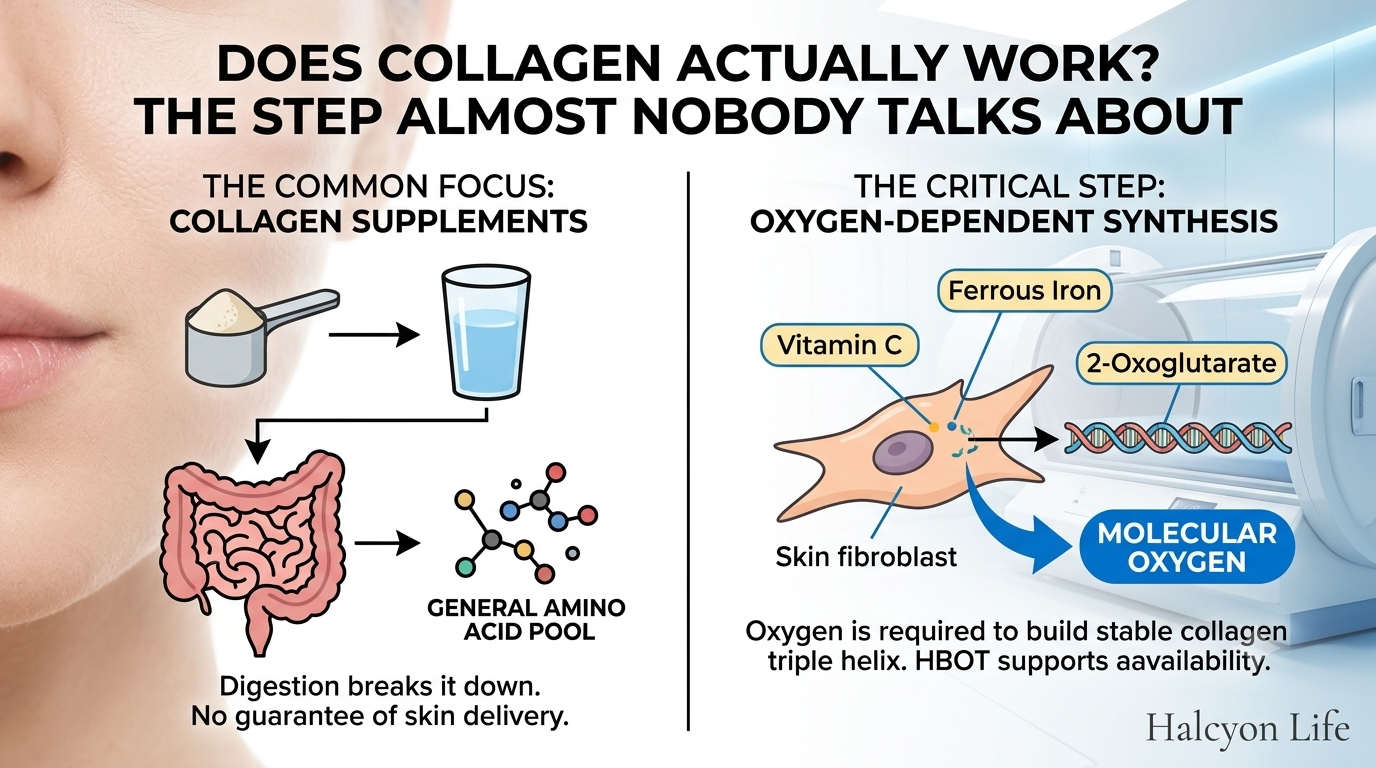
When you drink collagen, you are not delivering collagen to your skin. Digestion does not permit that. Collagen is a large protein, and your gut breaks it down into amino acids and short peptide fragments before absorption, the same way it handles chicken or fish or the collagen already in your diet. Those fragments enter the general amino acid pool. Some researchers propose that specific small peptides may act as signals to skin cells, which is a reasonable hypothesis under active investigation. But nothing you swallow arrives at your face as collagen.
Which means the useful question changes shape entirely. Not "am I getting enough collagen," but "is my body currently able to manufacture it well?"
That is a different question, with a different and much more concrete answer.
The Step Nobody Puts on the Label
Collagen production happens inside fibroblasts, the structural cells of your dermis. The chain gets assembled, and then something has to happen to it before it can become functional collagen.
Specific proline residues along that chain have to be chemically modified, converted into hydroxyproline. The enzyme that does this is prolyl 4-hydroxylase, and it requires four things to run: ferrous iron, a molecule called 2-oxoglutarate, vitamin C, and molecular oxygen.
The vitamin C requirement is the famous one. It is the entire reason scurvy exists as a disease, and it is why every collagen supplement on the shelf now includes vitamin C on the label.
The oxygen requirement gets almost no attention at all, and it is not a minor cofactor. It is the substrate the enzyme actually consumes.
And the consequence of skipping that step is not that you get slightly weaker collagen. Collagen chains that lack hydroxyproline cannot fold into a triple helix that stays stable at body temperature. Hydroxyproline is roughly a tenth of every collagen molecule. Without that modification, the structure does not hold. You have made the raw material and failed to build the thing.
So collagen synthesis is not a supply chain. It is a factory floor, and oxygen availability at the tissue level is one of the conditions the machinery runs on.
Why the Factory Slows Down, Particularly Here
Fibroblasts in the dermis are supplied by an extremely fine capillary network, and several ordinary features of adult life in this city degrade that network or the conditions around it.
Capillary density in the skin declines with age, which lengthens the distance oxygen has to diffuse to reach the cells doing the building. Chronic low grade inflammation shifts fibroblasts toward a state that favors breakdown over construction. Elevated cortisol, the kind produced by a nervous system that never fully stands down, suppresses collagen synthesis directly. Smoking constricts cutaneous microcirculation. Ultraviolet exposure drives enzymes that degrade existing collagen faster than it is replaced. Poor sleep compresses the overnight window when much of this repair work is scheduled.
Now picture the version of this that plays out between Midtown and a fifth floor walkup. Five and a half hours of sleep on a good night. A nervous system running elevated from Sunday evening through Friday. Meals eaten standing up. Real recovery deferred to a vacation that keeps getting rescheduled. Against that, a scoop of powder in the morning coffee.
The powder is not the problem. The problem is that the powder is aimed at a shortage that probably does not exist, while the actual constraint sits somewhere in inflammation, circulation, sleep, and stress load, and nobody is selling a tub for that.
This is the same pattern we keep running into across the wellness market. It shows up in how oxygen bars compare to actual hyperbaric therapy, and it shows up again in how IV drips and NAD infusions get marketed. Something real gets identified, then sold as a supply problem, because supply problems have products attached to them.
Where HBOT Fits, Stated Carefully
Hyperbaric Oxygen Therapy is a systemic modality that influences the human body on cellular and physiological level. It raises oxygen availability well beyond what circulation delivers under ordinary conditions, and the relevant point for this conversation is that the oxygen reaching tissue is a condition the collagen machinery depends on, not a nutrient the tissue is short of in the way a supplement implies.
There is direct human evidence here, and it deserves to be described precisely rather than enthusiastically.
Hachmo and colleagues published a 2021 trial in the journal Aging that took repeated skin biopsies from participants in a larger aging study, before and after a course of hyperbaric sessions. They reported significantly increased collagen density, longer elastic fibers, more blood vessels, reduced fiber fragmentation, and fewer senescent cells in the tissue afterward. Effect sizes were large.
Now the limitations, which matter as much as the findings. Thirteen participants gave consent for the biopsies. All thirteen were men, average age around 68. There was no placebo group. Each participant served as his own control through a three month no intervention period before sessions began, which is a reasonable design but not a randomized controlled trial. Elastic fiber density and thickness did not change. And the aging work from this group comes out of a single research center.
That is a real finding in real human tissue, and it is preliminary. Both things are true, and we would rather you hear that from us than discover it later.
What we will not tell you is that hyperbaric sessions rebuild your face. HBOT does not treat skin aging, and it is not a cosmetic procedure. What it may do is support the internal conditions that tissue construction depends on, alongside sleep, inflammatory load, and everything else. The mitochondrial and cellular groundwork is the same groundwork underneath our broader look at the aging evidence.
The Money Question, Honestly
A tub of collagen runs somewhere between thirty and sixty dollars and lasts a month. Over a year, that is a few hundred dollars against an evidence base that its own strongest advocates are currently defending from a methodological critique.
Hyperbaric sessions cost meaningfully more per session, and we are not going to pretend otherwise or suggest they are a substitute for a supplement budget. They are a different category of decision with a different time commitment.
What we would actually suggest is unglamorous. Before spending on either, look at what is compressing the repair window. An extra hour of sleep costs nothing and is worth more to your dermis than most things you can buy. If inflammation, circulation, and recovery are genuinely where your constraint sits, then it is worth understanding what hyperbaric therapy is before deciding whether it belongs in your situation. If it does not, we will say so. Our owner Jacob has talked more people out of sessions than into them, usually because something more basic was clearly the limiting factor first.
What This Actually Comes Down To
Your skin is not waiting on a delivery. It is running a construction project, continuously, with whatever conditions you give it, and it has been doing that since long before anyone sold you a scoop.
The collagen conversation got framed around what to add, because adding is easy to sell. The more useful frame is what is currently in the way. Sleep that does not restore. A nervous system that never lands. Inflammation that lingers. Circulation that has quietly narrowed.
Fix the conditions and the machinery does what it has always done. That is less exciting than a supplement and considerably more likely to show up in the mirror. If you want to talk through where hyperbaric therapy sits in that picture, our team in Midtown Manhattan is glad to have an honest conversation about it, including the parts where the honest answer is that you do not need us.
Frequently Asked Questions
-
Not directly. Collagen is broken down into amino acids and small peptides during digestion, so it does not arrive at your skin intact. Whether those fragments meaningfully signal skin cells to build more is an open research question, and the current trial evidence is small and heavily industry funded.
-
Yes. The enzyme prolyl 4-hydroxylase requires molecular oxygen along with iron, 2-oxoglutarate, and vitamin C. Without that step, collagen chains cannot form a triple helix that stays stable at body temperature.
-
HBOT does not treat skin aging and is not a cosmetic procedure. A small 2021 biopsy trial reported increased collagen density and reduced senescent cells after a course of sessions, though it involved thirteen men with no placebo group. It may support the conditions tissue repair relies on, and outcomes vary.
-
Elevated cortisol suppresses collagen synthesis, and much of the skin's repair activity is scheduled during sleep. Compress that window and the construction side of the balance falls behind the breakdown side.
-
Vitamin C is a genuine requirement for the hydroxylation step, which is why it appears on most collagen labels. That said, outright vitamin C deficiency is rare on a normal diet, so adding more is unlikely to be the thing standing between you and better skin.
-
For most people in New York, recovery. Sleep, inflammatory load, stress, and circulation determine whether the machinery can run at all. Supplements address a supply constraint that usually is not the limiting factor.
-
Halcyon Life offers hyperbaric oxygen therapy in Midtown Manhattan, with an emphasis on honest guidance and pacing matched to your biology rather than a fixed protocol for everyone.