HBOT for the Running on Empty New Father in NYC: When You Are Depleted and Still Expected to Show Up
The exhaustion nobody asks him about
When a baby arrives, almost every question goes to the mother, and rightly so. Her recovery is physical and immediate and visible. But there is a second person in the room who is also being quietly remade by this, and almost nobody checks on him. The new father in New York City is expected to be the steady one. He is back at work within days, often without anyone noticing he left. He is running on the same shredded sleep as everyone else in the house, and he is supposed to absorb it without comment.
This is the part of new fatherhood that does not make it into the cards. The fog that sets in around week three. The strange flatness where motivation used to be. The short fuse. The sense of moving through the day at seventy percent and pretending it is a hundred. He did not have the surgery and he is not breastfeeding, so the assumption is that he is fine. But depletion does not require a medical event. Months of fragmented sleep, elevated stress, and no recovery time will hollow out anyone, and the men this happens to often do not have the language or the permission to name it.
In a city that already runs people thin, new fatherhood lands on top of an existing deficit. The demanding job did not pause. The financial pressure of a new child often intensified it. And the cultural script tells him to be grateful and quiet, which is the same script handed to new mothers, just with even less acknowledgment that anything physical is happening to him at all.
What is actually happening to a depleted new father
It is tempting to file this under stress and leave it there. But what a new father is experiencing is not just a mood. It is a physiological state with real mechanisms underneath it, and naming them is part of the relief.
Start with sleep. Sleep is not downtime. It is when the body consolidates repair, clears metabolic waste from the brain, regulates hormones, and resets the nervous system. Chronic fragmented sleep does not just make you tired. It interferes with the deep restorative stages that keep cognition sharp, mood stable, and energy reliable. Weeks of it compound. The brain fog, the irritability, and the flat motivation are downstream of a brain and body that have not had a proper chance to reset in a long time.
Layer stress on top. The early months of parenthood keep the nervous system tilted toward alertness, the on guard state that is useful in a crisis and corrosive when it never switches off. A nervous system stuck in that mode taxes everything: sleep quality, inflammatory balance, recovery capacity, and the steady baseline energy that makes a person feel like themselves. Add the fact that recovery time has vanished, and the body never gets the window it needs to climb back out.
This is the cell to system to lived experience chain. At the cellular level, the machinery that produces energy is working under sustained strain with poor recovery. At the system level, sleep, the nervous system, and inflammatory regulation are all running rough. And at the level of lived experience, that shows up as the new father who is foggy, flat, short tempered, and quietly worried that this is just who he is now. He is not broken. He is depleted, and depletion has a biology.
Where HBOT fits
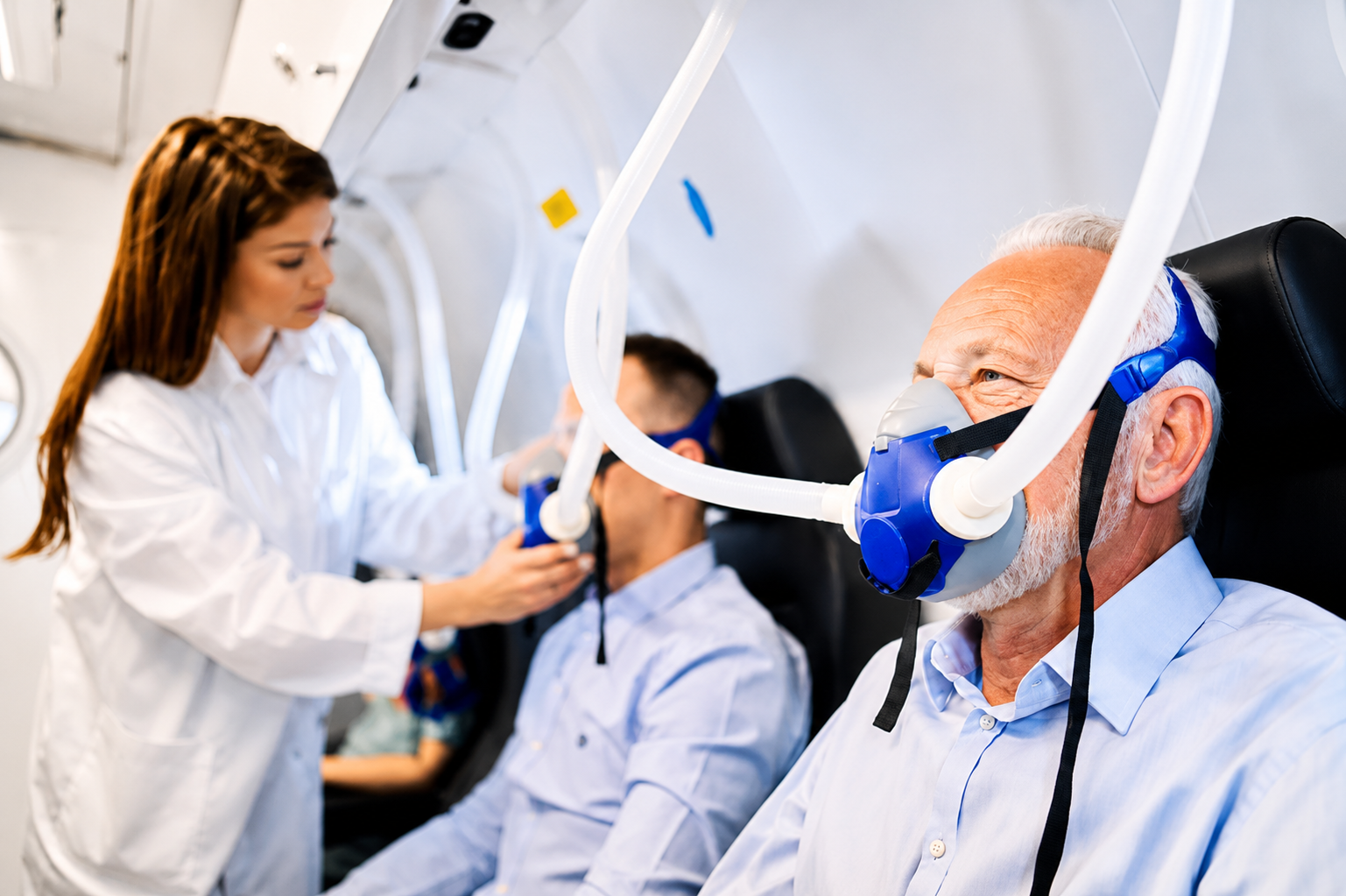
Hyperbaric Oxygen Therapy is a systemic modality that influences the human body on a cellular and physiological level. For a depleted new father, the relevant part is not oxygen as a headline. It is what the body does downstream with a richer internal environment.
The processes that a worn out father most needs support in, steady energy, a nervous system that can actually downshift, sleep that restores rather than just passes time, and the inflammatory balance that chronic stress erodes, are exactly the downstream physiological outcomes that this kind of support is oriented toward. Inside a pressurized environment, the body takes on more concentrated oxygen than normal, and the point of interest is how that supports the internal conditions underneath recovery capacity, nervous system regulation, and energy stability. It is foundational and capacity building rather than stimulating. It is not a substitute for sleep, but it may help create better internal conditions for the body to recover when sleep alone is not available in the quantities a new parent needs.
The honest framing matters here more than usual, because depleted men are a prime target for hype, and they deserve better than that. HBOT does not treat or cure exhaustion, and it does not replace the things that actually move the needle, more sleep where possible, support at home, and time. The body is not one switch. What a thoughtful approach can do is support the systems that fatigue, fog, and a frayed nervous system all run through, so the body is better resourced to climb back to baseline. For a man who has quietly decided this flatness is permanent, the more accurate story, that he is depleted and depletion can be supported, is often the missing piece.
The NYC version of this
There is a recognizable figure here. He is mid career, in a job that did not slow down for a second, often the kind of high performer who is used to being able to push through anything. Then a child arrives, the sleep collapses, and for the first time pushing harder stops working. He cannot out hustle this one, and that is disorienting for someone whose whole operating system is built on effort.
The city makes it worse by rewarding the performance of being fine. He keeps showing up, keeps delivering, and tells no one that he is running on empty, because admitting it feels like a liability. So he absorbs the depletion silently, and the silence is part of why it lingers. The men who slow down for a moment to understand what is happening to them tend to do better than the ones who white knuckle it, because they stop blaming their character for what is actually a physiological state.
This is also where the cost reframe lands. A father in this state pays for it whether he names it or not, in lost presence with the very child this is all about, in worse work, in a shorter temper with his partner during the exact season they most need to be a team. Set against the slow, open ended cost of months spent at seventy percent, a focused investment in supporting recovery looks less like an indulgence and more like a reasonable decision for the whole family. The men we talk to who explore HBOT for fatigue and energy in NYC are usually not chasing optimization. They are trying to feel like themselves enough to be present.
What this means in practice
The first move is to stop treating the depletion as a personality flaw and start treating it as a state with causes. That alone takes the self blame out of it, which is its own kind of relief.
From there, the practical priorities are familiar but worth protecting fiercely: claw back whatever sleep is available, even in fragments, and treat it as non negotiable repair time rather than wasted time. Find the small windows where the nervous system can actually downshift, an idea worth more attention than it usually gets, which is why we wrote about HBOT for stress and recovery in NYC. Do not let the on guard state become the permanent baseline. And for the man who wants to actively support the internal environment that energy, sleep, and recovery all depend on, modalities like HBOT can be part of a thoughtful, individualized approach. Protocols should be aligned to the person's biology, not forced onto everyone the same way.
None of this is a promise, and the honesty is the point. A new father does not need another voice selling him certainty. He needs an accurate map. The accurate map says this: you are not who you have become over the last few foggy months, you are a depleted version of yourself, and a depleted body can be supported back toward its baseline. For the man trying to be present for a child he can barely keep his eyes open to enjoy, that reframe, and the support that follows it, is often exactly what fits. If it is worth a real conversation, the grounded next step is talking through your sleep, your stress, and your actual life, which is what the experience at the best HBOT in NYC is meant to be. You can also read more about why you wake up tired after sleeping enough, how HBOT supports the nervous system, and HBOT and postpartum recovery for new mothers on the other side of the same season
Frequently Asked Questions
-
HBOT may support the systems that fatigue runs through, including sleep quality, nervous system regulation, and steady energy. It is best understood as systemic physiological support, not a treatment or a replacement for sleep and recovery. Outcomes vary from person to person.
-
Depletion does not require a medical event. Months of fragmented sleep, sustained stress, and no recovery time will hollow out anyone. The fog, flat motivation, and short temper are downstream of a brain and body that have not had a proper chance to reset.
-
Yes. Chronic broken sleep interferes with the deep restorative stages that keep cognition sharp. The fog is a real, physiological consequence of sustained sleep disruption and stress, not a character flaw.
-
No. Nothing replaces sleep. HBOT is something some people use to support the internal conditions underneath recovery when sleep alone is not available in the amounts a new parent needs. It works alongside rest, not instead of it.
-
Because depletion is a physiological state, not a motivation problem. Effort cannot override a worn down nervous system and a sleep debt that keeps compounding. Supporting the body's recovery tends to work better than trying to power through it.
-
That is a personal decision. The honest frame is that running on empty for months has its own cost, in presence with your child, in work, and in patience with your partner. Set against that, some men find supporting their recovery to be a reasonable investment. It is not a guaranteed result.
-
Often it is a mid career high performer who is used to pushing through anything and is disoriented when, for the first time, that stops working. The reframe many find useful is that they are depleted rather than diminished, and depletion can be supported.